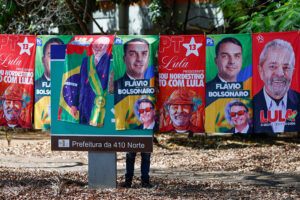



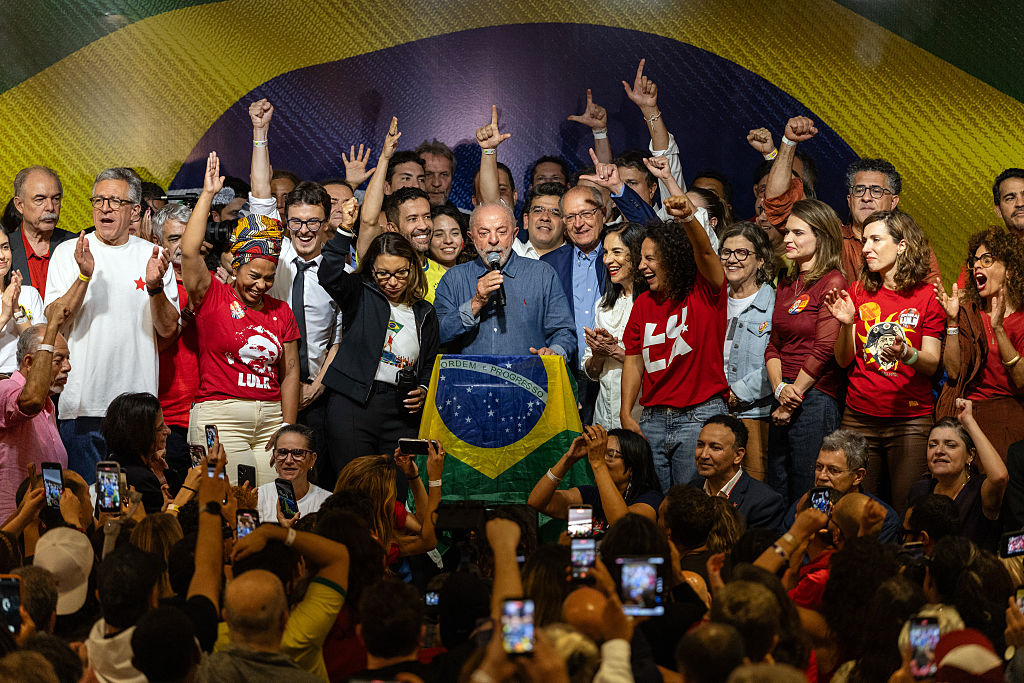
President Luiz Inácio Lula da Silva won an unexpected comeback in Brazil’s runoff election, halting a string of victories by right-wing leaders in Latin America and triggering a selloff among investors worried about the country’s economy.
Lula, a leftist, received 51.8% of the vote versus 48.2% for conservative challenger Flávio Bolsonaro, who alleged irregularities and said he would challenge the outcome.
The result shocked many observers after almost all polls showed Bolsonaro ahead by a small margin in the campaign’s final days. Lula will now face pressure to address Brazil’s fiscal deficit, which is approaching 10% of GDP following heavy pre-election spending. He will also need to deal with a conservative Congress and a Trump administration that may also question the election’s legitimacy.
AQ asked analysts to share their reactions.

Brian Winter
Editor-in-Chief, Americas Quarterly
What a comeback.
We will need time to properly understand it. But I think this was a 20th century politician who, at the very last possible moment, figured out how to run a 21st century campaign. After his first round loss, Lula started carrying a smartphone for the first time in his life, brought in younger aides who knew how to run a real digital operation, and finally was able to create some excitement in one of the world’s most terminally online countries. The net result was 3 million more people who turned out to vote, fewer spoiled ballots, votes from third-party candidates, and some repented bolsonaristas as well.
Flávio Bolsonaro challenged the results, but he faces an extremely difficult battle. The margin of victory, more than 4 million votes, was too large to be explained by the delay in polling stations closing or any other abnormalities. Big Brazilian power brokers, including the so-called Centrão, are dutifully accepting the result. The Bolsonaros will ask the White House for support, but it’s important that the vast majority of Latin American leaders, including those on the right like Keiko Fujimori and José Antonio Kast, quickly recognized Lula’s victory. They concluded this is over, and the Trump administration may do the same.
For Lula, the good news is that he won, and the bad news is that he won. He ran up a big bill to help make this happen: More than $60 billion in extra spending, welfare payments, debt forgiveness and other fiscal largesse. This in a country with real interest rates above 8% and a debt burden forecast to reach 83% of GDP this year, up a whopping 12 percentage points in Lula’s term. Markets are hemorrhaging in the hours after his victory, and they may get worse until Lula details his plans to cut spending. Lula also faces the most conservative Congress on record, a skeptical business community, and consumers who are struggling under huge debts as well.
But look, Lula would rather deal with those problems than the alternative. He will be the man who defined an entire half-century of Brazilian history, from the metalworkers’ strike he led as a labor union leader in 1979 to the end of his fourth term in 2030. A truly epic story that is still being written, and may still bring some surprises.

Alessandra Ribeiro
Partner and Director of Macroeconomics and Sectoral Analysis at Tendências Consultoria in São Paulo, Brazil
In his fourth term, Lula will face major challenges, especially with the opposition Liberal Party (PL) holding significant sway in Congress. The party now accounts for 23.6% of the Chamber of Deputies and 34.6% of the Senate, further strengthening its ability to shape the legislative agenda and exert pressure on the executive branch—a dynamic that has become increasingly evident in recent years.
Beyond this difficult political backdrop, Lula’s new government will also have to tackle what is arguably its most sensitive economic issue: fiscal adjustment. According to Tendências, gross public debt as a share of GDP is expected to continue rising, reaching 83.3% this year, alongside a primary deficit of 0.5% of GDP. This trend reflects both higher public spending and elevated interest rates.
Any meaningful fiscal adjustment will require curbing growth in mandatory spending, including pension outlays, social benefits, constitutionally mandated minimum expenditures on health and education, public sector administrative costs, and congressional earmarks. On the revenue side, the government is expected to continue reviewing tax expenditures. The fiscal challenge has become even more acute in light of the measures adopted in recent weeks, as well as the promises made on the campaign trail.
Given Lula’s limited political capital and the negative market reaction, the new government will need to move quickly to announce key appointments—especially the finance minister. To avoid the risk of an economic crisis in the near term, it will need figures who command market confidence and can present a credible plan to stabilize public finances. Failing to do so could quickly turn the administration into a lame duck and revive memories of 2015’s Dilma Rousseff crisis.
On the opportunity side, three important policy agendas are likely to move forward. The consumption tax reform, set to begin implementation next year, is expected to survive despite the risk of being derailed under an opposition victory. Second, the infrastructure concession agenda is also likely to continue, supported by regulatory changes that have helped strengthen private-sector participation in recent years. Finally, on the foreign policy front, the government is expected to pursue a multilateral agenda, seeking new trade agreements to reduce Brazil’s vulnerability to major trading partners such as China and the United States.

Daniela Campello
Senior Lecturer in the Discipline of International and Public Affairs, Columbia University
Lula won an unequivocal victory despite reported last-minute efforts to keep poorer voters from the polls. He becomes the first Brazilian elected president four times and the first to win a runoff after trailing in the first round. After years of instability, culminating in the January 8, 2023, assault on Brazil’s institutions a week into his term, the fact that Lula completed his mandate and guaranteed free elections is itself a democratic victory. Abroad, Brazil becomes an outlier in a region shifting right, and the main counterweight to a South America increasingly aligned with Washington by default, while facing a Trump administration that has never hidden its preference for the Bolsonaros.
Lula will, however, face major challenges, among them a hostile Congress and a fiscal crisis that must be tackled at the outset of his term, amid a crisis of confidence. His expansive social promises still need a clear fiscal path, and the most hostile Senate of his career will make every vote costly. The escalating confrontation between Congress and the Supreme Court, over the court’s powers, the impeachment of justices, and an amnesty for Jair Bolsonaro, has already shown it can spill over onto the executive.
Lula’s climate agenda will also need to reconcile record-low deforestation with plans for oil exploration in the Equatorial Margin, while contending with a Congress poised to weaken environmental regulation. Still, a decisive mandate and institutions that withstood years of strain give him a stronger hand than he had in 2022—and the Workers’ Party a chance to prepare a new generation of leaders for 2030. The Bolsonaro family’s defeat, meanwhile, could clear the way for what Brazilian democracy has long been missing: a democratic right capable of competing, and losing, by the rules.
Brazil’s Right Will Have Power Beyond the Presidency
The first-round election result underscored a conservative ascendancy rooted in Congress and the states, with implications for the Bolsonaro family and more.
REACTION: Flávio Bolsonaro and Lula Advance to Brazil’s Presidential Runoff
The eldest son of former President Jair Bolsonaro now looks like the favorite against the incumbent in the October 25 runoff.