




This article is adapted from AQ’s special report on Mexico’s path forward | Leer en español | Ler em português
Donald Trump’s second presidency has seen the unthinkable become reality—not just for Mexico, but the world. From declaring his intention to annex Greenland or make Canada the 51st U.S. state, repeatedly saying the war in Iran is over or announcing plans to turn Gaza into a Middle Eastern riviera, to the way he refers to and communicates with his global peers, generalizes about countries and reduces complex problems into quick solutions, we are still failing to understand these actions not as isolated random ideas, but a whole new way of thinking about the world. It is not just Trump, not just one man—but a way of doing politics that is gaining traction inside and outside the United States, including in parts of Latin America.
That said, arguably no country has been as exposed to this new reality as Mexico. Our relationship of interdependence with the United States is unique, captured by numbers many Mexicans can now recite by heart—the destination of more than 80% of our exports, nearly $900 billion in bilateral commerce every year, and the source of more than $60 billion a year in remittances, equivalent to 3.4% of our GDP. Our integration is not just about dollars, but people—more than half of Mexicans now say they have a close relative living in the United States. Given these deep ties, the recent shift from a system of predictable rules to one of ad-hoc bargaining conducted country by country, on terms well beyond trade, has shaken our nation to its core.
The recent shift from a system of predictable rules to one of ad-hoc bargaining conducted country by country, on terms well beyond trade, has shaken our nation to its core.
Perhaps inevitably, some in Mexico have asked whether there is another path. Whether Mexico should take steps to reduce its dependence on the United States by pursuing ties with other partners, or by restructuring its own economy to become more self-sufficient. Others look at Canada’s more confrontational strategy, and wonder if Mexico should do the same.
The instinct to think big, and try to come up with a strategic survival plan for coming years, is fundamentally correct. But any solutions must account for the fact that, despite all the noise, Mexico’s trading position with the United States remains quite strong relative to other countries. They must consider the possibility that elements of Trump’s worldview may outlast the end of his term in 2029, regardless of who succeeds him. They must factor in domestic challenges including Mexico’s deteriorating fiscal profile, and the political realities facing President Claudia Sheinbaum. In summary, any strategic plan must clearly recognize what Mexico can—and cannot—control, mixing a dose of geopolitical realism with essential steps we can take to put our own house in greater order.
Clear cooperation
Faced with constant pressure from the Trump administration, Sheinbaum’s government has answered not with confrontation—but with cooperation of an exceptional degree.
Indeed, migrant encounters at the U.S.-Mexico border fell from more than 2 million in 2022 to 237,538 in 2025, the fewest in 55 years. U.S. fentanyl deaths roughly halved over the same span, to about 37,400. It widened intelligence-sharing, joint operations and training, accepted a larger U.S. security presence at its embassy, and sent 178 high-value criminals to the U.S., 92 expelled under its National Security Law, among them the infamous drug lord Rafael Caro Quintero. In February the army, acting on intelligence shared with the U.S., killed Nemesio Oseguera, “El Mencho”, head of the Jalisco New Generation Cartel.
This has been the clearest proof Mexico could give that it was resolved to preserve the partnership at almost any cost. Why have President Sheinbaum and her team adopted such a position? Because no matter how much they would like to currently de-invest from the huge concentration with the U.S., diversification is a long-term strategy even if pursued ferociously. As you cannot answer a short-term challenge with a long-term approach, Mexico chose to double down on cooperation and integration with the U.S. Additional proof was the incorporation, as of January 2026, of new specific tariffs of between 5-50% on goods from countries with which we do not have a free trade agreement, including China, India, South Korea and Vietnam. This decision appeared explicitly designed to address Washington’s concerns about an increasing Chinese presence in North American supply chains.
On trade itself, Mexico has negotiated on three tracks at once.
The first is a 54-point list of non-tariff barriers delivered by U.S. Secretary of State Marco Rubio in September 2025 when he met with President Sheinbaum, who later in the year said they were near resolution. The U.S. Trade Representative’s National Trade Estimate gathers them in a few areas, energy above all, from revoked permits and the folding of the independent regulator into the energy ministry to Pemex’s overdue payments to U.S. firms above $2.5 billion at the close of 2025, alongside agriculture, pharmaceuticals, telecommunications and intellectual property.
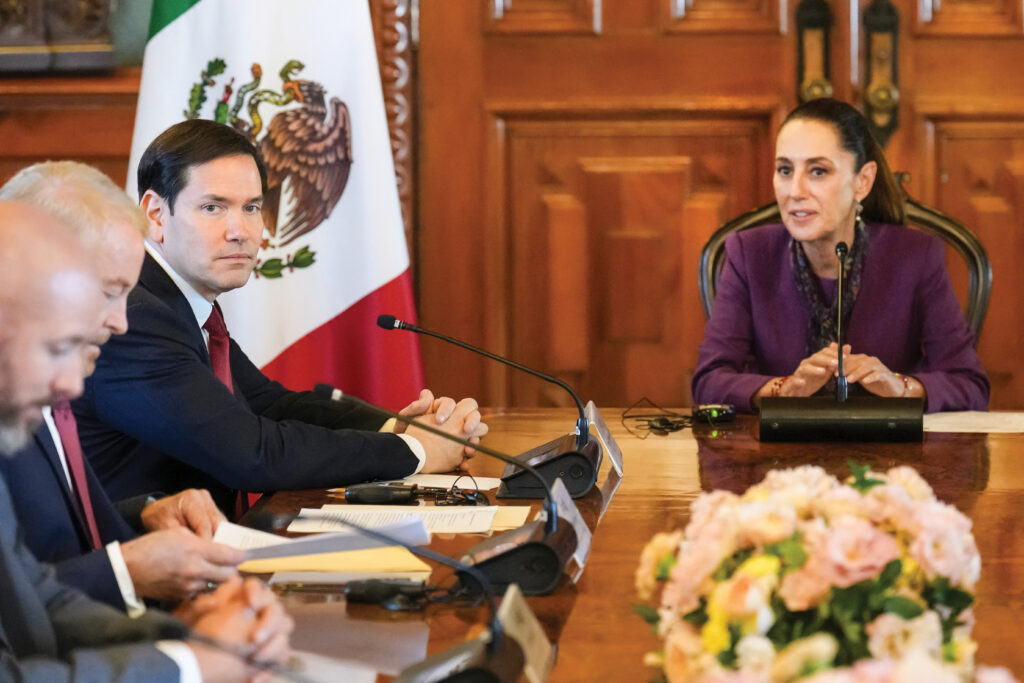
at the Palacio Nacional in Mexico City in 2025.
Jacquelyn Martin/POOL/AFP via Getty Images
The second is the formal negotiation, four bilateral rounds since late May 2026, counting a September round in Washington. Trade deficit and rules of origin sit at the center, with the Trump administration pressing for clearer sight of Mexican content and a fixed share of U.S.-made value in each vehicle, which Mexico rejects as a break with the treaty, next to the 50% tariffs on steel and aluminum and an “economic security” drive against Chinese inputs. Mexico’s Secretary of Economy Marcelo Ebrard called the early talks constructive. There is even the possibility of a permanent negotiation that will constantly bring trade and non-trade issues to the table, in order for the U.S. to make demands on security and national resources (as has already happened with water).
The third track is quieter and more political, pursued through diplomatic and back-channels, with Mexico offering, for instance, to buy more U.S. goods and find ways to sell somewhat less and invest more across the border to help reduce the unresolved and constantly present trade deficit tension.
Favorable terms
The net result of all this: Because of what it has conceded, and also due to geography and the complex interdependence, Mexico still holds one of the most favorable positions of any country trading with the United States.
Close to 87% of Mexican exports enter duty-free, and the effective tariff they meet averages about 3.4%, against 21.7% for China, 10.9% for Brazil and 9.1% for India. The trade has shifted too from cars toward electronics, so that computer equipment has now passed vehicles as Mexico’s largest single export north. Much of it is server and data-center hardware, where Mexico now supplies about a quarter of all U.S. imports of AI-related goods, matching Taiwan and far outstripping China.
Alongside all of its concessions, Mexico has clear priorities and red lines: to keep the trade framework as intact as possible, to maintain tariffs few and low, and overall, to guard against an outright cancellation of the USMCA and a wider wave of tariffs. While preserving this relative preferential treatment, the country is avoiding what it considers existential threats: unilateral interventions by the U.S. on security, meaning a military action on its soil (drones or different) and in domestic politics, perceived by the government in growing threats through the cancellation of visas, prosecution and requests for extraditions of Morena militants. Trespassing these hard stops would immediately cancel the enormous margins of maneuver that President Sheinbaum has to manage tensions with the U.S., and would oblige her to take an undesirable hard line with Mexico’s forever neighbor and main trading partner for the foreseeable future.
In a setting this uncertain, Mexico has responded about as rationally as it could, yet the strategy can still be sharpened. One can only govern what lies within your control, and that is where most of the energy should be aimed.
Degrees of control
There are three directions in which Mexico has some room for maneuver.
The first is geopolitical, and sits largely beyond the government’s reach. Since the Middle East conflict escalated in late February, the prices of oil, fertilizers and maritime freight have climbed, as the blockade of the Strait of Hormuz disrupted a fifth of the world’s oil supply. For Mexico, higher oil prices are no longer the windfall they once were. The economy now depends far less on crude exports, which fell from 1.1 million barrels a day in 2019 to about 0.3 million in 2026, while it still relies heavily on imported fuels. Higher prices thus bring extra revenue to Pemex but also raise the cost of those imports, and they weigh on the public finances.
Second is the relationship with the United States, which Mexico cannot control but can manage and reduce risks as much as possible. The Mexican government has not quarreled with President Trump in public, denying him the fight he relishes and keeping the temperature down. It has worked every channel at once, formal and discreet, to reach those who shape decisions in the United States, from federal officials to governors and the heads of the firms whose supply chains run through Mexico. Mexico has cooperated as far as it can while holding firm on the red lines mentioned above.
The space for improving the approach lies mainly in better coordination of the strategy, the narrative and the various interlocutors that participate in its delivery. Coherence and consistency are essential. It is worth mentioning how this approach is dramatically different to that pursued by Canada, but in order to understand this disparity, one should make sense of the different political contexts in Mexico and Canada. President Sheinbaum does not have a nationalistic mandate from voters to openly confront President Trump similar to that of Prime Minister Mark Carney, which helps explain why he got the job in the first place. Points of departure and contexts are essential to understanding policy responses.
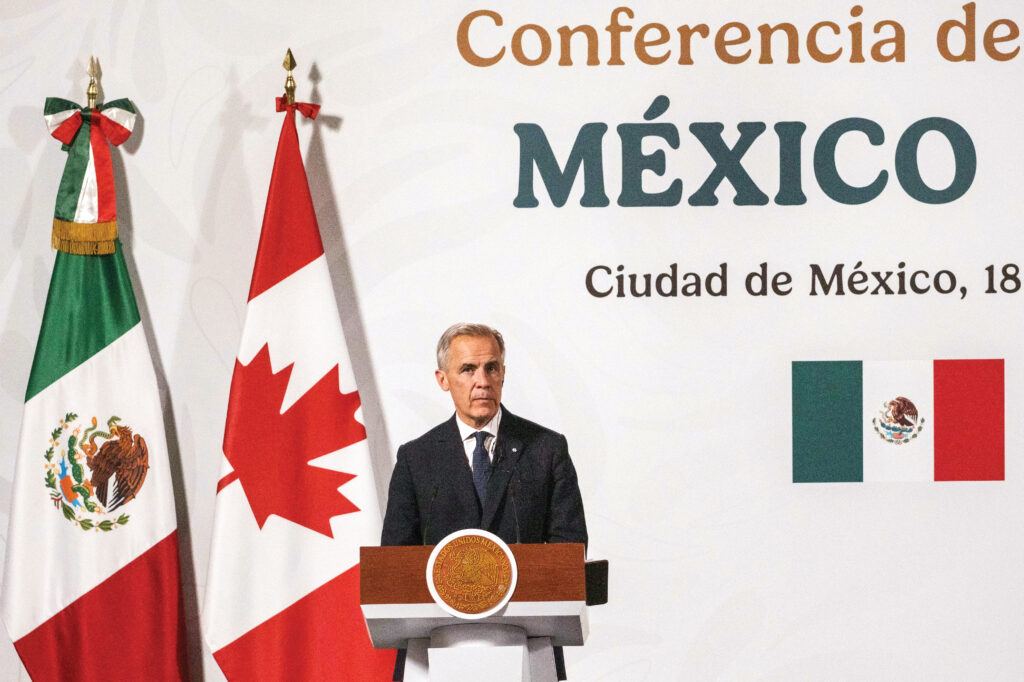
Luis Antonio Rojas/Bloomberg via Getty Images
Third and perhaps most importantly, what is under full control of the Mexican government: homework.
Indeed, the current uncertainty surrounding Mexico stems not only from geopolitics but from the domestic context, in the form of a greater concentration of power and weaker institutional checks. A 2024 reform eliminated seven autonomous bodies, among them the Competition Commission (COFECE) and the Energy Commission (CRE), transferring their functions to government agencies. A judicial reform introduced direct elections across the federal judiciary, making Mexico the only country in the world to elect its entire federal judiciary by popular vote, including the Supreme Court, reducing their judicial impartiality and technical quality. Turnout in the first election was only about 13% among more than 99 million eligible voters.
The current uncertainty stems not only from geopolitics but from the domestic context, in the form of a greater concentration of power and weaker institutional checks.
For investors, these changes create a great deal of uncertainty together with constantly changing regulation, unpredictable contract enforcement and significant red tape. Mexico attracted a record $40.8 billion of foreign direct investment in 2025, but only 18% was new investment. Federal physical investment then fell 7.9% in real terms in the first half of 2026. The response has been Plan México, a $277 billion project portfolio that aims to shift investment from 20.1% in 2020 to above 25% of GDP in 2026 and 28% by 2030; 15 development poles aiming at 300,000 jobs; and a new investment office promising qualifying approvals within 30 days.
The point of departure is sensible, but delivery has been harder. In 2025, the federal government budgeted $44.7 billion for physical investment, but actual spending reached only $40.1 billion (90% of the budget). For context, the investment portfolio underpinning Plan México implies average annual investment needs of around $46.2 billion through 2030. Yet this comes in a context of declining investment; gross fixed capital formation fell from 23.8% of GDP in 2024 to 22.4% in 2025, then another 3.0% year-on-year in the first quarter of 2026.
The credibility gap
Looking at the bigger picture, other lights are flashing yellow: GDP expanded only 0.5% in 2025. After contracting 0.3% quarter-on-quarter in the first quarter of 2026, the economy rebounded by 1.4% in the second. This recovery prompted Banco de México to raise its 2026 growth forecast from 1.1% to 1.6%, and it now expects growth of 2.0% in 2027, although the central bank judges the balance of risks to growth to be tilted to the downside. The GDP growth average in the eight years since Morena took power has been just 0.8%, making fiscal consolidation harder. Persistent deficits are pushing the stock of public debt to historic highs, a burden already visible in a budget where interest payments have climbed from around 12% of government revenue in 2015 to more than 20% in 2025, the steepest such increase in the Americas.
That credibility gap is already showing up in Mexico’s credit ratings. Since 2018, Mexico lost a combined six notches across the three major rating agencies (Moody’s, Fitch and S&P), with Moody’s and Fitch rating Mexico at the lowest level that still qualifies as investment grade, and S&P placing it only one notch above that level. Moody’s downgraded Mexico again in May 2026, S&P moved its outlook to negative, and Fitch maintained a stable outlook. Ratings on Mexican issuers could move over the next 12-24 months if sovereign creditworthiness deteriorates. In addition, Pemex is central to the pressure: federal support reached about $35 billion (1.9% of GDP) in 2025, while public debt rose from 43.6% in 2018 to 53.2% in 2025 of GDP, and is forecasted to be 54% in 2026. That dangerously raises the bar on delivery.
So what can be done?
One place to start is regulatory certainty in energy, where the appetite for investment is enormous. Greater certainty is a requisite for both existing production and new investments, particularly in the fields of data centers and semiconductor manufacturing. The next step is to turn that appetite into investable projects. Mexico still needs a framework that gives private generators enough long-term visibility to commit capital: predictable tariffs and clean-energy rules, transparent procurement for new capacity, and regulatory decisions governed by clear and impartial procedures.
However, clearer rules will accomplish little if projects remain trapped in bureaucracy or are not paid for. Although Pemex’s debt to suppliers fell from $27.6 billion at the end of 2024 to $22.6 billion in 2025, it still accounted for $21.4 billion during the first half of 2026, nearly three times its 2018 level. Projects need a single and effective chain of accountability and efficiency from permit to payment. Those arrears point to a deeper problem: Pemex’s operating model. Financial debt fell from $105.8 billion in 2018 to $79 billion in the first quarter of 2026, but this came after significant government support. While the mixed-development framework offers a way forward, allowing Pemex to share investment and risk with private partners, nothing would be as impactful as a structural overhaul of the business model through more transparency, improved governance, dealing with pensionary liabilities, focusing on profitability and thinning its business to focus on competitive areas.
In the absence of deeper solutions for Pemex, a more focused and efficient social expenditure, or the overall improvement of investment climate, the government will need to increase revenues. Some figures in the president’s party have floated the possibility of a tax reform, but support for such a sweeping measure in Congress is uncertain, especially as legislative elections approach in 2027. An alternative that would create fiscal space without broad federal tax increases would be a property tax reform. Property tax revenue was just $3.6 billion in 2024—around 0.2% of GDP. Through changes such as implementing a national registry of properties, updating valuations and assigning minimum rate bands, the government could probably collect additional revenue of around 2.8% of GDP.
Just as important, the government should call time on the unsustainable double-digit minimum-wage increases of recent years. While a certain degree of catch-up was necessary, purchasing power has already recovered 154.2% while the general minimum wage has risen 256.5% between 2018 and 2026. Future increases should more closely track inflation and productivity, preserving the gains of recent years without creating an additional constraint on formal employment and growth.
Mexico cannot foresee the next shock from the complex geoeconomic context, nor from unpredictable Washington, but it surely can determine how resilient the economy and its enabling environment will be when it eventually arrives. Avoiding self-inflicted damage is the most important shield against uncertainty and volatility. It’s time we come to terms with the fact that we are in the transition to a brave new world that will indeed be more brave and bold than principled and cooperative. We need to revise our mental frameworks and action plans to improve our antifragility mechanisms, and that begins by reducing our domestic vulnerabilities. There is significant homework for us to do.
ABOUT THE AUTHOR

Vanessa Rubio-Márquez
Reading Time: 10 minutesRubio-Márquez is a professor of practice at the London School of Economics (LSE) School of Public Policy and a senior advisor at McLarty Associates. Previously she was a member of Mexico’s Senate and a deputy minister in the finance, foreign affairs and social development ministries.
NEW AQ: A Middle Path for Mexico
Mexico can cope with uncertainty in the U.S. by focusing on domestic reforms.