



This article is adapted from AQ’s special report on Mexico’s path forward
For the better part of a decade, ever since President Donald Trump came down an escalator and launched his presidential campaign with criticism of their country, Mexico has lived with tremendous uncertainty in its relationship with the United States. While much of the world has also faced tariffs, sanctions and the threat of military intervention, arguably no other country is as exposed as Mexico. Given the stakes, some Mexicans have wondered if their government should pursue a more confrontational path, as Canadian Prime Minister Mark Carney recently has, or move to diversify its trading relationships with less overbearing partners.
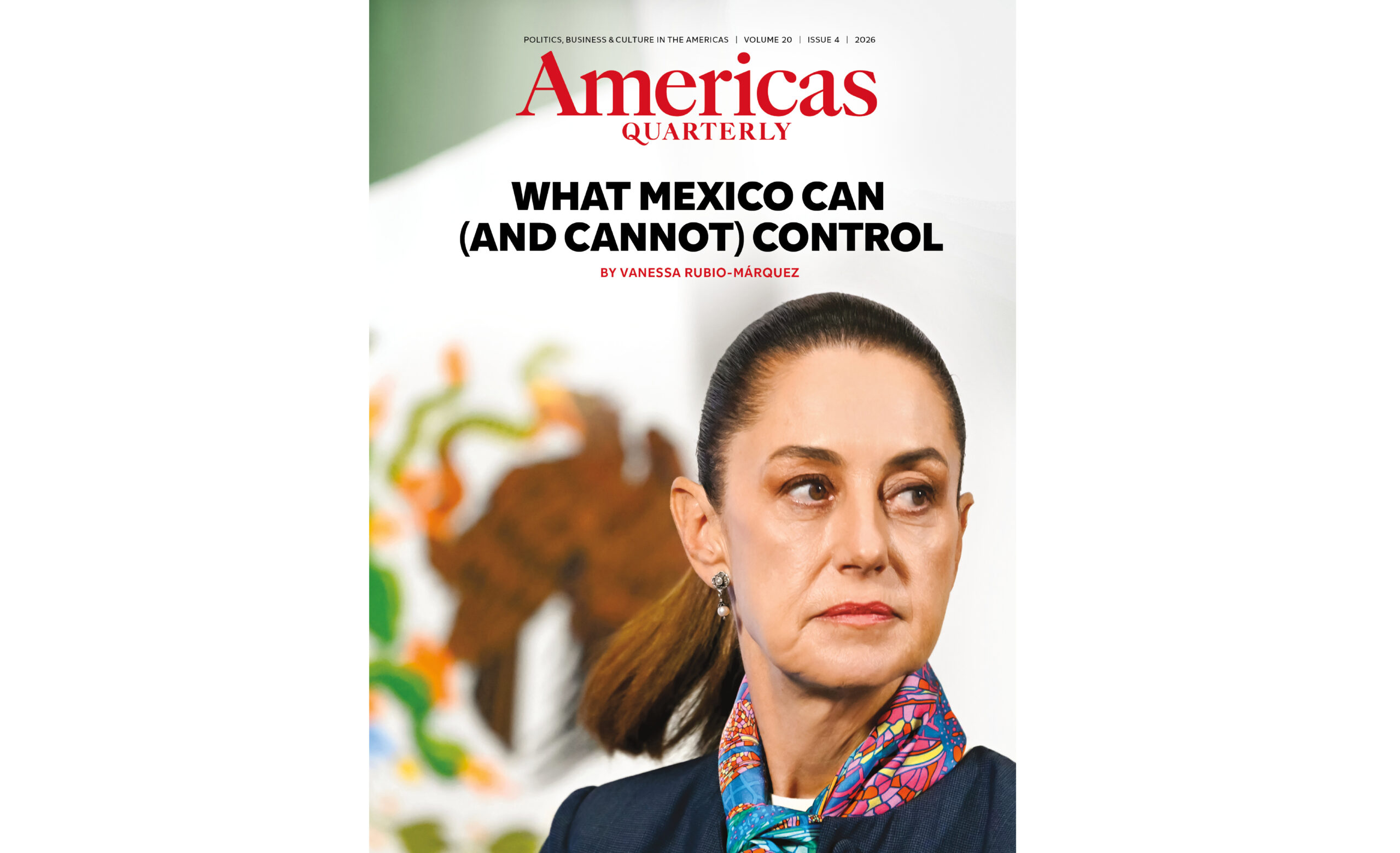
In this issue’s cover story, Vanessa Rubio-Márquez argues for a steady middle path. A widely respected former senator and official at Mexico’s finance and foreign ministries, Rubio-Márquez says Mexico has little choice for now but to continue its special relationship with the United States. She cites several decisions by President Claudia Sheinbaum suggesting the Mexican government has also concluded that any significant diversification would take decades, if it is viable at all.
However, Rubio-Márquez writes, Mexico can take important steps to put its own house in order—and thus reduce its vulnerability. She points to measures that would curtail the sizable fiscal deficit, such as more transparent management and better governance of the state oil company Pemex, whose financial debt was a staggering $77.5 billion at the end of June and has struggled for years to reverse its declining crude production. A reform of property taxes, which generates revenues equivalent to only 0.2% of GDP today, could push that number closer to 3%.
Along the way, Sheinbaum will need to continue to enforce red lines in its relationship with Washington, such as a possible unilateral U.S. military strike on a cartel target in Mexican territory. But if Mexico can tolerate the uncertainty and frequent insults hurled its way, the country is in a strong position compared to the rest of the world. As Rubio-Márquez notes, close to 87% of Mexican exports still enter duty-free, and those with tariffs have an average rate of just 3.4%—compared to 22% for China. That’s one more argument in favor of continuity, even when it’s difficult to swallow.

What Mexico Can (and Cannot) Control
Mexico can focus on navigating tensions with the United States while putting its own house in better order, writes a former policymaker.