



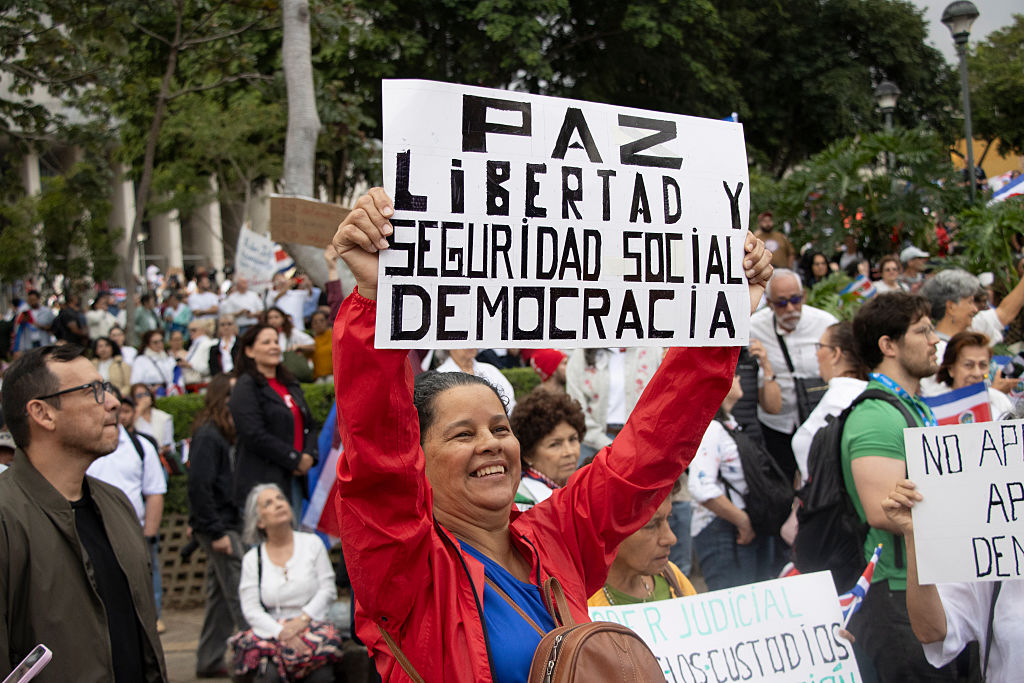
After more than a decade of steady erosion, support for democracy in Latin America appears to be rebounding. Sixty-five percent of Latin Americans now agree that democracy, whatever its problems, is better than any other form of government, six points higher than in 2023. With gains in nearly every country and across every age group and education level, it is the first broad upturn in a generation.
This finding comes from the 2026 Pulse of Democracy, published this month by Vanderbilt University’s Center for Global Democracy with the Kellogg Institute for International Studies at the University of Notre Dame. The report draws on the AmericasBarometer, the hemisphere’s most comprehensive study of public opinion and democratic attitudes: nationally representative samples of voting-age adults fielded since 2004, including more than 433,000 interviews in 34 countries. The 2026 round comprises 25,282 interviews across 21 nations.
This turnaround is happening as the COVID-19 pandemic and post-pandemic malaise have both passed, and citizens feel better about their economic lives again. In a nutshell, people now feel that their governments are, to some extent, delivering palpable results.
But our study also revealed two critical concerns. First, greater support for democracy is not translating into greater support for the norms and institutions that keep democracies alive. Large majorities of Latin Americans associate democracy favorably with what we term “illiberal majoritarianism”—a system in which an elected president can get things done without obstacles, sidelining political opposition, the judiciary, and minority rights.
Second, much public support for democracy is contingent on two key factors: the government delivering concrete results and the economy providing greater opportunity. If either factor falters, it seems, so will public commitment to democratic systems.
Evidence abounds that democracy’s brand in the region may be weaker than it appears. Amid the high-profile rivalry between the U.S., the world’s oldest democracy, and China, the world’s largest authoritarian state, for example, Latin America’s views are changing rapidly. A decade ago, 62% of the region trusted the U.S. government, compared with just 57% for China.
Today, China has a wide lead: Only 40% trust the U.S., versus 51% for China. In Mexico, 55% trust China and 23% trust the United States. In Haiti, it’s 73% and 40%. Only in Costa Rica, the Dominican Republic, and Honduras does the U.S. government still come out ahead.
Paradoxical gains
The broad uptick in support for democracy comes amid serious institutional challenges to liberal democracy across the region. Nicaragua has announced it would cease holding elections, El Salvador has scrapped presidential term limits, Mexico has elected its entire federal judiciary with only 13% participation, and Peru has sworn in its ninth president in a decade.
How can citizens be warming to democracy while liberal institutions are being hollowed out?
First, the warming seems to reflect improvements in daily life more than state dynamics. Since 2023, the share of Latin Americans who say their economy has worsened has fallen in 14 of 16 countries. Food insecurity eased from a pandemic peak of one-third of the region to just over one-quarter. The share feeling unsafe in their own neighborhood fell from 49% to 40%.
Generally, people are now more likely to feel that their governments are responding relatively effectively to their needs. And to many of them, this is the core of democracy: Elected leaders are delivering concrete results. Less important is how.
Support for democracy is only weakly connected to support for the institutions that make democracy liberal. This year, we asked seven questions about core democratic norms. Respondents’ support for “democracy” had virtually no correlation with how they felt about these core pillars of democratic systems.
In El Salvador, the Dominican Republic, Honduras, and Guatemala, more than 60% of citizens fall on the upper half of an “illiberal majoritarianism” scale: They are likely to favor fewer checks and balances in politics, especially on executive power. Yet across the region, illiberal majoritarians are more, not less, likely to say that they support democracy. Only in Chile, Argentina, and Uruguay does the relationship run the way democratic theory predicts: Support for democracy reflects support for norms like strong civil liberties, separation of powers, and protections for minorities.
El Salvador is the clearest case. Salvadorans are the most supportive of illiberal majoritarianism in the region. A majority there believes the country’s last authoritarian regime was more respectful of civil liberties than its current government—yet the public largely supports the current government and increasingly supports democracy.
From 2023 to 2026, support for democracy there rose a full seven points. What Salvadorans see in their daily lives is the lowest rate of crime victimization in the hemisphere at 8%, and a president with an 83% approval rating, the highest. Their responses suggest that to them, winning elections and delivering results alone determine democratic legitimacy. Meanwhile, anything that constrains a popular president—someone they view as finally responding to their needs and fulfilling their hopes—is an obstacle to democracy rather than a safeguard.
Memories of authoritarianism
So what builds citizens’ commitment to liberal democracy and the institutions that sustain it? This year’s survey asked people in 14 countries to compare their current democratic systems with their past authoritarian governments. The responses are revealing.
Citizens who credit democracy with protecting freedoms better than the authoritarians did are consistently more likely to: call democracy the best system; insist that leaders respect election results; and reject censorship, one-party rule, and presidents who override courts or Congress. On the other hand, those who credit democracy with delivering better economic growth are barely more committed to these stances than those who don’t.
In other words, support for democracy based on appreciation for civil liberties is durable, while support based on economic performance is more fragile. This is critical to remember, given that the rise in support for democracy over the past three years has more to do with the latter.
This is far from just a Latin American problem. Asked to choose between a political system guaranteeing fair elections and one guaranteeing income and basic services, the U.S. and Canada rank last among the 20 countries surveyed, with only 46% and 35%, respectively, choosing elections. At the top, Haiti (84%) and Peru (77%) are most committed to elections. Majorities of both Democrats and Republicans would take the guaranteed income.
Clearly, democratic commitment is not a function of how rich or how consolidated a democracy is. Instead, for now, it’s largely a function of what citizens believe democracy is doing for them.
ABOUT THE AUTHOR

Noam Lupu
Reading Time: 4 minutesLupu is the Gertrude Conaway Vanderbilt Professor of Political Science at Vanderbilt University and director of the Center for Global Democracy and LAPOP Lab.

The High-Stakes Threats to Latin American Democracy
Latin America’s impressive progress on electoral democracy, perhaps its most important achievement of recent decades, could soon be rolled back.
Latin America’s Fading Demographic Tailwind
The region has anchored part of its growth on an age bonus. As it wanes, what needs to happen to solidify the economic progress?