



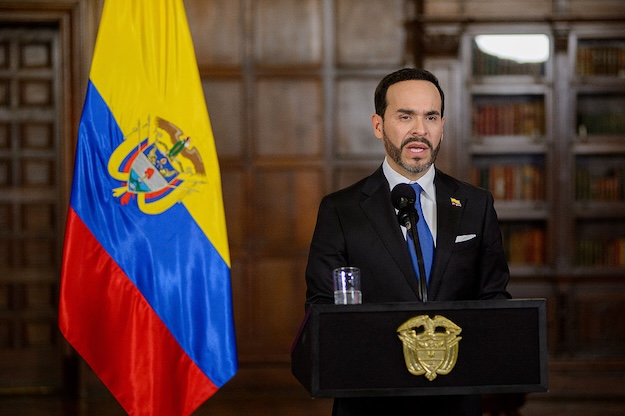
BOGOTÁ—President Abelardo De La Espriella campaigned on a promise to reduce the size of Colombia’s state by 40% without raising taxes. However, the Economic Rescue Bill his government submitted to Congress on October 29 shows how difficult it will be to keep that pledge. Although the government claims that much of the fiscal adjustment will come from spending cuts, most of it would actually come from higher taxes and social security contributions.
Still, the proposal deserves the legislature’s full attention. Colombia urgently needs to repair its public finances, and the bill takes important steps in that direction by broadening the bases of the value-added tax (VAT) and the personal income tax. It leaves untouched, however, the costly subsidies behind much of the fiscal deterioration the nation has endured in recent years and creates preferential treatment for large investments. For that reason, the debate in Congress will test the government’s ability to win political support and deliver an adjustment that is both substantial and fair.
For more than a century, Colombia stood out in Latin America for sound fiscal and monetary policies, which helped limit it to just four recessions in the past 125 years. But its fiscal deficit exceeded 6% of GDP in four of the past six years, and current projections point to a record 9.4% of GDP in 2027 if no measures are taken.
Beyond the pressing issue of spending more than the Colombian state earns, the country’s net debt rose from 47% of GDP in 2019 to 60% this year, and interest payments absorb more than a quarter of tax revenues. In short, there is little room to postpone the reckoning; the question is what kind of fiscal adjustment the country will get.
From the budget to the rescue bill
According to the Ministry of Finance, the rescue bill would improve the primary balance by 2.35% of GDP next year and by 4.1% in 2030, rising to 4.7% of GDP once measures to be adopted outside the law are included. However, these figures count as part of the adjustment the revenues the government expects from faster growth, which reach 0.5% of GDP in 2030. Without them, the measures add up to about 4.2% of GDP by 2030, which still makes the bill the most ambitious fiscal adjustment presented to Congress in decades.
The main difference between the government’s narrative and the bill’s content comes from how the measures are classified. The government counts higher employer and employee social security contributions, and higher excise taxes on tobacco and alcohol earmarked for health care, as measures to reduce the size of the state. Together, these measures would raise between 1.3% and 1.5% of GDP each year.
Once they are reclassified as revenues, the bill includes 2.8% of GDP in tax and contribution increases and 1.4% of GDP in spending cuts. Only 1% of GDP of those cuts is specified in the bill, while the rest depends on measures the government has yet to detail.
These figures are roughly the reverse of those presented by the government. The increase in taxes and contributions would be about twice the revenue raised by the 2022 tax reform under former President Gustavo Petro.
On the spending side, the bill halves the government’s use of outside service contracts in 2027 and cuts the national government’s wage bill by 20% in nominal terms in 2028. The proposal would also give the president extraordinary powers for six months to abolish or merge national government agencies, under a plan that has not been specified.
On the revenue side, the bill would eliminate the 5% value-added tax rate and move most excluded and exempt goods to the 19% rate. A new program, EfectIVA, would partially or fully refund the VAT paid by eligible low-income residents, with a monthly refund limit. The income at which wage earners start paying income tax, now about $2,800 per month, would be lowered to $1,700. The bill also partially reverses a 2012 tax reform that exempted employers from payroll contributions for workers earning up to 10 times the minimum wage (about $5,500 a month).
In the opposite direction, the bill lowers the corporate tax rate from 35% to 31%, bringing Colombia closer to the Latin American average of 28%. Although the president promised in his inaugural address that he would eliminate the wealth tax, the bill only raises its threshold and sets it to expire in 2030.
More controversial is a tax incentive program for large investments, known as RUGE. For projects over $42 million, it offers a 20% income tax rate for 16 years, an 8% final tax on dividends paid abroad, accelerated depreciation, and legal stability.
Broader bases, untouched subsidies, new privileges
The bill’s primary benefit is that it signals the government’s willingness to spend political capital on unpopular but necessary measures. EfectIVA, which provides aid directly to poor households instead of exempting products that everyone consumes, follows a longstanding recommendation by economists.
Its main weakness is what the government’s fiscal strategy leaves out. The diesel subsidy alone will cost 0.5% of GDP in 2027, or about $3.3 billion. Cutting it requires no legislation, only higher regulated prices, yet the bill moves in the opposite direction by excluding diesel from VAT. Electricity subsidies are also left untouched, even though about 80% of them go to households that are not poor. The bill also keeps the exemption for high pensions, so a worker earning $1,900 a month would pay income tax, but a retiree with a monthly pension of about $6,300 would not.
The proposed reforms have other disadvantages, such as higher taxes on specific sectors, including brewers, distillers, and financial services firms. In addition, because payroll contributions apply to the entire wage, employers will pay up to 7.5 percentage points more on an employee’s whole salary when earnings exceed two or three times the minimum wage. This may lead them to hire workers as independent contractors.
What comes next
Ordinary congressional sessions to discuss the proposal will conclude on December 16. Although the president can call extraordinary sessions, 16 provisions in the bill modify organic laws and require an absolute majority in both houses of Congress, pointing to lengthy political maneuvering, so time is running out.
Attracting votes could be even harder. Government allies have welcomed the spending cuts and rejected the tax increases. Several senators from the conservative Centro Democrático, whose 47 members the government needs to pass the bill, have opposed tax increases on the middle class. The centrist Nuevo Liberalismo has opposed VAT increases on coffee, sugar and oils. Opposition parties have criticized the VAT as regressive, despite the refund for low-income households.
These positions suggest that the spending cuts, the lower corporate tax rate and RUGE are likely to survive. The broader VAT and income tax bases, which produce most of the new revenue, will face stiff opposition. If Congress preserves the broader bases, and the government adds further spending cuts, Colombia could begin to recover the fiscal reputation it spent more than a century building.
ABOUT THE AUTHOR

Luis Fernando Mejía
Reading Time: 4 minutesMejía is the founder and CEO of Lumen Economic Intelligence, a Bogotá-based consulting firm. He served as executive director of Fedesarrollo from 2018 to 2025 and as Colombia’s Deputy Minister and Minister of Planning from 2014 to 2018.

Will a Fiscal Miracle Happen in Colombia?
A rising fiscal deficit needs decisive action from De La Espriella’s government to avoid further economic complications, an expert writes.
AQ Podcast | Colombia: An Early Test for the New Government
Former Finance Minister Mauricio Cárdenas on what the earthquake means for De la Espriella's ambitious agenda, and whether he can get both things right.