



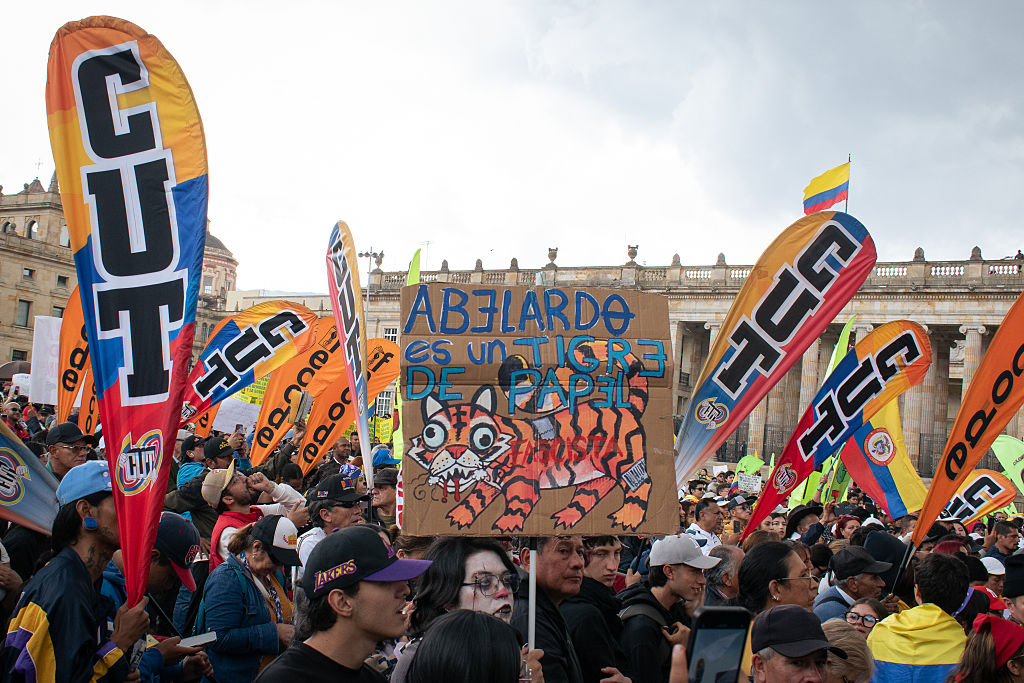
BOGOTÁ—In Colombia, everything now seems to have a miracle-themed nickname: “miracle week” with foreign investors, “miracle housing,” “miracle reconstruction fund,” and so on. But for any of these to materialize, trust is essential, and given the country’s precarious fiscal situation, something extraordinary needs to happen.
President Aberlardo De La Espriella is trying to put the house in order, but the country of miracles faces a serious structural fiscal problem that will likely define his administration. Colombia ended last year with a fiscal deficit of 6.4% of its GDP, and is projected to close this one at 7.8% of GDP. The independent Fiscal Rule Advisory Committee—which issues recommendations on public finances—estimates that, without additional measures, the fiscal gap might exceed 9% of GDP next year. In layman’s terms, this means that Colombia will have the largest fiscal deficit in its history and the largest in Latin America and the Caribbean. Next year, the government would need nearly $50 billion in net financing, a figure likely to push interest rates charged to Colombia to unprecedented levels.
How did Colombia’s public finances become so unsustainable? Political polarization and former President Gustavo Petro’s fiscal populism took a heavy toll on the economy. Petro abandoned the limits imposed by the so-called fiscal rule and adopted an expansionary fiscal policy—during his four-year term, the nation’s fiscal deficit ballooned from 5.3 % in 2022 to the aforementioned 7.8% in 2026— leaving higher debt and rising interest rates amid sluggish economic growth.
As the fiscal situation deteriorated, Petro’s administration canceled a Flexible Credit Line with the IMF in October 2025, and the multilateral lender withdrew from Colombia’s fiscal debate. This lack of accountability worked to Petro’s advantage. Markets were willing to finance his government without asking too many questions, and they charged a price for it. Interest rates on the 10-year peso-denominated government bonds reached 14% annually in May, just before the first round of the presidential election that De La Espriella won in the June 21 runoff. No investor wanted to miss the party.
The underlying assumption was that the elections would bring to power a team willing to put the country’s finances in order. The day after De La Espriella’s victory, the bond yield fell to 11.8%, and the Colombian peso strengthened to unexpected levels. However, yields are back at 13%, suggesting that the honeymoon is over, at least in financial terms. The initial reaction likely stemmed from the candidate’s campaign promise to reduce the size of government by 40%.
But will De La Espriella deliver on his campaign promise?
2027 deficit and the IMF
Hours after he took office in early August, a devastating earthquake wreaked havoc on more than 400 municipalities across the country. Preliminary estimates placed reconstruction costs at several percentage points of GDP, further worsening the fiscal outlook.
In September, De La Espriella announced talks with the IMF to reach an agreement that would allow the government to obtain sizable funding. Some analysts estimate that Colombia could receive as much as $16 billion, disbursed in three annual installments beginning next year. Although the details of the commitments the government would undertake remain unknown, the most likely arrangement would be an Extended Fund Facility (EFF), similar to what Ecuador signed in recent years.
Praised by the IMF, the government presented a broad fiscal reform days ago that seeks a considerable reduction in public spending and an increase in taxation. The bill—also known as a fiscal rescue law— is a solid, well-documented adjustment proposal, but also an extremely unpopular one. Through this initiative, the government hopes to cut next year’s deficit by 2.2 percentage points of GDP, with the reduction increasing in subsequent years, mainly through the proposed tax measures. The bill projects that by 2030 the deficit will decline to 4% of GDP.
If governing means making difficult and often unpopular but necessary decisions, then this bill marks the true beginning of De La Espriella’s administration. Moreover, the proposal could help the government stay away from right-wing populism.
Cutting expenses
Technically, the bill’s proposals are sound, but politically they are radioactive. The bill proposes increasing VAT by moving several products currently subject to reduced rates (0% and 5%) and putting them at the standard 19% rate. These include coffee, fertilizers, and private health insurance, among many others. It also proposes broadening the personal income tax base. Currently, individuals with monthly employment income of approximately $2,800 or more pay this tax. The bill proposes lowering that threshold to $1,700 per month, with a marginal rate of 9%, affecting approximately three million workers.
If the government wants to succeed, it will need to rethink its strategy. Voters do not want to hear about taxes until they see spending cuts. The administration should begin implementing spending cuts that do not require congressional approval. A good example would be eliminating fuel subsidies, something the government has been unwilling to do. But that is not all: Eliminating or merging government agencies, reducing public-sector staffing levels, terminating temporary service contracts, and establishing a public-sector salary policy for the coming years are all examples of decisions the executive branch can make without Congress.
The greater evil to avoid at all costs is a major economic crisis currently taking shape because of fiscal mismanagement. But because the crisis has not yet been felt or seen on the streets, securing the political support needed to pass this bill is no easy task. Based on social media messages, including those from members of Congress closely aligned with the government, the president doesn’t have the necessary votes to get the legislative green light.
These are difficult decisions. To paraphrase Charles de Gaulle, governing means choosing between what is bad and what is less bad. Political capital is meant to be spent. How the president will play his cards remains uncertain. But one thing is clear: If he does not build legislative majorities, seek consensus, and form a coalition, the fiscal rescue bill risks either failing to pass or being significantly watered down.
Either outcome would represent a serious political setback for De La Espriella’s government. Markets, which have waited patiently, could react strongly. This could be the prelude to a fiscal and economic crisis that must be avoided at all costs, and that could imply the return of Petro’s irresponsible populism.
ABOUT THE AUTHOR

Mauricio Cárdenas
Reading Time: 4 minutesCárdenas is professor of professional practice and director of the MPA in global leadership at Columbia University’s SIPA. He was finance minister of Colombia from 2012 to 2018 and is a member of AQ’s editorial board.