



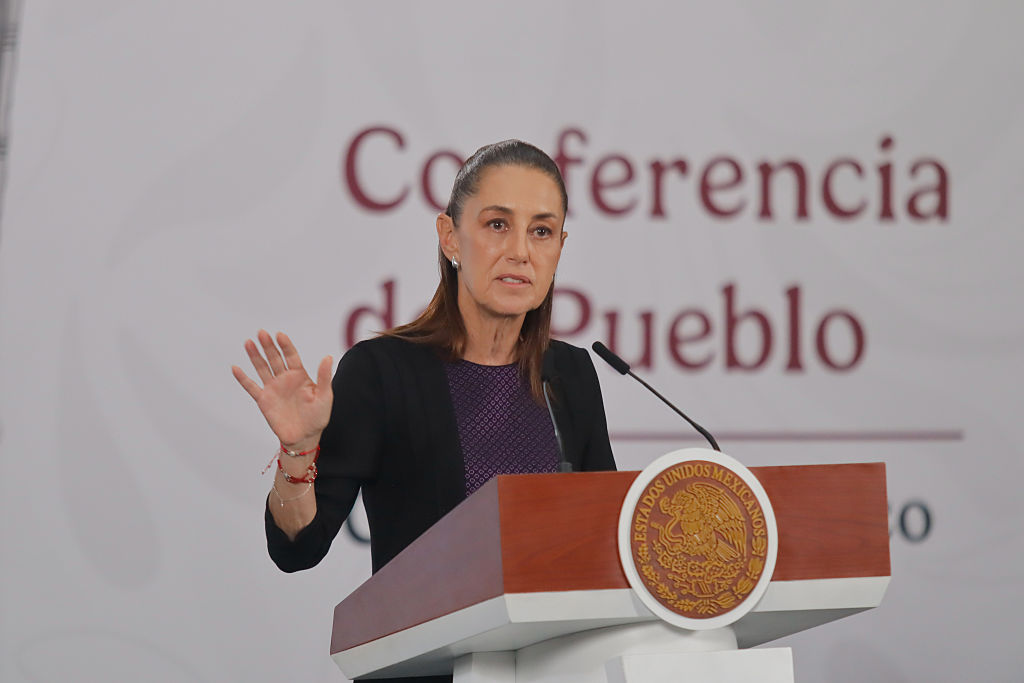
MEXICO CITY— Mexico’s President Claudia Sheinbaum is trapped between three competing forces: her predecessor, President Donald Trump, and her own ideological instincts. For a while, she appeared capable of juggling all three. But eventually each began demanding her undivided attention. Instead of choosing a path—or devising a strategy that might expand her options—she has continued digging herself deeper into a political hole with no obvious exit.
What makes Sheinbaum unique in modern Mexican presidential history is that she sees herself primarily as a caretaker: the steward of Andrés Manuel López Obrador’s political project rather than the architect of one of her own. Although she has introduced new policies and modified aspects of Morena’s governing style—security policy being the clearest example—she has made little effort to build an independent political base or define a governing vision that carries her own imprint and legacy.
That peculiarity now carries serious consequences. First, her government already feels old, weighed down by the previous administration’s errors and unfinished business rather than energized by a fresh agenda. Second, and more damaging, she lacks the political flexibility needed to confront the growing number of crises in which AMLO’s legacy has become more of a liability than an asset.
Sheinbaum’s popularity, though still relatively healthy by global standards, rests on two increasingly fragile foundations. First, her ability to communicate with Morena’s base, which AMLO turned into an art. Her daily press conferences serve the key political objective of keeping the base in step with the leadership. Second, and more important, is the direct cash transfers to about 45% of Mexican families through various programs: for the elderly, the young, the peasantry, and the like, with the criterion being loyalty to the party and the president. When the rhetoric and the people’s direct knowledge clash, as is likely happening amid evidence of corruption and a stalling economy, the president’s popularity inevitably suffers, as polls suggest is already happening.
Caught between these factors, Sheinbaum has increasingly appeared reactive rather than strategic. When two CIA officials died in a car accident in Chihuahua alongside two Mexican agents, she did not respond primarily with empathy or statesmanship. Instead, she seized on the episode to launch a partisan offensive against the PAN governor of Chihuahua, María Eugenia Campos, a state Morena hopes to capture in next year’s elections.
Then came the ten indictments issued by the U.S. Justice Department against Sinaloa Governor Ruben Rocha and nine state officials accused of conspiring with leaders of the Sinaloa Cartel to smuggle narcotics into the U.S. in exchange for political support and bribes. These allegations strike at the heart of Morena’s purported links to organized crime.
According to the allegations, criminal organizations played a decisive role in the 2021 elections by intimidating some voters while mobilizing others, helping a criminal organization secure a corridor stretching from the Pacific coast to the U.S. border with little effective opposition and under the complacent eye of the federal government. The broader implication is even more explosive: that the former governor, now under scrutiny, allegedly served as an intermediary between the Sinaloa cartel and Morena operatives. (All involved deny wrongdoing.)
Cascading pressure
Corruption has long been embedded in Mexico’s political system, often tolerated as part of the unwritten rules of governance. But overt collaboration between a ruling party and organized crime—with the implicit blessing of the head of government—would represent something entirely different. Sheinbaum’s insistence on demanding proof behind the indictments could ultimately produce evidence she would much rather avoid seeing.
Meanwhile, Washington has steadily increased the pressure: more indictments, visa cancellations, threats to withhold ratification of the USMCA, and relentless demands that Mexico fully comply with the bilateral extradition treaty. Taken together, the situation increasingly resembles a political “Mexican standoff” in the literal sense of the term.
Sheinbaum initially seemed inclined to buy time by demanding evidence for the accusations against the indicted officials. But after visiting Palenque, where López Obrador now resides, she returned with markedly different rhetoric. Rather than focusing narrowly on legal proof—which the extradition treaty does not require—she shifted toward nationalist grandstanding, accusing the United States of interference, asserting Mexican cultural superiority, and wrapping herself in the flag with increasingly xenophobic language. In doing so, she not only raised the political stakes but also made any eventual compromise more costly.
All of this is unfolding against the backdrop of a weakening economy heavily dependent on exports and remittances tied to the U.S. Recent economic indicators point to a possible recession, fueled in part by the deteriorating investment climate created by the administration’s legislative and regulatory decisions. However, for this to have lasting consequences, somebody must be able to catch the fallout, and there seems to be no opposition in sight capable of doing so.
The consequences
The current situation is plainly unsustainable. For a brief period, the three central forces shaping Sheinbaum’s presidency—AMLO’s influence, Trump’s pressure, and a deteriorating economic environment—appeared loosely aligned. Increasingly, however, they are colliding head-on. Predicting which factor will ultimately break first is impossible. But one thing is certain: the pressure on Sheinbaum will continue to intensify.
The foremost concern is the economy, where evidence of a looming recession is everywhere. The GDP contracted 0.8% in the first quarter, wider than the 0.5% decline expected. As fiscal revenue declines, public debt has increased steadily, a factor that led Standard & Poor’s to revise the government’s debt rating to negative. Hence, with an economy stalling, American unrelenting pressure, and the president’s attempts to ride the wave without conceding anything, the potential for a clash increases by the day. Something will have to give, and the weakest link, as the polls suggest, is Morena’s credibility.
Oddly, this might present the president with the opportunity to both address the structural issues that hinder the growth of the economy and lay the foundation for a revamping of her own presidency, but nothing suggests any of this is in the offing.
The longer it takes for Sheinbaum to recognize that the status quo cannot hold, the more costly the eventual reckoning will be. The manner in which she chooses to escape this conundrum matters enormously, because Mexico’s political stability itself may soon hang in the balance.
ABOUT THE AUTHOR

Luis Rubio
Reading Time: 4 minutesRubio is chairman of the think tank México Evalúa. He writes a weekly column in the newspaper Reforma, and is the author and editor of dozens of books, including Unmasked: López Obrador and The End of Make-Believe, published by the Wilson Center.

The Strategic Link Between USMCA and Critical Minerals
North American security requires that critical minerals be part of trade negotiations, writes a former Mexican ambassador to the U.S.
Mexico: A Story in Three World Cups
Since first hosting the FIFA World Cup in 1970, the country has seen a remarkable transformation. This time, the challenge is security.