


This article is adapted from AQ’s special report on Latin America’s demographic transformation
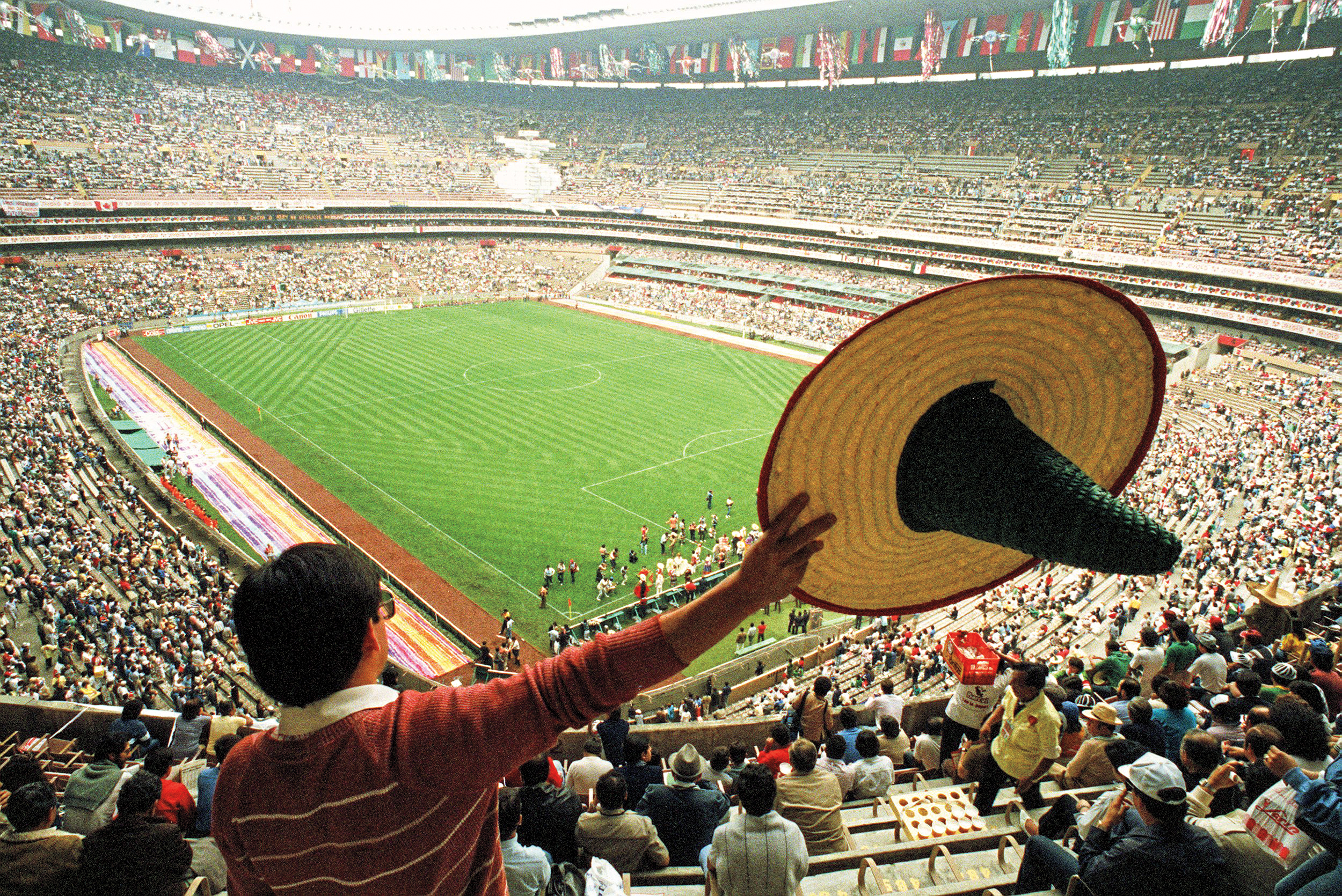
MEXICO CITY—This summer, Mexico will become the country that has hosted the FIFA World Cup more times than any other.
The thread connecting 1970, 1986 and now 2026 is not merely a passion for sport. Indeed, the three World Cups also tell the story of Mexico’s geopolitical evolution from an emerging economy under single-party rule to its current identity as a key player in an integrated North America, co-hosting the tournament with the United States and Canada.
Of course, not all is roses—but then again, it never was. On the two prior occasions Mexico hosted the Cup, its governments were under intense scrutiny. This year, with attention on Mexico’s volatile relationship with U.S. President Donald Trump, as well as the threat of drug-related violence, will be no exception.
1970: The “Mexican Miracle” and innovation
Considered by many experts and participants as the best World Cup to date—a tournament that helped change soccer in varied ways—the 1970 tournament took place during the last years of the so-called “Mexican Miracle,” a period from the start of the Cold War to the Latin American debt crisis of 1982 marked by strong economic growth based on industrial expansion and an infrastructure boom.
By organizing a premier international soccer tournament as a developing nation, at a time when the world was divided between Washington and Moscow, Mexico attempted to forge its own path, demonstrating that a non-aligned country could handle the technological and logistical challenges of a world-class event.
And Mexico scored. The event introduced numerous innovations that changed the perception of what a World Cup should be. The introduction of satellite technology and color television—the legacy of Jalisco-born engineer Guillermo González Camarena—showed that Mexico’s industrialization was no accident.
The event also served as a second global stage for the government of then-President Gustavo Díaz Ordaz to try to shake off the grim shadow of the Tlatelolco massacre. Occurring less than two years prior, the president had ordered the suppression of student protests in a plaza in the nation’s capital, resulting in the deaths of dozens of young people and bystanders just 10 days before Mexico inaugurated the 1968 Olympic Games. At both events, the public made its repudiation of the leader known, with the boos at the World Cup being the most notorious.
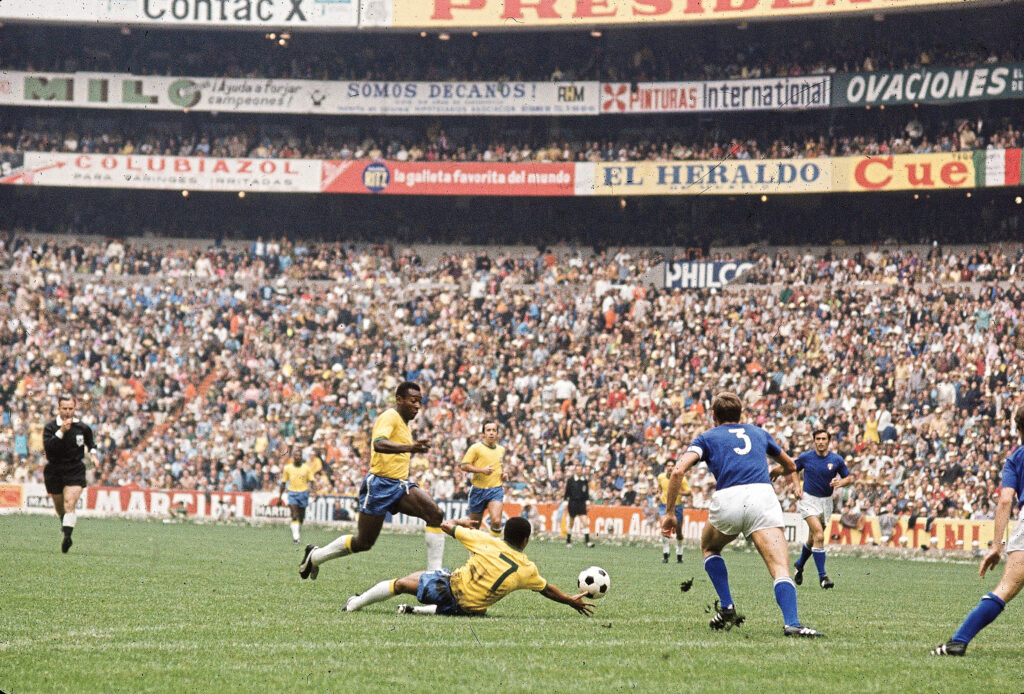
The 1970 FIFA World Cup in Mexico also reconfigured the sport domestically. For FIFA, thanks to two entrepreneurs who saw the event as an ideal showcase for promoting the country and growing their businesses, it became a turning point. In a nation where soccer and the Virgin of Guadalupe are sacred, the inaugural venue was the Estadio Azteca, an enormous stadium opened in 1966 with a capacity for over 100,000 spectators that quickly became a favorite for local and international teams alike. On its field, the Brazilian squad led by Carlos Alberto—and featuring stars like Pelé, Jairzinho, Gérson, Tostão, and Rivelino—shone with their jogo bonito, securing their third world title by defeating Italy 4-1. To reach the final, Brazil overcame Uruguay and Peru, while Italy defeated England and West Germany.
It was this World Cup that gave the federation a blueprint for integrating advertising, marketing, and media partnerships to elevate future events, driven by the growing popularity of soccer among mass and international audiences.
1986: Resilience amid crisis
By 1986, Mexico hosted the tournament for the second time after Colombia withdrew due to its inability to develop the required infrastructure amid a severe economic and security crisis.
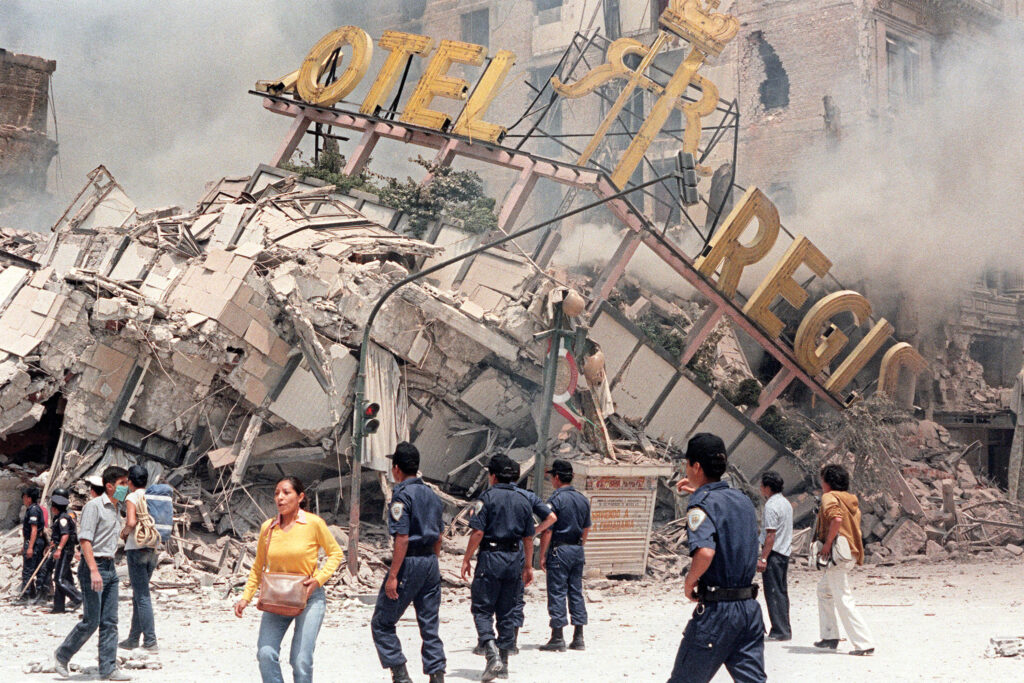
Mexico certainly had its own challenges. It organized the 1986 FIFA World Cup only eight months after a devastating 8.1 magnitude earthquake killed thousands and toppled dozens of buildings in the capital. However, stadiums such as the Azteca remained largely unaffected. The government of President Miguel de la Madrid was viewed unfavorably after a slow and poorly articulated response to the earthquake, leaving citizens to figure out how to rescue survivors, remove debris with their own hands, hand out food, and create voluntary aid networks.
The country faced consequential challenges, including a rapidly rising inflation rate exceeding 100% and crippling external debt. But in a rupture with the populist model maintained by his two predecessors, De la Madrid introduced a neoliberal program to stabilize the nation.
To the outside world, this World Cup portrayed a resilient Mexico—a country that, despite a tragedy, managed to host a grand celebration. In the stadiums, fans enthusiastically participated in the “ola” or “wave,” with thousands of fans spontaneously raising their arms, helping make the gesture internationally popular for years afterward. The 1986 Cup also gave the world an icon: Mar Castro, a 17-year-old model dressed in a short white top with a brewery’s logo, who drew the attention of thousands and became a symbol of that tournament. She was known as “La Chiquitibum,” and morphed into Mexico’s ultimate cheerleader.
On the field, the undisputed star was Argentina’s Diego Armando Maradona, who made his mark in the quarterfinals with the controversial “Hand of God” and then led his team to win the championship in the final against West Germany.
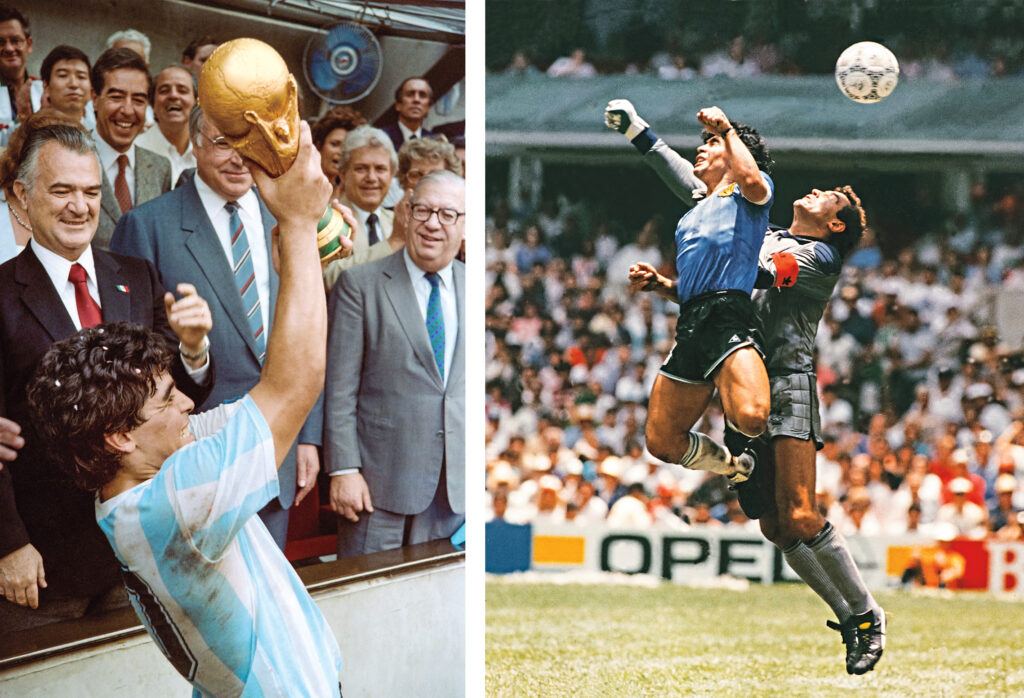
Germany, as Mexican President Miguel de la Madrid (left) and West German
Chancellor Helmut Kohl (center) look on. Right: Maradona uses the “Hand of
God” to score his team’s first goal during the 1986 World Cup quarterfinal between
Argentina and England. Photos by Archivo el Gráfico/Getty and AFP via Getty Images
Beyond social resilience, 1986 marked a crucial turning point for Mexico’s integration into the global order. A few weeks after the Azteca World Cup final, the country formally joined the General Agreement on Tariffs and Trade (GATT). This decision was Mexico’s response to pressure from international financial institutions to abandon protectionism and pursue an export-led strategy to escape the debt crisis.
2026: The security challenge
In just under three months, Mexico will host the soccer tournament for a third time (or fourth, if you include the 1971 Women’s World Cup). However, this edition will be held alongside the U.S. and Canada. Bound to these two nations by the USMCA, Mexico will leverage soccer as a cultural bridge for one of the most powerful trade zones on the planet.
The event will coincide with the USMCA review. For Mexico, the goal is a fundamental narrative shift: moving beyond its image as a low-cost manufacturing hub to highlight a high-tech innovation ecosystem. Infrastructure investments in Monterrey and Guadalajara, which will host Cup matches alongside Mexico City, are intended to signal to global investors that the country is a stable, technologically advanced backbone supporting the continent’s nearshoring future.
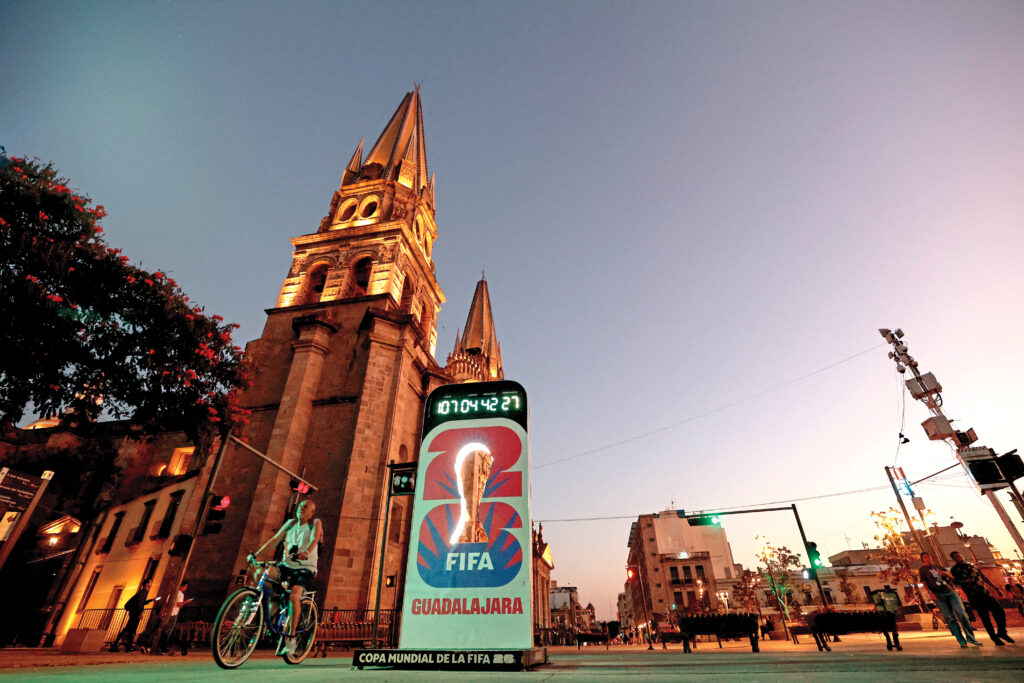
However, the February killing of CJNG cartel leader Nemesio “El Mencho” Oseguera has radically altered the security strategy around a tournament expected to attract 5.5 million local and international fans. The death of the leader triggered an immediate surge of “narco-blockades” and retaliatory actions in at least 20 states, forcing the Mexican government to deploy over 10,000 additional troops to secure transit routes around Jalisco.
Security experts are now watching for a violent power struggle as CJNG is expected to splinter into smaller, more unpredictable cells. But President Claudia Sheinbaum quickly assured the public that the situation is under control, and proceeded with a free concert by Colombian singer Shakira that attracted close to 400,000 fans in the capital with no incidents, just a week after the narco kingpin’s death. “Safety is guaranteed for all visitors to the World Cup,” she stated.
“The government has to say that,” Aldo Sales, founder of sports business intelligence firm Playbook, told AQ. “If something unfortunate were to happen during the World Cup, which is the biggest sporting event in the world and the stage with the greatest exposure, it would be terrible in terms of Mexico’s country brand.”
To prevent that, Mexico is deploying the Kukulcán plan—named after the Mayan feathered serpent god of creation—an initiative that will mobilize 20 federal agencies, as well as state and municipal authorities, said Security Minister Omar García Harfuch in March. Mexico will also deploy close to 100,000 security staff, both private and from the military.
Sheinbaum has received strong backing from international allies. FIFA President Gianni Infantino spoke with her shortly after the February unrest, reaffirming “full confidence in the host country.”
A changing experience
Not everyone believes that global soccer has evolved for the better since Mexico last hosted the tournament. Tom Wiecking was a kid when he watched the 1986 World Cup matches in awe from his native Düsseldorf. “The Azteca stadium, the mariachis, the cheering. That planted the seed of love for Mexico,” he told AQ. When Germany hosted the Cup in 2006, his city became a default party central for the Mexican and Brazilian fans attending matches in nearby Gelsenkirchen. “We bonded over beer and soccer.” Now a resident of Mexico City for nearly two decades, Wiecking is not enthused by the upcoming matches. He described a radical change, watching a once mostly fan-driven celebration mutate into a money-first endeavor. “It all becomes a VIP lounge for a select few. A caviar buffet. Business dominates everything,” he said.
Sales, the sports business analyst, echoed the criticism, but said the Cup still presents Mexico with plenty of opportunities. “The task at hand is to leverage the World Cup as a catalyst for the sports industry in Mexico, and the soccer industry in particular,” he said. “Come August, what are we doing as a country to take advantage of this event?”
ABOUT THE AUTHOR
Cyntia Barrera Díaz
Reading Time: 7 minutesBarrera Díaz is a bilingual editor and journalist. She covered corporate and financial news across the U.S. and Latin America for Reuters and later served as a Spanish-language team leader and breaking news editor at Bloomberg.

A Mexican Firm Bets Big on Live Events
Corporación Interamericana de Entretenimiento (CIE) has become a juggernaut by capitalizing on demand for live entertainment.