


This article is adapted from AQ’s special report on Latin America’s demographic transformation
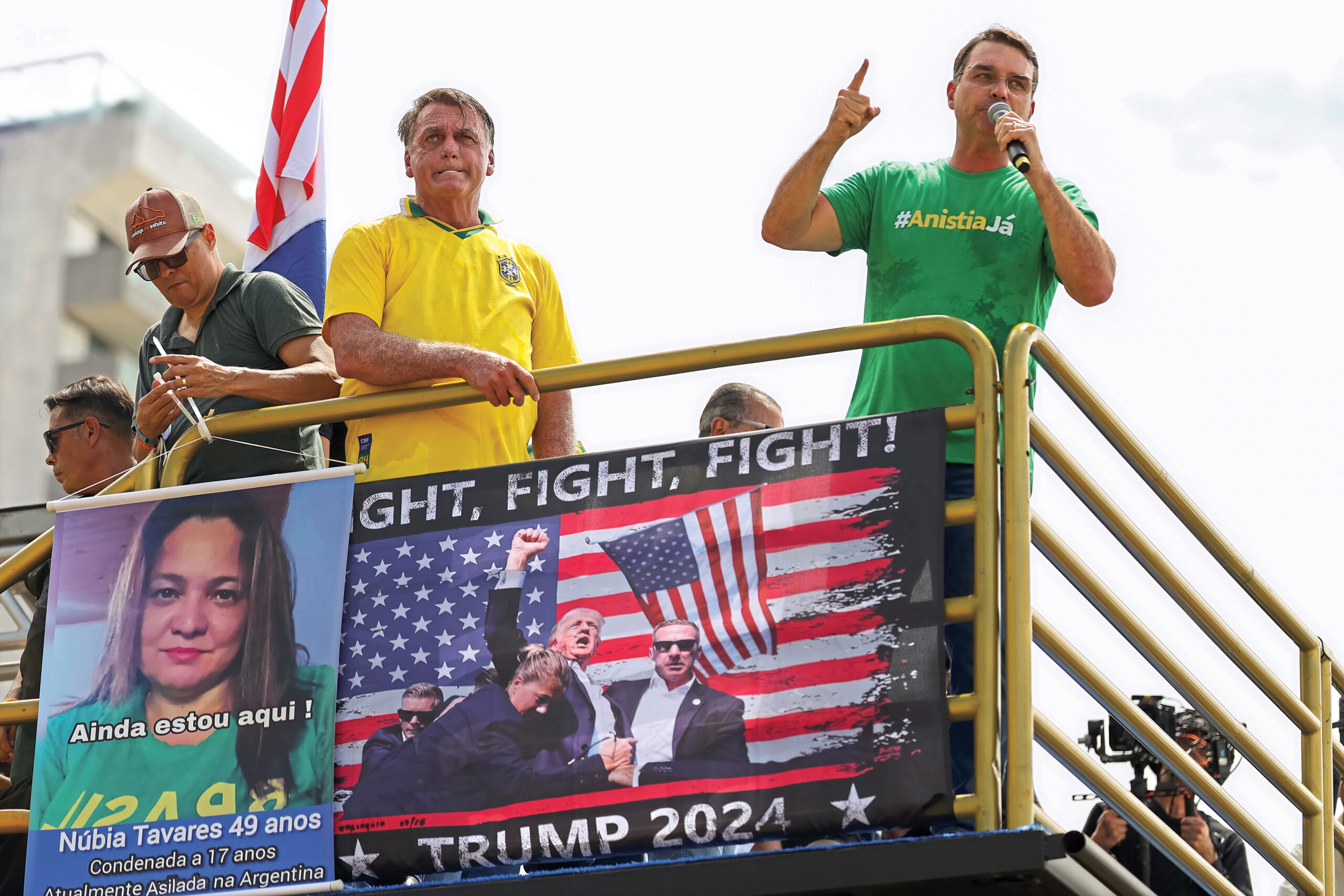
SÃO PAULO—At a recent event here with bankers and investors, Senator Flávio Bolsonaro mentioned that he had just visited the military police battalion where his father had been in jail since the beginning of the year.
“God will still honor him, and we will have the opportunity to restore justice,” said the eldest son of Jair Bolsonaro, who governed Brazil from 2019 to 2022 and was later convicted by the Supreme Court of attempting a coup to remain in power.
The audience seemed somewhat subdued. The senator spoke for 45 minutes about his father’s decision to back him as a presidential candidate in this year’s election and about his plans for the country, but he was interrupted by applause only twice. First, Flávio compared President Luiz Inácio Lula da Silva to an old car that “really guzzles.” Later, he promised to appoint a better finance minister than the current one, Fernando Haddad, should he be elected president.
The event in some ways encapsulated the opening months of Flávio Bolsonaro’s 2026 campaign. On the one hand, the eldest of Bolsonaro’s five children is often perceived as lacking in charisma and his father’s talent for inciting crowds with attacks on his rivals. On the other hand, Flávio, 44, still has the most powerful name in Brazilian conservative politics, and some wonder if his relative blandness might end up appealing to the more moderate swing voters who will probably decide this election.
According to an April survey by Quaest, Lula continues to lead in first-round polling, but in a second-round scenario, Flávio pulled ahead of Lula by two percentage points—within the poll’s margin of error.
Flávio’s nomination, announced by his father in a letter from jail at the end of 2025, was initially greeted with skepticism by much of the Brazilian political establishment, who expected Bolsonaro to nominate São Paulo governor and market darling Tarcísio de Freitas. But Flávio has enjoyed a quick consolidation of support among his father’s voters, especially the evangelical Christians who account for about 30% of the Brazilian electorate. Lula has also seen his popularity sag amid recent corruption scandals and concerns over organized crime.
Most analysts expect a close election, especially considering that Lula beat Jair Bolsonaro by only two percentage points in the 2022 vote. To win, Flávio will still need to conquer independent voters. Right-wing parties that once backed the Bolsonaro government and now hold seats in Lula’s coalition are keeping their distance. Business leaders and sympathizers in financial circles also seem to be holding back, at least for now.
“The two camps into which Brazilian voters are divided are clearly defined, left and right, and Flávio quickly carved out his space with the votes he inherited from his father,” said political scientist Felipe Nunes, director of polling firm Quaest. “His ability to make inroads among independents is still uncertain and will depend on the choices he starts making on the campaign trail now.”
Shadows of the past
A lawyer by training, Flávio entered politics shortly after finishing his degree. He followed in the footsteps of his father, a former Army captain who served successive terms in Congress before reaching the presidency. Flávio began his career in the state assembly in Rio de Janeiro, which the family has turned into its main electoral base. His brother Carlos, Bolsonaro’s second son, served as a city councilman in Rio. Eduardo, the third son, was a federal congressman for São Paulo. His mandate was recently revoked, and he now lives in the United States.
Flávio served four consecutive terms in the state assembly, from 2003 to 2019. During that period, he forged ties with elements of Rio’s Military Police, connections that were scrutinized by courts and the Brazilian press after his father came to power.
Flávio employed on his staff relatives of a police officer who was expelled from the force after prosecutors accused him of being a hired killer. In 2018, weeks before Jair Bolsonaro’s inauguration as president, an investigation led by state prosecutors exposed unusual financial transactions in the account of another police officer who worked for Flávio. Prosecutors allege that a portion of the salaries paid to his office’s staff was being skimmed by the family, in a scheme that may have involved other lawmakers as well.
The family’s lawyers halted the investigation after pointing to irregularities in the way prosecutors had obtained the financial records of Flávio’s aides. The case was ultimately closed without a trial, but it will almost certainly be revived by his opponents during the campaign. Flávio has always denied any wrongdoing.
The conservative wave that carried his father to power helped Flávio win his Senate seat. He built a reputation in Congress as a skilled political operator, steadier in temperament than his brothers or his father, and capable of dealing across party lines.
The investigations that led to Jair Bolsonaro’s conviction on planning a coup found no evidence that Flávio had any part in the plot. After the January 8, 2023 attacks, when Bolsonaro supporters stormed buildings housing the three branches of government in Brasília, Flávio called the actions unjustifiable and said his father had nothing to do with the violence.
“Many Brazilians have trouble telling Bolsonaro’s sons apart and assume they are all just out to cause trouble in defense of their father’s interests,” said Christopher Garman of political risk consultancy Eurasia Group. “Flávio is well positioned to project a more moderate profile on the campaign trail, once doubts about his electoral viability fade.”
A divided right
Flávio has been balancing gestures toward moderates with nods to the core elements of the bolsonarista base. Early in the year, he embarked on an international tour with his brother Eduardo, visiting far-right politicians in France and the Middle East, and even suggested he might appoint Eduardo, a favorite of the conservative base, as his foreign minister. Flávio has said he plans to pardon his father.
But Flávio’s main difficulties within the right have nothing to do with ideology. They reflect the competitive nature of Brazil’s political system, in which dozens of parties hold seats in Congress and draw on public funds to finance their operations. In this year’s election, these parties’ priority is to expand their ranks in the lower house and ensure they will have enough leverage to pull strings in the next government, whoever wins the presidency in October.
Bolsonaro’s Liberal Party elected the largest bloc in the lower house in 2022 and still holds that position today, despite some defections. But Congress’ legislative agenda is driven by a center-right caucus known as the Centrão—literally, the “Big Center”—which controls 276 of the chamber’s 513 seats. It brings together eight parties, none of which has committed to Flávio so far. Four of them hold positions in Lula’s government, and two recently drew closer to him in search of protection for regional interests.
One of them, Gilberto Kassab’s PSD, which has three ministers in Lula’s Cabinet, has fielded three state governors as potential presidential candidates, all of them opposition figures, and ultimately decided to launch Ronaldo Caiado, the former governor of Goiás. The move made clear that strengthening the party at the state level will be PSD’s priority in the first round of the election, and that it will be open to dealmaking with anyone heading into the runoff.
The fracturing of the right is also a consequence of Bolsonaro’s conviction, which has sharpened the competition over his electoral spoils. Governor Tarcísio de Freitas, once seen as the frontrunner to lead the opposition to Lula, stepped aside after realizing he would not have Bolsonaro’s backing and decided to run for reelection in São Paulo instead.
In an interview given months before being anointed as a candidate, Flávio himself signaled that anyone seeking his father’s support would have to pay a steep price. They would need to commit not only to granting a pardon to free him from prison, but to lobbying the powerful justices of the Supreme Court to approve such a measure.
All of this complicates Flávio’s efforts to build the statewide coalitions his campaign will need, but it may only be a matter of time. In an attempt to ease investors’ concerns. Flávio has spoken of privatizations, public spending cuts, and tax reductions. But he has not yet offered specifics, and recently postponed plans to unveil a sketch of his campaign platform and his economic team.
“He needs to present a strong, reform-minded team,” said an investment manager who backed Bolsonaro in the past but is still hesitant to support his son, and asked not to be named. “Flávio looks competitive, but we need to wait a little longer to see if that’s really the case.”
Domestic tensions
The polls suggest that a critical factor in winning over independent voters will be the support of evangelical Christians, one of the pillars of the coalition that propelled Bolsonaro’s political rise. Flávio has made rapid inroads there as well. According to pollster Datafolha, he would command 48% of the evangelical vote in the election’s first round, close to the 50% his father received in the last election.
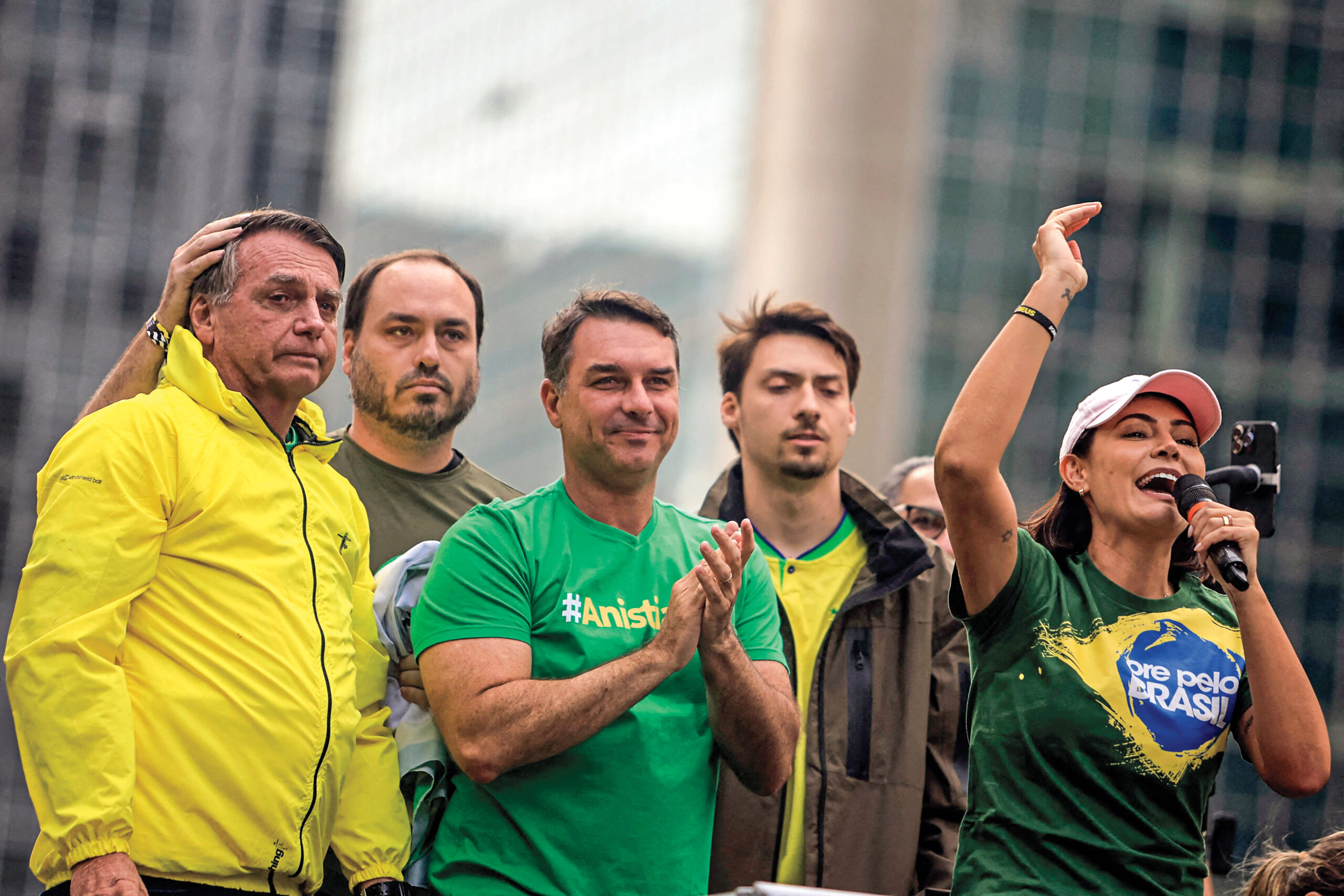
Former first lady Michelle Bolsonaro, the ex-president’s third wife, is the family’s main bridge to the evangelical world. She had been floated as a running mate on a ticket headed by Freitas and even as a presidential candidate herself before Flávio was put forward by his father. She has a tense relationship with her husband’s three eldest sons, from his first marriage.
Flávio’s brothers have been pressing Michelle to take a more active role in the campaign, but she appears to have other priorities. In recent years, she devoted herself to building a network of female leaders within the Liberal Party, many of whom are expected to run for state office this year. Michelle herself is considering a Senate bid. She has also pushed back against some of the regional alliances Flávio has been negotiating, worried they could conflict with her allies’ interests.
“Michelle has become a very powerful leader because she reinforces the traditional image of womanhood among evangelicals, and has an intimacy with that world that her husband and his sons never had,” said anthropologist Juliano Spyer, a scholar of Brazil’s evangelical movement. “She has become an autonomous leader within that constituency.”
As Bolsonaro’s wife, Michelle had privileged access to him in prison. In late March, he was temporarily transferred to house arrest on medical advice, further increasing their proximity. The former president also added Flávio to his legal defense team. Throughout the campaign, he will be allowed to visit his father only on weekdays, for no more than 30 minutes at a time.
ABOUT THE AUTHOR

Ricardo Balthazar
Reading Time: 7 minutesBalthazar is an independent journalist based in São Paulo who has covered politics, economics and international affairs for more than 35 years.