



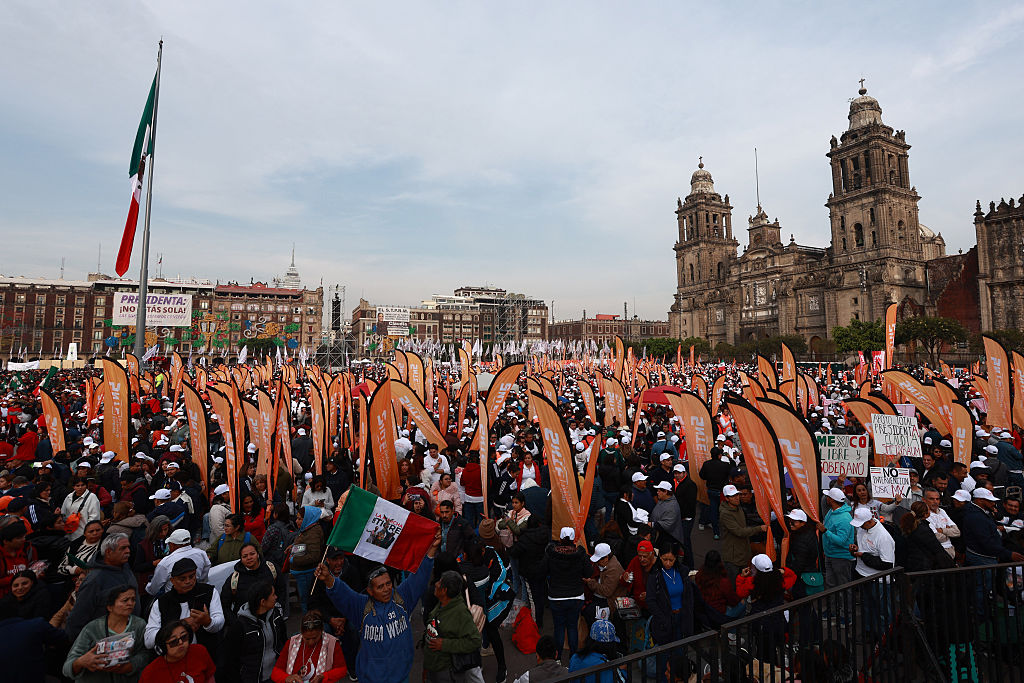
MEXICO CITY—Across the world, dominant parties often appear invincible until the institutions that sustain them begin to weaken. Mexico may be approaching one of those moments. Morena looks politically invincible. It isn’t.
President Claudia Sheinbaum remains extraordinarily popular, an underperforming economy has yet to produce a major political backlash, and the opposition is at its weakest point in decades. Yet appearances can be deceiving. Unlike the PRI during its 20th-century heyday, Morena has never built the institutional foundations that sustained one-party rule for generations, and that distinction may ultimately define the limits of its dominance.
Morena became a national juggernaut in large part by using elements of the PRI’s voter mobilization machinery and by rolling out broad cash-transfer programs that were more generous—and costly—than what the PRI ever offered. But Morena’s strength on the national stage belies a weaker position at the regional and local level. Morena has neglected the kinds of local organizations and networks that the PRI developed and that traditionally determine electoral success in Mexico. It also lacks the structures of control, discipline, and participation that the PRI relied upon to maintain internal cohesion.
This could spell trouble, given that Morena has normalized corruption within its ranks, maintains troubling proximity to organized crime, encompasses an extraordinarily diverse coalition of interests, and remains heavily dependent on centralized decision-making, a legacy of its origins as former President Andrés Manuel López Obrador’s personal political instrument. These underlying factors are fonts of potential vulnerability—especially if fiscal constraints force Morena to backtrack on its expansive social programs.
Mark Twain famously observed that history doesn’t repeat itself, but it often rhymes. Mexico today is experiencing an unusual revival of its old political system, minus the fundamentals that made it durable.
An opposition in the wilderness
Morena’s strength does not fully account for the opposition’s extraordinary weakness. The traditional opposition parties, the PAN and the PRI, lost much of their credibility after participating in opaque negotiations during Enrique Peña Nieto’s administration (2012–2018) to enact a series of major reforms with virtually no public debate. The manner in which those politically sensitive reforms—particularly in the energy sector—were approved handed Andrés Manuel López Obrador a powerful political weapon. He successfully portrayed both parties as indistinguishable members of a discredited political establishment, and neither has recovered.
The other opposition force, Movimiento Ciudadano, led by Dante Delgado, a former PRI leader, has benefited from the decline of the traditional parties by attracting voters unwilling to support Morena. Yet it remains more a vehicle for protest than a credible governing alternative. Across the opposition, leadership is weak, few figures command national stature, and many appear more interested in advancing personal ambitions (and business opportunities) than in rebuilding viable political organizations.
Mexico’s political landscape today shows an opposition in dire straits, barely existing—either in the polls or in the public debate. The contradiction is striking, especially when contrasted with the political ferment unfolding across much of Latin America, an ascendant rightward shift that leaves Mexico as an exception.
Next year’s midterm elections
The 2027 midterm elections will provide the first meaningful test of Mexico’s evolving political balance. Seventeen governorships (out of 32) and every seat in the Chamber of Deputies (500 seats, of which 300 are by direct representation and 200 by proportional representation) will be contested. (The senate is not in play, as it is elected once every six years.) Morena currently governs 12 of those states and hopes to expand its control. While the party enters the campaign from a position of considerable strength, its record in government has made it more vulnerable than headline polling suggests. Whether the opposition can capitalize on that vulnerability remains doubtful.
Morena itself faces structural obstacles, including a lack of regional organizational strength. The result is a movement that often appears stronger nationally than it is locally on the ground. Chihuahua offers an example. Morena has repeatedly targeted the state’s governor, María Eugenia Campos Galván, using the deaths of two CIA operatives as if they worked in that state only, and not in the nation at large, believing the state is within reach. However, those attacks have instead strengthened local resistance, potentially undermining the party’s electoral prospects there.
The midterms will also test two newly (conditionally) registered political organizations, Somos México and Partido Paz. Somos México is a social-democratic entity that includes experienced politicians drawn from several other parties. Paz is an evangelical party that has twice been registered with a different name as it has not reached the 3% threshold necessary to retain its registration.
Without an overwhelming federal presence—and especially without a towering figure like López Obrador dominating the political landscape—local dynamics are likely to matter far more than they have in recent elections. Given the growing public dissatisfaction with Morena’s performance, the electoral map in 2027 could look quite different from the present political landscape. Morena currently governs 24 states (74% of the population), 12 of which are up for grabs in 2027. PAN governs four, PRI two, Movimiento Ciudadano two and the green party (PVEM) one.
Fragility under the surface
Morena is a movement more than a political party. Internal conflicts over nominations for elected office have become more frequent, and both the government and the party have struggled to respond convincingly to the indictments recently announced by the U.S. Department of Justice. Once López Obrador’s political instrument, its relationship with the presidency today is far more complicated.
For all its electoral dominance, Morena is considerably more fragile than it appears. Unlike the PRI at its peak, it lacks a solid institutional structure and is permanently vulnerable to fragmentation. This raises serious questions about its capacity to remain the country’s dominant political force over the long term.
While Morena unquestionably controls an enormous political apparatus and commands a vast network of loyal beneficiaries sustained through increasingly costly social spending, no governing machine is immune to economic reality. Without sustained economic growth or a sense of direction for the future, even an increasingly centralized and authoritarian political system has limits.
For these reasons, reports of Mexico’s opposition’s demise—as Mark Twain supposedly said of his own—may be greatly exaggerated.
ABOUT THE AUTHOR

Luis Rubio
Reading Time: 4 minutesRubio is chairman of the think tank México Evalúa. He writes a weekly column in the newspaper Reforma, and is the author and editor of dozens of books, including Unmasked: López Obrador and The End of Make-Believe, published by the Wilson Center.
Claudia Sheinbaum’s Conundrum
Trump’s diplomatic pressure, AMLO’s influence, and a deteriorating economy are testing the president’s leadership, an expert writes.
Getting the China Dimension of USMCA Right
North America would benefit from three decisions that could cement the region’s security and competitiveness for years to come, an expert writes.