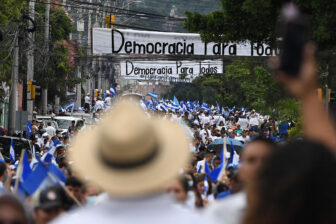



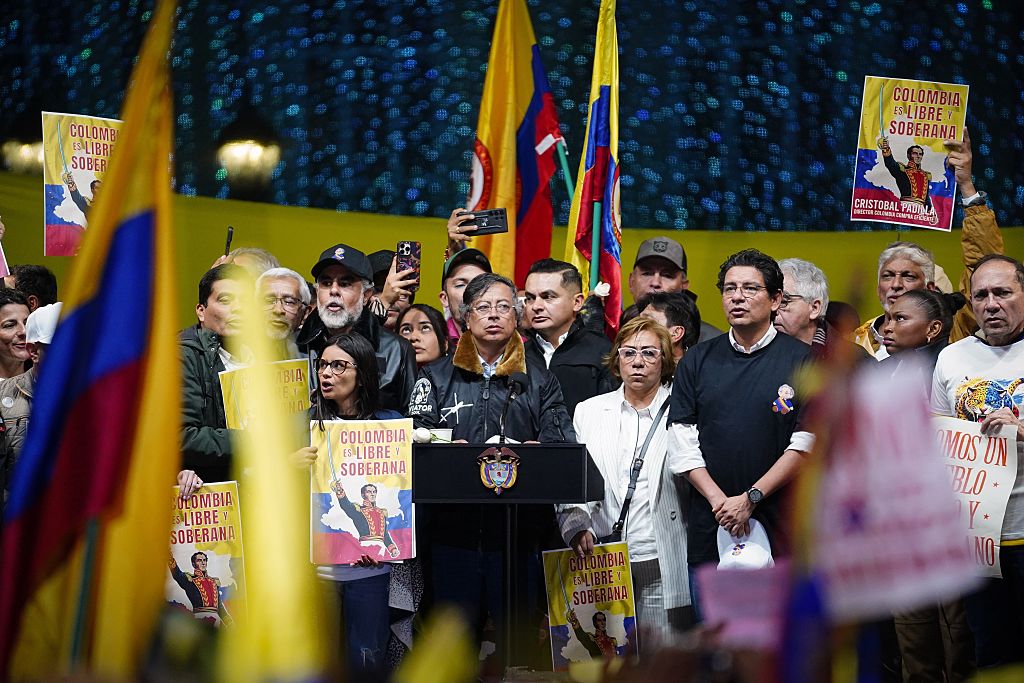

BOGOTÁ—Bogotá’s main square, Plaza de Bolívar, was full on the night of January 7 when President Gustavo Petro took the stage at 6:30 p.m. In front of him, a handwritten banner read “Colombia does not kneel before any empire,” as tricolor flags waved amid the crowd’s noise. The president, however, started his speech with an unexpected declaration: “I had brought one speech, but now I must give another one.”
Earlier that week, the Colombian president had called for this rally amid rising tensions with Washington, triggered in part by his criticism of the U.S. capture of Venezuelan dictator Nicolás Maduro and President Donald Trump’s subsequent threats against Colombia.
Besides describing his Colombian counterpart on several occasions as “a sick man who likes making cocaine and selling it to the United States,” Trump sent him a direct warning. After reporters on Air Force One asked early in the week about a potential military operation, similar to the one in Venezuela, the response was a “sounds good,” accompanied by a more explicit phrase on Petro.
Just hours before speaking in Bogotá’s main square, however, Petro and Trump held a phone conversation—their first—that defused (at least temporarily) what seemed to be an irreversible clash between the White House and Palacio de Nariño, Colombia’s presidential palace. Now, Petro is expected to visit the White House next month, a dramatic improvement after what had been the lowest point in bilateral relations since the U.S. backed Panama’s secession from Colombia in 1903.
It is no exaggeration to say that the news was met with relief both inside and outside Colombia. Political leaders, opinion makers, businesspeople, and ordinary citizens praised the turn of events. “I even imagined that Bogotá was going to be bombed like Caracas,” said Yadira Ariza, an executive assistant working in the Colombian capital.
But the road ahead for Colombia-U.S. relations remains challenging. Colombia is the world’s largest cocaine producer and is making more of it than ever before. Its economy is vulnerable, and punitive tariffs, for example, could wreak havoc. Meanwhile, it is also home to the world’s largest Venezuelan diaspora. Any deterioration in Venezuela that increases migration would affect Colombia immediately. These and other issues make the country especially sensitive to decisions made in Washington. As Colombia gears up for legislative elections in March and presidential elections in May, the U.S. will be a major factor in a tense and uncertain election season.
A long road ahead
Petro, who cannot run for reelection, has been a vocal critic of not only the U.S. operation in Venezuela, but also the strikes on speed boats in the Caribbean and the Pacific Ocean since last September. In November, Petro suspended intelligence cooperation with the U.S. over the controversial attacks, a move that underscored his government’s framing of the U.S. campaign as a violation of regional sovereignty.
This criticism has not been received well in Washington. Petro claims that Colombian authorities seized almost a thousand tons of cocaine last year, but according to the United Nations, 3,708 tons of pure cocaine were manufactured in 2023 in South America, of which 2,664 came from Colombia, an all-time high.
Venezuela’s future remains uncertain. The chavista regime continues to hold power, led now by the former vice president, Delcy Rodríguez, who is seeking to rebuild economic and diplomatic ties with the U.S. Petro has offered his services as a mediator, describing himself as a friend of Rodríguez, a statement that could displease Washington if he overplays that role.
Colombia shares a 1,380-mile border with Venezuela and was home to over 2.8 million Venezuelans in early 2024, according to Migración Colombia. If conditions improve in Venezuela, tens of thousands of those migrants might return home, easing the pressure on Colombia. But if the situation deteriorates, a massive new influx of people would take place, worsening security challenges and increasing strain on Colombia’s social and physical infrastructure.
Meanwhile, crime rates are going up, including homicides and kidnappings. In fact, recent polls show that security is at the top of citizens’ concerns. “When they cast their ballots, voters will consider how things are with Venezuela and the U.S.,” political analyst Camilo Granada told AQ. Which candidate benefits from the crisis in Venezuela depends on what happens from here.
A complex presidential election
If calm persists, other issues will determine how citizens vote. According to AtlasIntel’s recent polling, the top two candidates in the presidential race are Abelardo de la Espriella, a populist lawyer from the right who is described as the “Colombian Bukele,” and Iván Cepeda, a senator representing the incumbent Pacto Histórico. Sergio Fajardo, a former mayor of Medellín, is running in a distant third.
However, it is still very early in the race. On March 8, primaries will define who, aside from Fajardo, will represent the political center. The group of presidential hopefuls, which started with more than 100 aspirants, will be reduced to fewer than five by the time of the first-round vote on May 31. A potential runoff is scheduled for June 21, and the presidential inauguration for August 7. Petro, who has a legal obligation to stay neutral, remains largely unpopular. The recent AtlasIntel survey gave him an approval rating of 35.7% and a disapproval rating of 53.7%.
So far, heightened tensions have fueled anti-U.S. rhetoric, and Cepeda made that clear during an appearance in Madrid before Petro and Trump spoke. “We are not a colony nor a protectorate,” he said, speaking at the event.
Other candidates in the presidential race have expressed disagreement with the U.S. actions, and some have been in favor of Maduro’s capture. But all have praised the détente with Trump. It’s too early to tell how the disruptive event will ultimately impact the vote.
Amid all this, the threat of U.S. tariffs looms large. “One thing is for Petro to be punished, and another is for tariffs to be raised and the business climate to deteriorate,” Granada said. He pointed to the U.S. Department of the Treasury’s October decision to sanction Petro and members of his family, among others.
Even as JP Morgan projects GDP growth of 2.7% for last year, the economic situation is far from calm. Inflation exceeded 5% in 2025, and the historic minimum wage increase of 23.8% that took effect on January 1 will push prices higher. Experts have warned that unemployment and labor informality will rise if firms reduce their payroll as expected in some quarters.
These issues show the many challenges Petro faced even before the confrontation with Trump. Petro’s incendiary rhetoric before calling the White House energized his political base, as seen in Plaza de Bolívar. The risks were huge, and prudence ultimately prevailed. But the peace seems fragile. Petro admitted seeing Trump’s comments as a “real threat,” and even small shifts may have outsize political consequences.
ABOUT THE AUTHOR
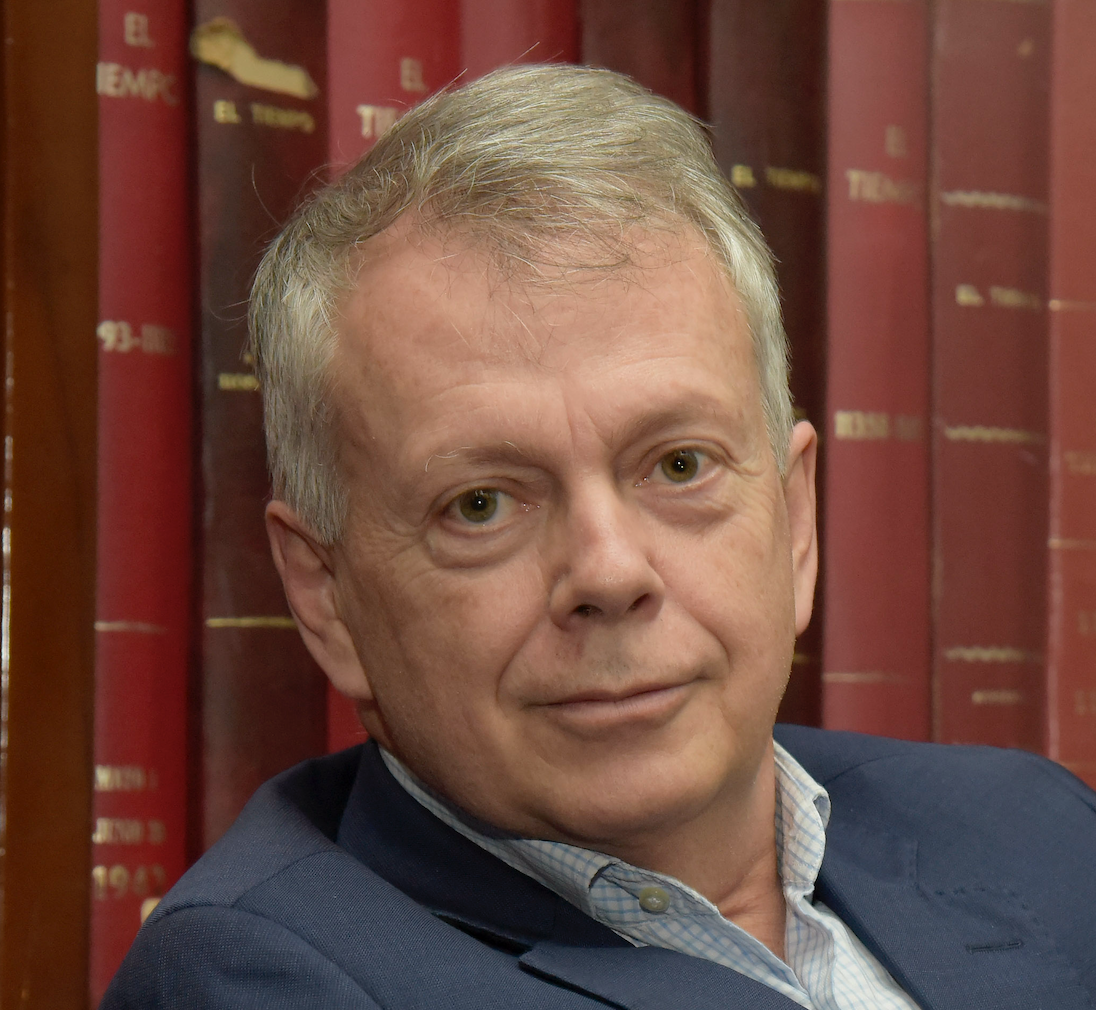
Ricardo Ávila
Reading Time: 4 minutesÁvila is a senior analyst at El Tiempo and a political consultant in Bogotá, Colombia.
Is This the End of the Fidel Castro Era?
Events in Venezuela, Cuba and beyond suggest that a particular brand of leftism is in its twilight in Latin America, writes AQ’s editor-in-chief.
After Maduro’s Capture, the Shockwaves Reach Mexico
U.S. pressure may force Mexico’s leaders to make crucial decisions on organized crime, Cuba, and their policy priorities.