



SANTIAGO—To win last year’s election, President José Antonio Kast campaigned on addressing Chile’s rising concerns over organized crime and public security. In his inauguration speech in March, Kast criticized his predecessor Gabriel Boric bluntly: “They’ve handed us a country in worse shape than we could have imagined. A country with weakened public finances. A country where organized crime and drug trafficking have gained ground. A country where families feel abandoned by the state.”
Kast set out to address that sense of abandonment with a new security plan and constitutional reform to expand the government’s capability to fight criminal activity. He tasked the roadmap to Trinidad Steinert, a former public prosecutor who presented the government’s security priorities to Congress but did not issue a formal plan before she was replaced in a May cabinet shuffle. Months later, the government withdrew the constitutional reform on national security because it lacked support in Congress, and is now betting that a new multiparty proposal to reform the Magna Carta can win lawmakers’ endorsements to improve how the country tackles crime.
Until recently, Chile was considered one of the safest nations in Latin America, but crimes such as kidnappings, extortion, robbery, and drug trafficking have become more common, according to recent reports from the Public Prosecutor’s Office. While the national homicide rate fell from its 2022 peak of 6.8 people per 100,000 inhabitants to 5.4 last year, the increase in other types of crime has alarmed Chileans, who used to see these as the problems of other countries in the region. Public authorities have identified at least 16 transnational criminal organizations operating in the country, and a recent U.S. State Department report labeled Santiago, the nation’s capital, as a high-threat location for crime directed at or affecting official U.S. government interests.
In August, Kast announced an Agenda against Organized Crime and Terrorism, saying that his administration would pursue, capture, try, and convict “all those who seek to destroy our society.” The agenda played a central role in a constitutional reform he eventually sent to Congress days later. Almost immediately, critics attacked the reform for giving the president special powers to declare a state of emergency for up to 240 days without congressional approval and for expanding the armed forces’ role in supporting police duties. After failed political maneuvering, the government withdrew the bill in early October due to lack of support.
As the government and lawmakers discussed the proposal, Chilean authorities arrested 20 members of the Primeiro Comando da Capital (PCC), Brazil’s largest criminal organization, in September, underscoring concerns about transnational organizations operating in the country and adding urgency to calls for a security strategy.
“We are facing crimes that are no longer local but transnational, in an increasingly complex landscape,” Senator Pedro Araya from the center-left Partido por la Democracia told AQ. “Organized crime is moving faster than the government,” he asserted. Prior to the raids on the PCC, in June authorities dismantled a local cell of Venezuela’s Tren de Aragua gang, which laundered more than $85 million between 2022 and 2025.
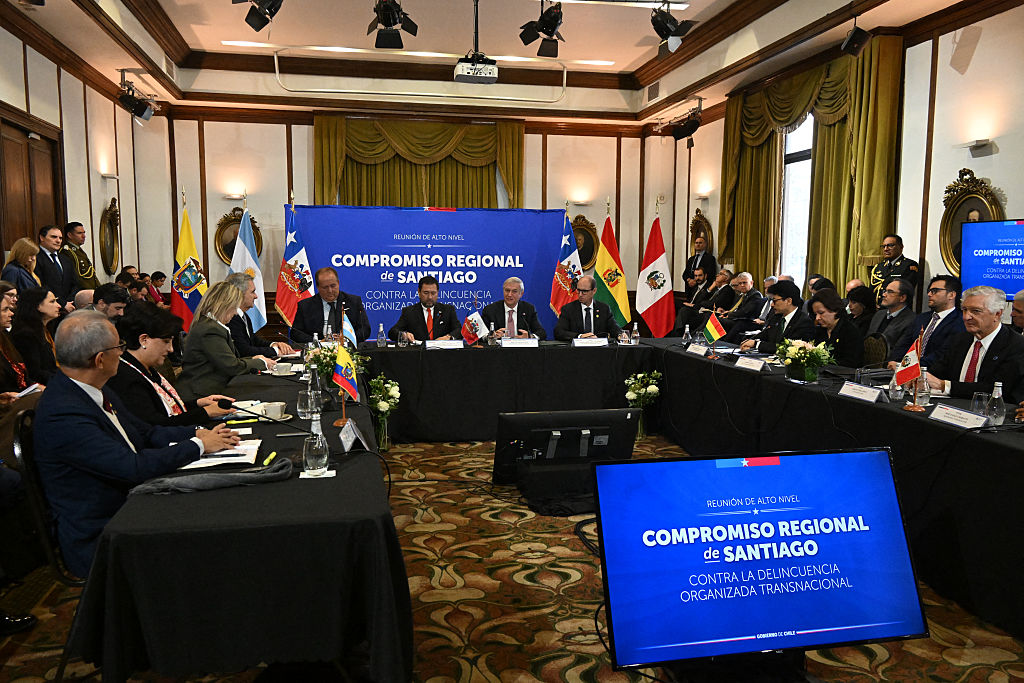
“People’s perception of insecurity increased due to the actions of these transnational organized crime groups,” said Pilar Lizana, a security specialist and executive director at Volpe Consulting, a risk analysis firm. In late May, Kast convened representatives from Argentina, Bolivia, Ecuador and Peru to launch the Compromiso de Santiago, a regional alliance against transnational organized crime.
Despite this initiative and the government’s efforts to strengthen police operations, a recent poll found that the perception that crime is more violent than a year ago rose 14 points to 68%. And so far, security concerns seem to be taking a toll on Kast’s approval rating, which fell to 26% in the last week of October, the lowest level since he took office.
A new security reform
After failing to pass his own security reform, Kast backed a new cross-party constitutional security reform last month, seeking to combat organized crime. The new proposal—submitted by two right-wing senators and one senator from the center-left—treats organized crime as an activity contrary to human rights. The legislation also requires high-risk inmates to be held separately and expands presidential powers to declare a state of emergency in case of imminent threats.
“It’s a fairly minimalist reform,” Senator Araya, one of the proposal’s authors, told AQ, and he is optimistic Congress will approve it by year’s end. To pass the bill, Kast’s political coalition will need votes from 29 of Chile’s 50 Senators and then the green light from the lower house, a process that may take place at some point next year.
As Congress continues to debate the new security reform, some are calling for consensus-based solutions. “The security crisis facing our country can no longer withstand further political entrenchment,” Ricardo Yáñez, a retired general director of the police force, wrote in a recent op-ed. “It requires all state institutions to pool their capabilities on the ground,” he argued.
Like many other countries in the region, Chile is confronting an uptick in extortion, orchestrated from prisons. Some analysts attribute this increase to the adoption of more sophisticated methods from other countries. Around 16% of the prisoners in Chile are foreigners, mainly Venezuelans and Colombians.
“They taught the local prison population how to commit crimes from within the walls, such as digital fraud and extortion,” Pedro Aracena, a retired prefect of the Investigations Police and advisor on public security at AthenaLab, a Santiago-based think tank focused on security and defense, told AQ. Visible extreme violence has decreased while other, less reported crimes like digital extortion and kidnappings have increased. “We believe there are between six and 10 kidnappings per week between rival gangs,” Aracena said.
Commitments and solutions
The Kast government’s Compromiso de Santiago to coordinate South American actions on security, financial intelligence, migration and border control has since expanded to include Paraguay and Uruguay.
Amid growing discontent over public security, in September Chile joined the Shield of the Americas, President Donald Trump’s initiative to counter drug cartels, irregular migration, and foreign adversaries in the Western Hemisphere. Chile has yet to decide whether to join the Shield’s operational counterpart, the Americas Counter Cartel Coalition (A3C), backed by U.S. Southern Command. According to local press, Defense Minister Fernando Barros favors keeping Chile as an A3C observer for now.
Former Presidents Boric and Michelle Bachelet have criticized Chile’s participation in Trump’s initiative and have urged Kast’s government to reconsider, arguing that the concept of “continental sovereignty” could weaken Chile’s national sovereignty.
With all the pieces set in motion, Kast still has over three years to deliver on security, and the path to success is not only complex but riddled with imponderables beyond local politics. It seems that whether he succeeds in tackling crime may well affect not only domestic politics but also Chile’s relationship with the United States.
ABOUT THE AUTHOR

Graciela Ibáñez
Reading Time: 4 minutesIbáñez is a Chilean journalist covering the politics, economics and cultures of Latin America