



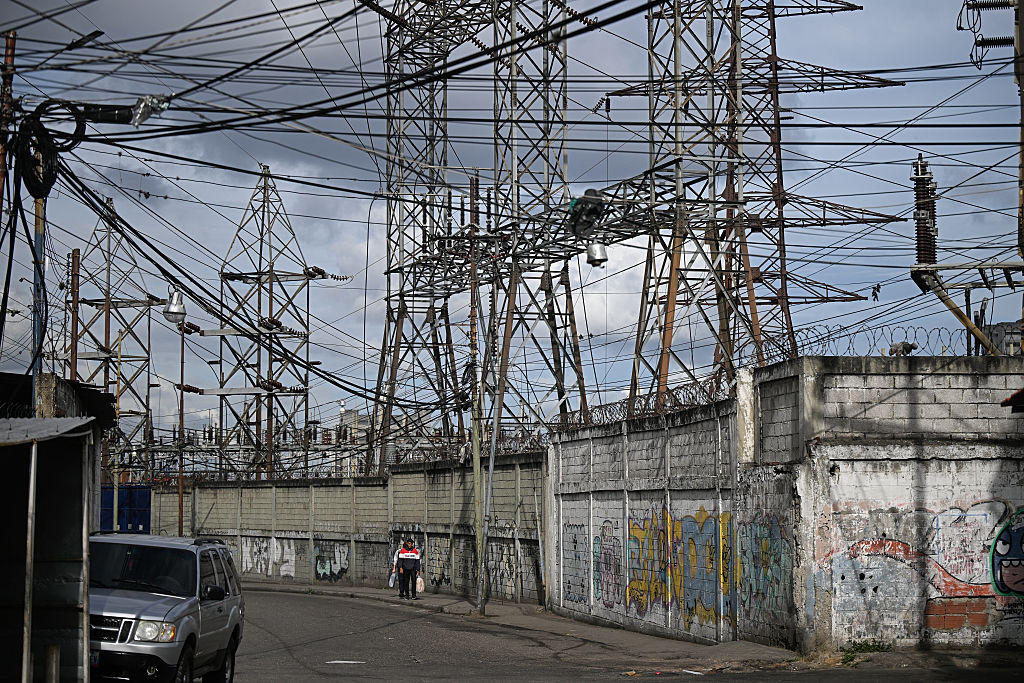
Venezuela is enduring its most intense wave of blackouts since 2019, and the timing could not be worse for a country attempting a full-scale economic recovery. Acting President Delcy Rodríguez has called for water and electricity rationing amid rising social tensions over the outages.
In an Americas Quarterly article in February, we argued that Venezuela’s electricity system had to be reinvented rather than simply repaired. That diagnosis has only become more urgent after the devastating twin earthquakes in June and the growing risk of a severe El Niño, which could wreak havoc on feeble hydroelectric generation mostly coming from the south of the country.
While Venezuelans from non-major urban centers have been suffering from constant blackouts for years, the problem is metastasizing to all of the country. Anecdotal evidence points to daily five- to seven-hour blackouts in key cities, such as Valencia—the country’s once-thriving manufacturing hub—and nearby Maracay. Large parts of the Andean and Western regions are also repeatedly affected by inconsistent thermoelectric plant operations; citizens are voicing their discontent in massive protests, and companies reported an average of 57 unplanned outages, five a week, in the second quarter of the year. Meanwhile, oil companies seeking to expand operations will need to supply their own electricity for related projects, given the poor state of the generation and the distribution network.
Executing two critical decisions postponed by the earthquakes will be key to overhauling a system on the brink. This includes signing a final contract with GE Vernova to repair existing power infrastructure and fast-tracking rehabilitation of thermal capacity to serve as backup. Second, and equally urgent, is scheduling a final vote on the bill to reform the electricity sector and open it to private investment.
Contracts with major power suppliers
Engaging foreign companies such as GE Vernova and Siemens Energy to repair existing infrastructure is a critical step toward stabilizing the system. However, addressing past arrears and securing future payments have been sticking points in moving forward with greater celerity.
Earlier this year, the state-owned Corpoelec and GE Vernova signed a memorandum of understanding (MOU) to repair, modernize, and stabilize the electricity system. The goal is to restore roughly 1,000 megawatts of generating capacity within 24 months and more than 5,000 megawatts over four to five years. GE Vernova CEO Scott Strazik recently suggested the partnership would include rehabilitating the 11 gigawatts of installed capacity GE already has in the country.
This is an important first step to address Corpoelec’s decaying power infrastructure, given the ample scope to restore transmission and substation networks, improve grid reliability, and reduce widespread outages.
The other tangible agreement is with the U.S.-Argentine company IMPSA, which recently signed a power generation-related accord with Corpoelec to rehabilitate and complete two hydroelectric projects, Tocoma and Macagua, in the state of Bolívar. IMPSA’s initial target is to restore 672 megawatts of generation capacity within 24 months.
El Niño: the next major stress test
According to recent estimates, there is a 90 % chance of a very strong El Niño from October to December this year. Venezuela is especially exposed because hydroelectricity accounts for 90% of the country’s power supply and its thermal fleet is unavailable or unreliable. GE Vernova seeks to help address this situation.
Drought conditions could affect water pumping, agriculture, and fuel logistics, worsening conditions for average citizens and compounding social and political tensions. Moreover, under this worst-case El Niño scenario, oil production, particularly on the eastern side of the country, which is more reliant on the grid, could be affected. This is one of the main reasons the new oil regulations require all new oil production to procure its own power.
At the same time, adding new thermal capacity for oil production could be difficult, given up to 5-year backlogs for natural gas turbines, in part due to the U.S. data center build-out.
The electricity reform: advantages and drawbacks
The electricity reform under discussion opens the door to private participation at all levels of the value chain and incentivizes new self-generation. This can help in the short term. Solar PV (photovoltaic), gas-fired generation, biomass, and hybrid solutions with Battery Energy Storage systems (assets that store electricity and release it when required, enhancing system flexibility and resilience) can all play a role depending on the sector, location, and availability of equipment.
If large consumers can cover part of their demand via self-generation during peak hours, the public grid gains breathing room. It also opens the door for the private sector to provide power services to support oil operations, food processing, health services, and logistics hubs. Particularly important for businesses and households is the provision that projects with less than 2 MW of generation capacity can proceed without a government permit.
In addition to self-generation, the law opens the sector to private participation in generation, transmission, and distribution through single and joint companies with the state, introducing concessions of up to 25 years, with possible extensions. With this, the government is trying to create a legal channel for private investment after years of state monopoly.
However, the proposed legal reforms contain problematic provisions for private investors. First, the concessions revert to the state at the end of the license. While not uncommon in Latin America, this build-operate-and-transfer scheme might be less attractive in Venezuela, given uncertainty about how the state will provide final compensation and the significant discretion over the causes for concession cancellation.
Second, the proposed changes also allow for significant government oversight of private-sector operations and discretion over penalties and fines. The bill imposes civil and even criminal liabilities on executives and directors for a myriad of issues, a problem in a country with serious rule-of-law deficiencies.
The law will only jumpstart investments if it is accompanied by bankable contracts, transparent project selection, cost-reflective tariffs, payment security, credible dispute-resolution mechanisms, and significant improvements in the rule of law. Support from multilaterals will be key to making all of this happen. The private sector should have incentives to invest with confidence in a system-wide recovery plan. Without these conditions, private capital may flow only to self-generation opportunities, leading to suboptimal solutions.
Venezuela’s electricity sector now faces four simultaneous challenges: converting memoranda into funded contracts, repairing earthquake-exposed infrastructure, finalizing a legal framework to attract private-sector investment while strengthening the grid, and preparing for a climate shock that could reduce hydropower availability. Any one of these would be difficult. Together, they make electricity the central test of the country’s capacity to recover.
ABOUT THE AUTHORS

Francisco Morandi
Reading Time: 4 minutesMorandi is an energy strategist with prior leadership roles at AES Corporation, including strategic planning for AES Electricidad de Caracas.

Luisa Palacios
Reading Time: 4 minutesPalacios is an Adjunct Senior Research Scholar at Columbia University’s Center on Global Energy Policy, Adjunct Faculty at Columbia’s School of International and Public Affairs, former Chairwoman of Citgo Petroleum, and a member of AQ‘s editorial board.
Reinventing Venezuela’s Struggling Electricity Sector
Having enough electricity is key to the nation’s post-Maduro recovery. Two experts offer a way forward.
Venezuela’s Shattered Post-Quakes Economy
The twin earthquakes are reshaping the economic outlook and upping pressure for new political agreements, two experts write.