


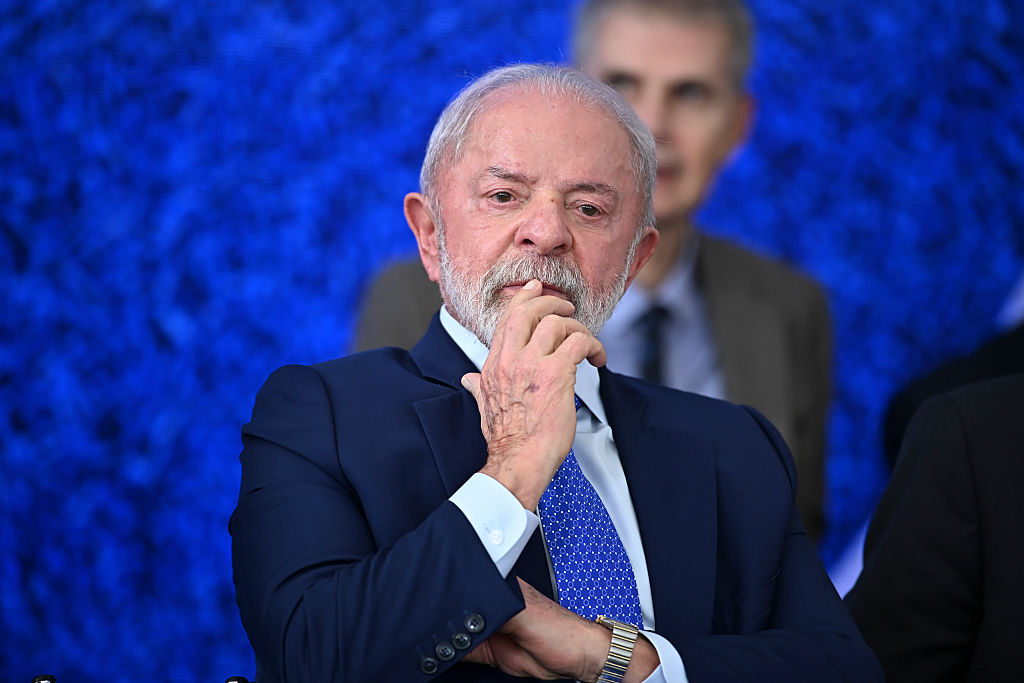
RIO DE JANEIRO—As recently as six weeks ago, President Luiz Inácio Lula da Silva seemed to be cruising to reelection. Unemployment was at record lows; the stock market at record highs; inflation had closed 2025 at its lowest level in seven years. Lula’s archrival, former President Jair Bolsonaro, was in prison—and had just chosen Flávio, widely seen as the least charismatic of his four sons, to be his preferred candidate in October’s vote. “We know it won’t be easy,” a Lula adviser told me, “but the wind is at our backs.”
Today, there is nary a breeze. A Datafolha survey published Sunday showed Lula with just a three percentage point lead in a hypothetical runoff against Flávio Bolsonaro, down from a 15-point advantage in December. Other polls have shown similar dynamics. The tightening is in some ways a return to familiar battle lines; after all, Lula won the 2022 election by just a 51%-49% margin. But there are signs that the Lula of 2026 is struggling to connect with voters, and could be at genuine risk.
Part of the problem, as others have noted, may be Lula’s age. He will be 80 on Election Day and running for president for the seventh time since 1989—giving Lula more sequels than Rocky. While he seems to be in better physical and mental shape than a certain former U.S. president, age can manifest itself in other ways: Lula proudly does not carry a cell phone. In a country with some of the world’s highest rates of social media use (an incredible 3 hours and 37 minutes a day, according to one study), Lula’s Instagram following is still only half the size of Jair Bolsonaro’s. On Sunday evening, the latest “reel” on Lula’s account was a 6-minute video—an eternity, and a sign of an operation not fully adapted to the digital era.
The eruption of a major scandal involving Banco Master, a small bank with extensive ties throughout the Brazilian political and business establishment, has also taken a toll. While Lula himself has not been implicated, the case has revived memories of the mensalão and Car Wash scandals that plagued his Workers’ Party in the 2010s, and put Lula in jail for almost two years before his conviction was overturned. Many expect the barrage of revelations to continue as the campaign heats up, with uncertain consequences.
There are other, deeper factors at work as well. A recent book by pollster Felipe Nunes, Brasil no espelho (“Brazil in the Mirror”), shows the degree to which Brazil, like much of Latin America today, seems to be shifting right. The book, based on a nationwide survey of nearly 10,000 Brazilians by Nunes’ firm Quaest, illustrates with data why the Bolsonaros’ slogan of “God, country and family” seems better attuned to the zeitgeist with each passing year.
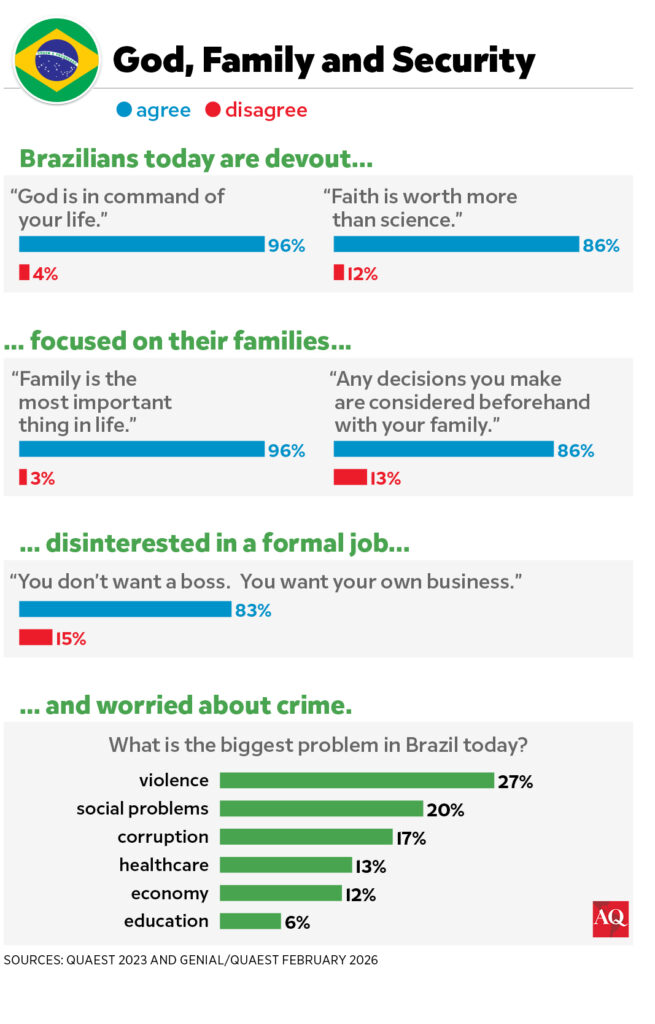
It’s true that Brazil has always been more conservative than its international image of samba and bikinis suggested, and Lula managed to win three elections anyway. But Nunes charts how public attitudes have now reversed a progressive shift seen in the 2000s and 2010s, returning more or less to where they were in the mid-1990s. One major underlying cause is the continued spread of Evangelical Christianity, from 7% of the population four decades ago to some 30% today. As Nunes notes, many recent converts live in the working-class periferias of major cities, transforming areas that used to be Lula strongholds into some of the Bolsonaros’ most fervent pockets of support.
The book captures two other important shifts. The first is the rise of crime as the leading concern of Brazilian voters, an issue where Lula has struggled, saying last October, for example, that drug dealers are “victims of drug users.” The second, less publicized change is the extent to which today’s Brazilians would rather be self-employed than have a salaried job. This is a major shift from the Brazil I first got to know 25 years ago, where a carteira assinada—a signed booklet proving one had formal employment—was the maximum aspiration of many Brazilians, a sign of not just economic stability but social status. The evolution toward independent work appears to be fundamentally changing what many voters want from their government—less a benefactor than a guarantor of basic security and stability, an “every man for himself” mentality that Lula’s Workers’ Party, with its roots in the trade union movement of the 1980s, is still trying to fully understand.
In light of these changes, Flávio Bolsonaro may be a better candidate than Brazil’s establishment originally believed. Flávio, a senator, lacks the high-testosterone, attack-dog energy of his father and politically active brothers. Yet his relative blandness may open the door to voters who are broadly in sync with the family’s conservative social and economic agenda, but were put off by the divisive rhetoric and mismanagement of the pandemic and other issues under Jair, and swung the 2022 election to Lula. Flávio’s biggest vulnerability, related to alleged money laundering and misdirection of salaries in his congressional office in the 2010s, now seems to pale in comparison to the Banco Master scandal. (Flávio has denied any wrongdoing.)
Those close to Lula preach calm. The president’s job performance approval has been stable, at about 47% in the latest Datafolha poll. Advisers believe that, if they can make the campaign primarily about the economy, as opposed to crime or corruption, their candidate will win. Indeed, real wages have increased by almost a fifth during Lula’s term, and new subsidies on natural gas and a tax break for working-class Brazilians will enter into effect just in time for the campaign. But the war in the Middle East is now one of several question marks. Indeed, the most likely scenario is a close race, where a single surprise development at home or abroad could swing the outcome. That will feel familiar to many Brazilians—but it is not the 2026 Lula and his team originally expected.
ABOUT THE AUTHOR

Brian Winter
Reading Time: 4 minutesWinter is the editor-in-chief of Americas Quarterly and a seasoned analyst of Latin American politics, with more than 25 years following the region’s ups and downs.