





This article is adapted from AQ’s special report
BUENOS AIRES—For more than 15 years, Satellogic has been working to fulfill its foundational promise: democratizing access to high-resolution satellite imagery by offering data at significantly lower costs than traditional competitors.
While legacy rivals limit satellite Earth observation imagery to wealthy governments and large corporations, Satellogic is betting that lower costs can become not only a commercial but also a geopolitical differentiator, via its growing network of satellites that monitor hundreds of sites worldwide each day.
The company, founded in 2010 in Buenos Aires and Nasdaq-listed (SATL), announced in May an $18 million contract to provide strategic defense monitoring to a new undisclosed client. The deal was more than a commercial milestone. For some, it signaled that Latin America’s space ambitions have moved beyond symbolism.
“Satellogic is the incarnation of the new space’s logic,” Lucas Arias Coco, a researcher at the AI & Robotics Group (GIAR) of the National Technological University in Buenos Aires, told AQ.
The company’s services span precision agriculture, environmental management, and defense. It also offers turnkey satellite systems to sovereign clients, giving smaller nations a faster path to technological independence in Earth observation. Satellogic, now headquartered in Davison, North Carolina, has been expanding its customer base and, in the first quarter of the year, signed deals in Australia, Malaysia, Albania, and Portugal, as revenue grew 80% year over year to $6.1 million.
“Defense and intelligence organizations are the primary drivers of demand because they understand that persistent intelligence is becoming a strategic capability,” Alan Kharsansky, Satellogic’s chief technology officer, told AQ. “Our view is that the market is evolving beyond Earth observation. Customers don’t wake up wanting satellite imagery. They want to understand what’s happening in the places that matter to them,” he added. The company plans to launch its AI-driven Merlin constellation in October and have it fully operational in the first quarter of 2027.
ABOUT THE AUTHOR

Horacio Aizpeolea
Reading Time: 2 minutesAizpeolea is a journalist based in Buenos Aires.

Argentina’s Global Satellite Aspirations
The national space agency’s satellite program is a rare example of sustained strategic investment.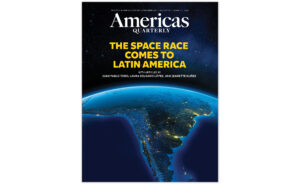
NEW AQ: Latin America Looks to the Stars
The region has a huge opportunity in the booming global space industry. What is necessary to take full advantage?
The Space Race Comes to Latin America
The region wants to be not just a battleground, but a protagonist in the burgeoning space economy.
Latin America’s Quest for Space Sovereignty
The region’s pursuit of autonomy in the growing space sector will be complicated. The U.S. can be an important partner.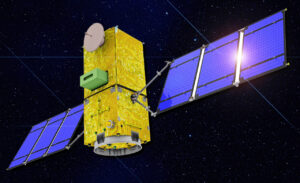
Brazil’s Landmark Satellite Program
Amazônia-1, the first satellite entirely designed and operated by Brazil, is part of a larger mission.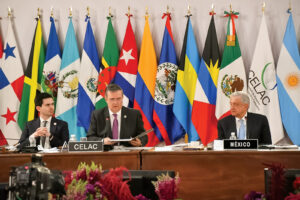
Latin America Has a Space Agency. Now Comes the Hard Part
ALCE held its first general assembly in Mexico in February, but faces questions about funding and political buy-in.
The Crucial Challenge of Building Space Expertise
As Latin America acquires more space technology, workforce development will be key to reaping the benefits.