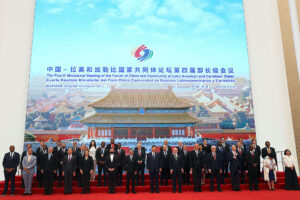



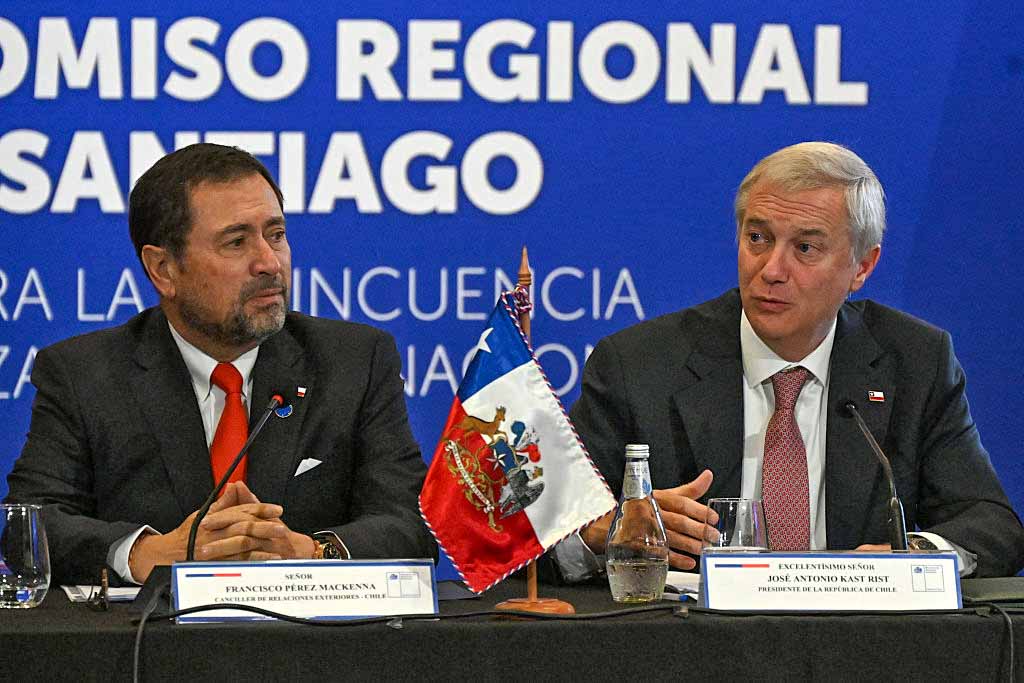
SANTIAGO—Earlier this month, Chile’s Foreign Minister Francisco Pérez Mackenna sent shockwaves through Santiago’s diplomatic circles when describing the country’s relationship with the U.S. “The United States is probably, from a strategic standpoint, our main partner,” the official said in a TV interview. He then quickly added that this “does not mean that China is not a tremendous partner of ours, nor that we shouldn’t seek other alternatives, such as what we have done with India.”
His comments may seem like a diplomatic balancing act, but they also exposed a real and growing tension at the heart of Chilean diplomacy. Days before the interview, on July 6, Pérez Mackenna held his first meeting with his U.S. counterpart, Secretary of State Marco Rubio, to discuss areas of cooperation, including regional security and critical minerals, as the conservative administration of President José Antonio Kast seeks to signal alignment with the West.
But as the new government makes this a priority, it is simultaneously aware that no other Latin American country sends a higher share of its exports to China. The Asian country absorbs 53% of Chile’s copper exports and 70% of its lithium—the two pillars of the country’s economic future. It is a dilemma that no amount of careful wording can paper over.
The meeting between Pérez Mackenna and Rubio took place just weeks after Chile’s government faced pointed pressure from Washington over a proposed transpacific submarine fiber optic cable, a project in which Chinese companies had sought a key role. The episode, like earlier disputes over a satellite ground station and a passport procurement tender, illustrates how quickly decisions that might seem purely economic can acquire geopolitical implications.
Amid heightened global tensions, a smart path forward for Chile is managing ties with the U.S. and China while diversifying its partnerships. Undoubtedly, Chile’s strategic interests are best served by avoiding overreliance on any single country.
A new kind of competition
The U.S.-China rivalry has entered a more transactional, sectoral phase—a contest for control over supply chains, critical technologies, and the infrastructure that will define the 21st-century economy. Latin America, once a peripheral concern, is now a key arena for this competition. As a result, countries holding strategic assets—critical minerals, ports, digital infrastructure—have more global influence. Some analysts now call them “geopolitical swing states.” Chile fits this description, and its challenge is to reap the benefits without alienating either of the great powers.
Washington’s approach under President Donald Trump has depended more on pressure than persuasion: tariffs, sanctions, and explicit demands for alignment. Chile has not been immune. In February, the U.S. alleged that the proposed Hong Kong-Valparaíso submarine cable undermined regional security, and announced visa restrictions on three members of the outgoing Gabriel Boric administration. These events underscore that the U.S. is willing to apply leverage even with partners it considers friendly.
China, meanwhile, has moved into a more selective and strategic phase. The era of large-scale lending and infrastructure projects is giving way to targeted investment in sectors such as lithium processing and high-tech goods.
Leverage, not just vulnerability
Chile’s position is often described in terms of its vulnerabilities, seen as too dependent on China and too exposed to U.S. pressure. Dependence, however, works both ways. Chile exports critical minerals to China, but much of that material is processed there and then sold to third markets, including Japan. China needs both these commodities at a time when global supply is tightening. Australia serves as a useful precedent: During a trade war in 2020, China never stopped buying Australian iron ore.
The U.S. and Western allies, for their part, urgently need copper and lithium to sustain their energy transitions. Chile holds the world’s largest lithium reserves and is the second-largest copper producer. This is not a weakness, but rather a structural advantage, provided Chile knows how to use it.
The new geopolitics of critical minerals means that Chile’s position gives it real negotiating power. The question is whether Santiago has the institutional capacity and strategic clarity to convert that power into better investment conditions, technology transfer, and value-added processing, rather than simply exporting raw materials to whoever applies the most pressure.
Building institutional resilience
Chile built its international reputation on openness, institutional stability, and predictability. That capital remains valuable, but it is no longer sufficient as a standalone strategy.
There is an increasing consensus among Chilean policymakers that the country needs an investment screening mechanism—clear, bounded, and transparent—that allows the state to review investments in genuinely strategic sectors, without becoming a tool for political discretion or deterring the foreign capital the country still needs. Several of Chile’s peers in Europe and Asia have adopted such frameworks. The risk of inaction is real. A state that adjusts criteria under external pressure introduces uncertainty and undermines long-term credibility.
Opportunity lies, then, precisely in what Pérez Mackenna signaled after meeting Rubio: positioning Chile as a reliable Western partner while maintaining the Asian ties that underpin its economy. The risk is overplaying ideological alignment with Washington, narrowing Chile’s room for maneuver with Beijing in ways that serve neither its economy nor its strategic interests.
The smarter path is diversification: new partnerships in the Gulf, deeper trade ties with India (a negotiation already underway), stronger links with ASEAN economies. The goal is not to replace China or the U.S., but to ensure that no single relationship becomes the source of undue leverage over Chilean decisions.
Chile’s longstanding soft power remains in place. But in today’s world, Chile also holds hard assets that others want. Learning to deploy both is the balancing act facing Chilean foreign policy. Chile cannot fully choose sides and should not try. In a more fragmented and competitive international landscape, the challenge is not to pick dependency, but to build the institutional capacity and strategic clarity to manage it.
ABOUT THE AUTHOR
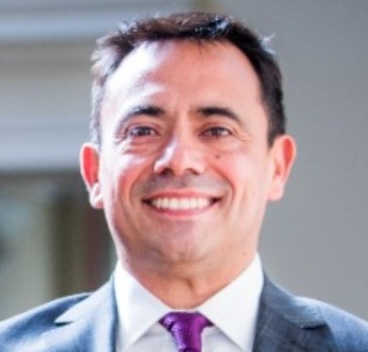
Andrés Villar
Reading Time: 4 minutesVillar is a senior fellow at the Catholic University of Chile’s Center for International Studies and an international consultant at Andes Risk Group. He is a former director of strategic planning at the Chilean Ministry of Foreign Affairs.
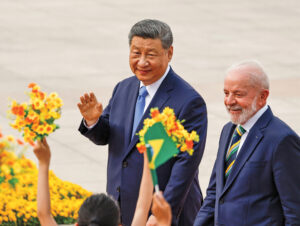
China’s New Playbook for Latin America
Beijing is shifting from an era of large loans and infrastructure initiatives toward more targeted, strategic engagement.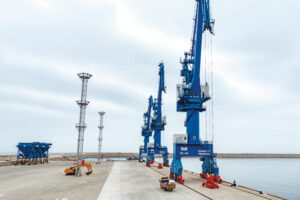
How Latin America Is Realigning
As Washington and Beijing vie for great-power influence, the region’s leaders are making moves that are often subtle.