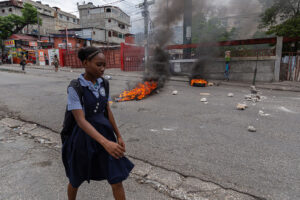



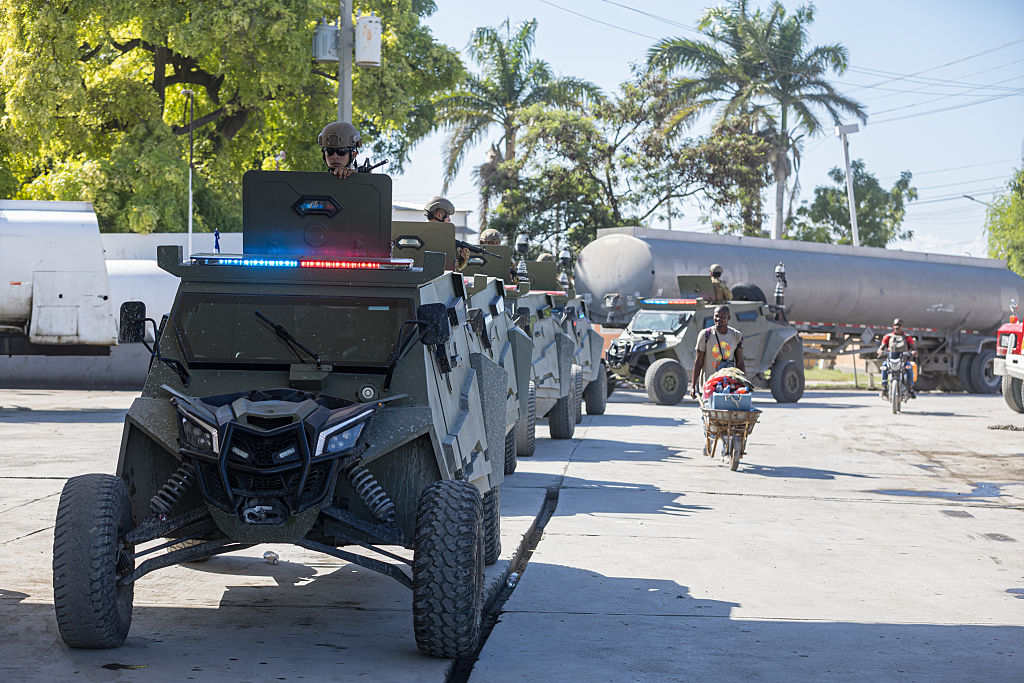
Haiti’s protracted political and security crisis may be entering a more dangerous phase. After El Salvador deployed more than 2,000 troops to Haiti following the disappearance of four Salvadoran military aviation technicians on Oct. 18, one of the nation’s most notorious gang leaders appealed to the United Nations for dialogue, raising questions about whether criminal groups are seeking a way out of the conflict—or simply stalling for time to regroup.
Days ago, Wilson Joseph, the leader of the gang known as 400 Mawozo, asked UN Secretary-General António Guterres to send a delegation for dialogue and mediation. The UN confirmed receiving the unusual letter, stressing that receipt implied neither recognition nor endorsement. The missive warns that President Nayib Bukele’s “vengeful remarks, expectations, and threats” could lead to “a logic of reprisals, of which the Haitian people would be the first victims.” The gang had issued a similar appeal in August, and an earlier truce reportedly lasted only days.
The letter calls for dialogue in the Plaine du Cul-de-Sac, where the four Salvadoran military aviation technicians serving with the UN-backed Gang Suppression Force (GSF) went missing in an ambush. Joseph denies responsibility and has claimed, without evidence, that the technicians are dead, pointing to Chen Mechan, another gang that reportedly controls the area where the incident took place. While El Salvador believes the technicians are alive, Haiti says they were abducted.
Until now, Joseph, better known as Lanmò Sanjou, has expressed willingness to lay down arms but has offered no details about the conditions he would demand in return. The timing of his appeal is significant. The letter, dated Nov. 1, became public the next day, as Salvadoran troops joined Haitian police and the GSF in an operation in the Cul-de-Sac plain. The offer of dialogue could help Joseph and his gang buy time, allow armed groups to reposition, and portray Bukele as the aggressor, but how will this new scenario play out as the country finally prepares to hold a general election next year?
The risk of rewarding violence
Joseph is under UN, U.S., EU, British, and Canadian sanctions and faces U.S. hostage-taking charges, with a reward of up to $1 million offered for him. The UN Panel of Experts on Haiti has documented how the country’s gangs rely on political, economic, and security actors who profit from criminal exploitation at Haiti’s expense. Unconditional talks would reward that system and deepen impunity for killings, kidnappings and sexual violence.
The letter calls 400 Mawozo a “rebel group” and stresses the protection of civilians, “particularly children.” His UN sanctions listing cites child recruitment. Joseph has also said that “Haitian politicians are the father of the gangs.” The letter seeks a dialogue between “the international forces present in Haiti” and the gang, bypassing the Haitian state. Treating it as a party to a peace process risks recasting a criminal enterprise as an armed movement with a political vision.
That danger is greater because Haiti has entered an electoral cycle, with a first round set for July 18, 2027. Canada has voiced concern that sanctioned individuals are seeking office, and the EU has linked sanctionsto the integrity of the electoral process. This points to weak national ownership of the sanctions regime and to the absence of a functioning criminal justice system. Turning gang leaders into negotiating partners could give them, and their backers, standing during the elections.
A fragile security architecture
Today, five security actors operate in and around Port-au-Prince. They include the Haitian National Police, the national Armed Forces, the GSF, a drone task force supported by Vectus Global, and now the Salvadoran contingent, whose presence will complicate coordination among security forces.
Haitian officials have welcomed the deployment as cooperation “within the framework” of the GSF, but the Salvadoran command arrangements remain unclear. The UN has confirmed that the vast majority of the additional Salvadoran troops are not deployed under the GSF and fall outside the UN Support Office’s mandate and reporting. Haitian authorities have reportedly approved the deployment, but its legal terms are not public. Are the reinforcements supporting the GSF, or assuming its mandated tasks under a separate command, with different safeguards and lines of accountability? Joint operations without a published legal framework, a clear chain of command, or defined lines of accountability could further fragment Haiti’s international security response.
Without a clear timetable, a prolonged Salvadoran deployment could raise questions about its neutrality during the electoral period. Civilian casualties or displacement would make it the focus of criticism and weaken the security architecture. Vectus Global already faces such scrutiny. The private security firm, founded by Erik Prince of Blackwater, supports a drone task force overseen by the Haitian prime minister’s office. Strikes attributed to the task force have already raised concerns about civilian casualties.
A Salvadoran operation that goes wrong could hand skeptical Security Council members an argument against renewing the GSF, and Haiti could lose what remains of its multilateral framework. The GSF’s mandate was renewed until March 31 of next year, and Russia and China sought a three-month extensionand an independent strategic review, then abstained from the resolution, along with Pakistan. The UN hasstressed that transparency and accountability remain essential to maintaining international support, and the UN political mission in Haiti—BINUH—is up for renewal in January, heightening concerns about El Salvador’s presence in the country.
Testing the offer
A credible test of the overture would begin with a verified halt to attacks on civilians before any formal negotiation. Further benchmarks, defined in advance, would include hostages returned or accounted for, roads reopened and held, humanitarian access restored and children released into reintegration programs. Any dialogue must exclude a political role for sanctioned leaders. 400 Mawozo belongs to Viv Ansanm, which the U.S. has designated as a Foreign Terrorist Organization. That designation does not, by itself, prevent the UN from engaging with the group.
Applying these benchmarks requires a published legal framework that defines the Salvadoran deployment’s mandate, duration, status, and relationship with the GSF; a coordination mechanism among the forces present; and a Haitian political settlement that anchors security operations and any dialogue. The letter may be a tactic. How Haiti’s partners respond will reveal what they are trying to achieve and who will be accountable for their decisions.
ABOUT THE AUTHOR
Philippe de Bard
Reading Time: 4 minutesDe Bard is an independent adviser on democratic governance, elections and stabilization, with more than 25 years of experience with the UN, EU and OAS in Haiti, the DRC, Afghanistan and other fragile states.
Can the Donroe Doctrine Help Deliver Stability in Haiti?
Getting it right in Haiti is good policy and politics for the Trump administration.
Haiti’s Political Crisis Deepens Amid a Slide Into Criminal Governance
Confrontation on the Transitional Presidential Council is not only about leadership, but about whether a future transition can reduce the influence of armed groups.
Ending Haiti’s Criminal Governance Crisis
The country needs a coherent political and sustainable financing strategy. A multilateral summit could bring all the parties to the table, an expert writes.