


The death of Nemesio “El Mencho” Oseguera is many things: A product of greater Mexico-U.S. cooperation, a motive for a potential truce between Donald Trump and Claudia Sheinbaum, and the most consequential operation against organized crime in years. But above all, it will be a test of Mexico’s comparatively small state — and whether it has the resources and skill to prevent yet another spiral of nationwide violence in the weeks ahead.
The Mexican military operation that resulted in Oseguera’s death was only the latest decisive action against the Cártel Jalisco Nueva Generación (CJNG), one of Washington’s top security targets and one of the criminal groups designated as a Foreign Terrorist Organization (FTO) by the U.S. Department of State. Just two days earlier, Mexican forces had captured the CJNG’s head of recruitment and training. In recent months, Mexican and U.S. authorities also imposed financial restrictions on institutions facilitating money laundering and arrested key financial operators tied to the organization. Mexican authorities also detained other senior figures—what the Sheinbaum administration calls “generators of violence”—who were central to the group’s operations.
Oseguera’s death cannot be understood outside the broader context of Mexico-U.S. relations. The Trump administration’s maximum-pressure strategy—which has included threats of unilateral military action inside Mexican territory—has pushed Mexico to align its security policy more closely with Washington’s priorities. That alignment has translated into a marked intensification of bilateral cooperation and intelligence sharing. In this context, the Joint Interagency Task Force–Counter Cartel, involving multiple U.S. agencies, was formally launched in early 2026 to map cartel networks on both sides of the border. According to Reuters, the task force played a crucial role in the intelligence work that led to El Mencho’s killing.
Mexican military and civilian officials acknowledged that the operation was conducted in coordination with U.S. agencies, while carefully emphasizing that no American personnel directly participated in the military action. U.S. officials congratulated Mexico and confirmed that account.
In other words, the operation provides President Sheinbaum with valuable breathing room in Washington at a particularly delicate moment in the bilateral relationship, marked by heightened political pressures and the looming revision of the USMCA. Oseguera’s death strengthens her standing in the White House and among Republican lawmakers, who have repeatedly framed Latin American and Mexican cartels as “narco-terrorist” organizations responsible for the fentanyl crisis in the United States.
Domestically, the operation also delivers a political boost. El Mencho had evaded capture for over a decade, and previous attempts to arrest him ended in severe violence and costly setbacks for Mexican security forces. Meanwhile, the CJNG built its power through systematic extortion schemes and “criminal taxation” across local economies, becoming one of the most feared organizations in the country. Unsurprisingly, major national media outlets and prominent political figures across party lines praised the government’s action.
Yet despite its immediate political wins at home and abroad for President Sheinbaum, El Mencho’s capture will ultimately test the Mexican state’s structural capacity. Over the weekend, the first signs of that test became evident, as authorities struggled to contain the CJNG’s immediate violent retaliation.
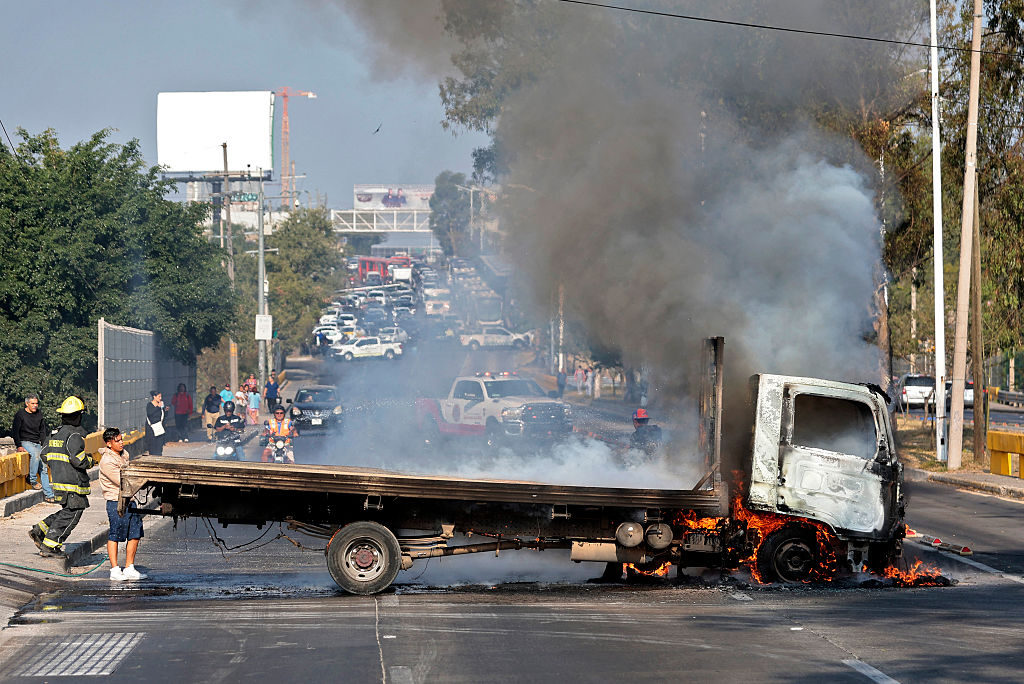
On Sunday, 25 members of Mexico’s National Guard were killed during the operations; 252 criminal roadblocks were reported across the country; Guadalajara—the capital of Jalisco and one of Mexico’s main economic hubs—became virtually a ghost town; stores, gas stations, banks, and businesses were attacked or set on fire in several regions of the country; and multiple states canceled classes on Monday.
Although conditions appeared calmer by Monday morning, the CJNG’s reaction may only be beginning. As security expert Eduardo Guerrero has suggested, the organization is likely to behave like a “wounded beast,” fighting brutally for survival. Experience shows that when a criminal organization is decapitated, intra- and inter-cartel conflicts often erupt as rival factions compete for control of routes, markets, and internal command structures. The recent case of Sinaloa—which has remained in sustained turmoil since the capture of El Mayo Zambada—is a stark reminder.
The situation is further complicated by the CJNG’s organizational structure. Unlike criminal groups that depend heavily on a single charismatic leader to vertically integrate authority, the CJNG appears more institutionalized and regionally entrenched. It operates through a semi-federalized system of regional “franchises,” in which local commanders retain significant operational and financial autonomy while remaining aligned with a central command. This raises serious questions about how deeply the organization has actually been weakened by El Mencho’s death.
In this context, two broad scenarios emerge, both deeply challenging for the Mexican state. One is continuity: the CJNG keeps operating under its decentralized model, in which case El Mencho’s death would represent more a symbolic and political victory than a structural dismantling.
The other is fragmentation: intensified intra- and inter-cartel disputes generating localized explosions of violence as factions compete for territory and markets. Such a scenario would resemble the 2007–2011 period, one of the most violent chapters in Mexico’s recent history, when President Felipe Calderón launched a militarized “war on drugs” centered on a decapitation strategy that triggered cascading regional conflicts among fractured criminal organizations, rival cartels, and state forces.
In either scenario, whether this episode is remembered as a decisive step toward reducing violence or as the beginning of a “second war on drugs” will depend on the Mexican state’s ability to contain the CJNG’s retaliation and prevent other criminal groups from seizing territories and markets previously under its control.
That capacity, however, is severely constrained by Mexico’s structural weaknesses, among them chronically low taxation. Mexico’s tax collection as a percentage of GDP is among the lowest in Latin America, and just half the average of the Organization for Economic Cooperation and Development (OECD), a group of mostly developed nations of which Mexico is a member. That leaves the government perennially short of resources as it battles cartels that are, in contrast, flush with cash after global cocaine production more than tripled over the past decade, allowing them to acquire mercenary soldiers and even build their own tanks.
Other challenges include entrenched corruption, the deep entanglement of organized crime with local political and economic elites, and a security alignment with Washington that does not always coincide with Mexico’s own priorities. (For instance, for the U.S. the priority is tackling fentanyl networks, while for Mexico the priority should be lowering the levels of violence, homicides, disappearances, and extortion; for Washington, “collateral damage” is bearable, while for Mexico it represents physical, economic, and psychological damage for its citizens).
As an academic colleague based in Guadalajara told me: “From here, this does not feel like a victory. Schools are closed. The city is paralyzed. My parents are over 70 and cannot even go out to get their medicine. People are afraid, and the state seems incapable of protecting them. While analysts in Mexico City and Washington celebrate a blow to the cartels, ordinary people here are paying the price.”
Whether Oseguera’s death marks a turning point or the beginning of another cycle of fragmentation and violence will ultimately depend not on headlines in Washington or Mexico City, but on the Mexican state’s ability to protect its own citizens in all the regions of the country.
ABOUT THE AUTHOR

Jacques Coste
Reading Time: 4 minutesCoste is a columnist at Expansión Política and author of Derechos humanos y política en México (2022).
Washington’s Sharpening Stance on Mexico
As the U.S. reclassifies Mexican cartels as a national security threat, pressure on Mexico is intensifying—and the margin for miscalculation is narrowing.
The Security Crisis Testing Mexico’s Sheinbaum
Recent killings in Michoacán are pressing the government to redefine its security strategy.