




This article is adapted from AQ’s special report on Mexico’s path forward
From the 1960s through the 1990s, Latin America was the world’s regional outlier in the frequency and severity of inflationary, currency, debt, and banking crises. Over the past three decades, however, and despite some notable exceptions, most Latin American governments have adopted increasingly responsible, and thus sustainable, fiscal and monetary policies, featuring more independent, inflation-focused central banks that allow exchange rates to be largely market-determined.
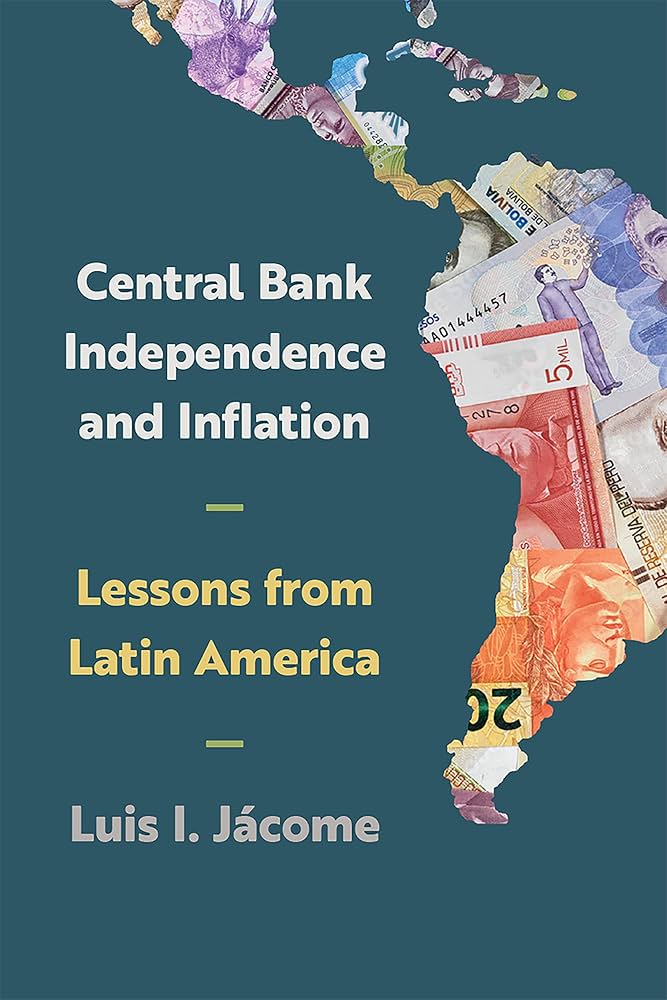
For more than two decades, Luis I. Jácome has tracked and analyzed the evolution of central banking in Latin America to distill lessons from recent institutional advances and policy experience. Several of his more than 20 published articles have become required reading for those interested in the topic, and Jácome has also shared his findings through numerous technical assistance missions to central banks around the world as part of his responsibilities at the International Monetary Fund’s Central Banking Division between 1999 and 2017. Now an independent consultant, Jácome has distilled his central banking research and advisory expertise into a book titled Central Bank Independence and Inflation, which offers a highly analytical, historically grounded review backed by useful tables, charts, and econometric results.
Jácome’s main message is that granting central banks political independence while mandating them to decelerate inflation and keep it low “is arguably the most significant economic reform of our time.”
He makes his case in two ways. First, by recounting the increasingly deleterious conduct of most Latin American central banks in the aftermath of the end of either the gold standard (mid-1930s) or the U.S. dollar standard (early 1970s). Both these international regimes had imposed printing-press discipline on Latin American central banks—rigid during the former and looser restraint during the latter—but once currencies were allowed to devalue, reflecting deteriorated national priorities and conditions, most central banks lost their way.
As interventionist, demand-boosting, and income-redistributing government policies became popular in the 1950s and thereafter, central banks were increasingly mandated or pressured into becoming de facto development banks, channeling bank credit at often concessional interest rates to smokestack industries and other strategic, import-substituting projects. Worst of all, they were allowed and sometimes forced to fund the government’s operating deficits resulting from ambitious spending and subsidy initiatives aggravated by unprofitable state-owned enterprises. The resulting excess monetary growth inevitably would lead to periodic and painful financial crises.
Second, Jácome presents a sophisticated index of central bank independence and proper mission focus going back to the founding of each central bank and pairs it up with inflation data for each country to demonstrate that there is a statistically significant relationship between better central banking and better inflation performance in econometrically static as well as dynamic terms. The main finding is that the extent of central bank underwriting of government deficits best explains the resulting inflation.
What I wish the thoroughly researched book had included is a chapter with memorable accounts of the challenges of attempting to act as an independent central banker in Latin America. Interviews with bold leaders like Argentina’s Martín Redrado, Brazil’s Arminio Fraga, Peru’s Julio Velarde, and Venezuela’s Ruth de Krivoy would have added good color to the sometimes tedious historical recounting and number-crunching.
Jácome has shared his riveting personal story, but elsewhere, via the Yale Program on Financial Stability (YPFS) in 2023. Appointed in September 1998 as the first head of a constitutionally independent Banco Central del Ecuador (BCE), he resigned six months later. President Jamil Mahuad not only refused to respect the BCE’s autonomy but took counterproductive measures to deal with a developing banking crisis—measures which ended up plunging Ecuador into a full-blown financial meltdown. As his own experience suggests, even when a Latin American central bank’s independence is constitutionally protected, that does not mean that it will be impervious to political pressures.
ABOUT THE AUTHOR

Arturo C. Porzecanski
Reading Time: 3 minutesPorzecanski is Research Fellow at American University’s Center for Latin American & Latino Studies, and until its disbandment Global Fellow of the Woodrow Wilson International Center for Scholars. During 2005-2021, he was a professor of international economics at American University and before that he worked on Wall Street for nearly three decades, starting as an international economist at JP Morgan (1977-89) and ending as chief emerging-markets economist with ABN Amro (2000-05).

The Hidden History of São Paulo’s “Japanese” Neighborhood
A new book shows how Brazil’s biggest city often literally paved over its Black past.
‘The Radical Spanish Empire’ Shows the Power of Paperwork
A new book explores how 16th-century commoners wielded the legal system against their colonizers to surprising effect.