



This article is adapted from AQ’s special report on Mexico’s path forward
After nine years of fighting, ELN commander and co-founder Ricardo Lara Parada had had enough.
In 1973, he fled the ranks of the Ejército de Liberación Nacional rebel group during Operation Anorí, a government offensive that deployed 33,000 troops against roughly 100 guerrilla fighters and killed a third of them. Later, in the 1980s, Lara accepted an offer of amnesty from President Belisario Betancur, renounced armed struggle, and become the first ex-guerrilla commander elected to office as a city councilor in his hometown of Barrancabermeja, Santander.
His peaceful politics seemed to be going well; the party he founded, the Frente Amplio del Magdalena Medio, was making gains at the local level. It had broken with the old Liberal-Conservative duopoly, and won votes by promising to improve schools, roads and public services.
But in 1985, Lara was gunned down outside his home as he returned from a council meeting. Though he believed a vengeful paramilitary right might claim his life, his killers were sent by his former comrades in the ELN.
His last recorded interview, which I discovered in 2017 with my late colleague Marc Chernick and made public earlier this year, gives an unprecedented view into the ELN’s DNA. Lara’s words are not the diatribe of a former commander attempting to justify his past, but a reckoning, delivered slowly and with remorse.
He describes a high command too violently strident to argue with, and waves of rash executions he himself helped to carry out. Lara confessed: “As the years pass and you learn how things really were, you realize many comrades should not have been shot.”
Ultimately, the ELN killed him because he was building an alternative to armed struggle in the group’s own backyard. It comes as no surprise to those who study the group, because throughout its history, the ELN has used violence to crush dissent and moderation.
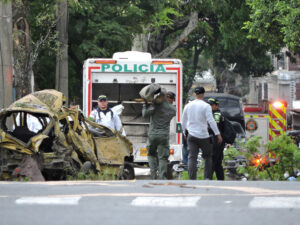
This is a key reason why the ELN has never made peace, why talks brokered by former President Gustavo Petro broke down, and why it is Colombia’s largest remaining rebel group. It is about 6,000 strong, with a presence in an estimated 19 departments in Colombia and at least seven states in Venezuela. As one of the region’s most powerful criminal organizations, it mounts sophisticated attacks with drones and car bombs and is a key factor in Colombia’s deteriorating security landscape.
Colombia’s new president, Abelardo De La Espriella, inaugurated on August 7, has promised to end to all peace talks and undertake a major new military offensive against the ELN. But the ELN’s history also suggests that De La Espriella may find victory elusive, and that the showdown could be a bloody one.
A crucible of violence
The ELN was born in the aftermath of La Violencia, a conflict between Colombia’s Liberal and Conservative Parties that claimed some 200,000 lives from the 1940s to the ‘60s before the two camps agreed to share power. In 1962, some 60 young Colombians, Lara among them, went to Havana on university scholarships funded by Fidel Castro’s new government. Some received military training and returned determined to rebel under the leadership of Fabio Vásquez Castaño.
They chose the department of Santander for its mountains, its oil and its workers’ union. On July 4, 1964, 16 men founded the ELN. Six months later, they took the town of Simacota, killed four policemen, emptied a bank, and explained their revolution to the assembled townspeople. By August they were bombing pipelines, a practice that continues to this day.
But what the ELN did to its own members is more telling than its manifestos. On the tape, Lara recalls that the first internal critique came within a year in the mountains: that a revolution could not be directed from the countryside, that the cities needed autonomy and a political movement. The high command rejected the idea as a threat to its authority. “There really were internal debates, but they were always lost,” Lara says. “The person was rejected along with his ideas.”
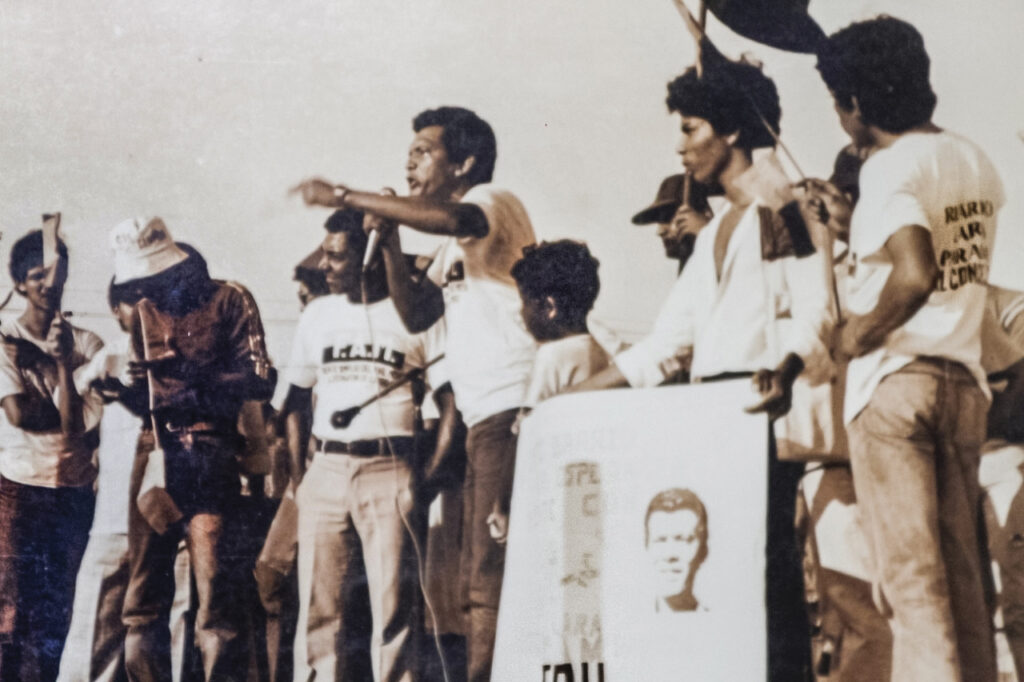
Courtesy of Luis Daniel González
The group executed anyone who criticized Vásquez, including co-founder Víctor Medina Morón in 1968. Soon after, a militant named Jaime Arenas deserted, and published the first inside account of the ELN. Two months later, he was murdered. In 1974, the group executed three of its urban commanders as traitors, later conceding that they were innocent. Lara explains on the tape, “Our mentality was the same mentality as the Inquisition.”
Resurrections
Operation Anorí left the ELN in shambles. What saved it was a Spanish priest and a geological accident: Manuel Pérez reconstituted the group in Arauca just as oil was discovered there, and pipeline extortion funded its recovery. While they expanded, every government from Betancur’s onward opened negotiations that ultimately fell apart.
When the group kidnapped 190 people from a Cali church in 1999, even the hardline government of President Álvaro Uribe (2002-10) pursued exploratory peace talks. His successor, President Juan Manuel Santos (2010-18), undertook a national peace process, but the ELN refused to negotiate alongside the FARC. Though the Santos government focused most of its energy on the FARC as the far larger group, separate talks with the ELN eventually produced a ceasefire and a coherent negotiating agenda. Yet no agreement was reached. In 2017, former ELN commander Carlos Velandia told me plainly: “Here we both lost the war. And so did the country. Nobody won.”
After most of the FARC demobilized, the ELN expanded into the areas the FARC had controlled. And despite having sworn never to finance itself with drugs, the ELN stepped into the vacuum and did just that. The administration of Iván Duque (2018-22) sat down with the group, but the ELN shattered those negotiations in 2019 with a car bomb that killed 22 police cadets.
When Gustavo Petro came into office in 2022, he promised to demobilize the ELN through negotiation. Though much of the public was skeptical, the conditions seemed right. There was broad international consensus for a negotiated settlement, and Petro, a former guerrilla himself, was Colombia’s first leftist president. If there were ever a time for the ELN to extract favorable terms from the state, this appeared to be the moment.
A new normal
Negotiations opened in Caracas, and in 2024, the two sides agreed on a model for the group’s transition to civil society, the furthest any talks have gotten. But the ELN refused to stop kidnapping for ransom. And in September 2024, the ELN assaulted a military base, killing two soldiers, and attacked a FARC dissident group in Catatumbo that was once its ally, killing scores of people and displacing 50,000. Petro broke off the talks.
Critically, when an ELN dissident front broke away to negotiate separately, eventually disarming, the ELN’s leadership read it as Bogotá fragmenting its chain of command. Like so many times before, this show of moderation within its ranks hardened rather than softened its posture. Since, the ELN has continued to target rivals, kidnap civilians and attack Colombia’s police and military.
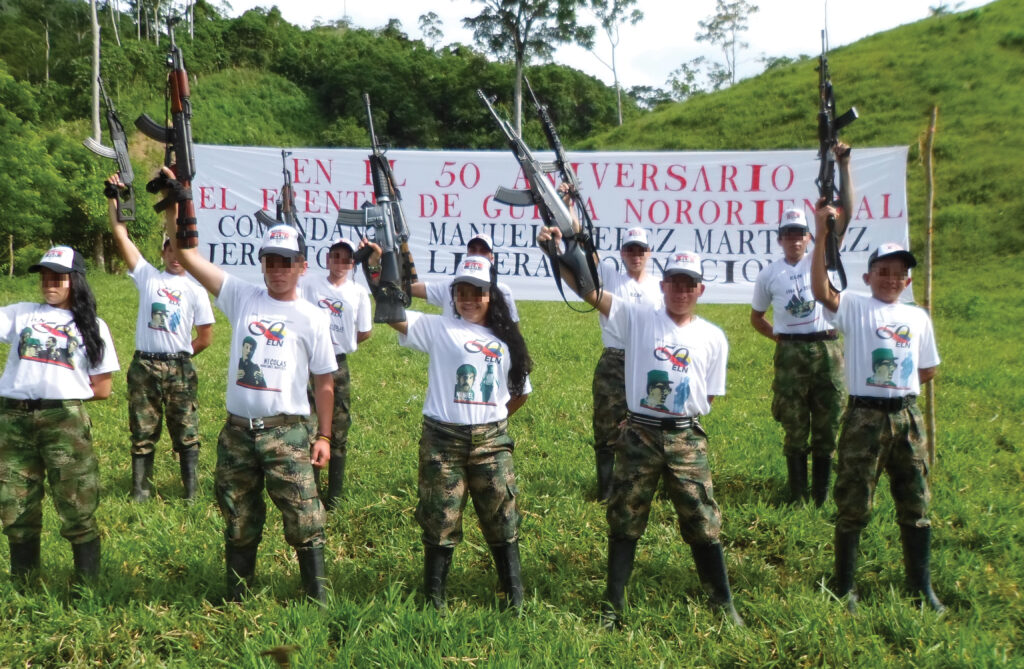
Braya234 via Commons.Wikimedia
Why did the group choose renewed violence when it had perhaps the most favorable negotiating conditions since its founding in the 1960s? Part of the answer is that the group is doing well. Its estimated 6,000 members are collecting massive revenues through participation in—or taxation of, if you believe their talking points—the trafficking of cocaine and illicit gold, both at record highs in the country. It is plowing these funds into weapons old and new, including explosive-laden drones, and rivals in strength the Clan del Golfo, Colombia’s largest drug-trafficking organization.
But the group now faces two new existential challenges. The first is De La Espriella’s promised offensive that will likely feature reinvigorated military cooperation with Washington. The second is Venezuela, where many of its fighters are based and government authorities had treated it as a paramilitary ally. In the wake of the U.S. capture of Nicolás Maduro, that safe haven could be in jeopardy.
Even so, if history is any guide, the ELN will probably survive, and the government may find itself further from a settlement than ever. The ELN’s decentralized structure—fronts with their own finances, a command that coordinates more than it dictates—makes decapitation less effective than during the FARC years.
There is always the possibility of a surprise: Guerrillas who swore they would never disarm have done so, and even Uribe’s hardline government pursued negotiation. But the ELN’s history, its recent growth, and its failure to disarm under relatively favorable conditions all indicate that any resolution, whether disarmament or destruction, is still far off.
ABOUT THE AUTHOR
Luis Daniel González
Reading Time: 6 minutesGonzález is a Colombian-American researcher trained at Georgetown and Stanford who works with internal guerrilla archives, interviews and other primary sources
The Unfulfilled Promises of Colombia’s Peace Process
Why the 2016 deal has fallen short of expectations and what it says about the country today.
Colombia’s Dangerous Regress
Intensifying violence and a divisive election season reveal a startling deterioration in the country’s stability.