


To Daniel Ortega, democratic elections are overrated. Nicaragua’s self-styled co-president recently announced to the world that elections won’t take place in his country ever again, lest they become a Trojan Horse for imperialism. Some dismiss Ortega’s comments as the rants of a deluded autocrat, but in fact they are part of a global assault on the legitimacy of elections as a foundational component of democracy.
A full fifth of humanity turned out to vote in the unprecedented 2024 global election cycle, yet this triumph of the ballot box looks increasingly hollow. International IDEA has tracked election credibility for decades, and today’s global score, which accounts for the extent to which elections are free from irregularities, is the lowest in 30 years.
This trend has not spared Latin America. It comes, however, in the wake of immense progress over the past generation. Nearly every Latin American political actor has accepted that elections are the only legitimate path to political power. This is a momentous social, political, and cultural transformation for a region where until recently power was often seized through either the military barracks or the mountains.
The dividends are precious. Elections have given Latin American citizens an unprecedented share of power, and this has resulted in real changes in people’s well-being. Over the past three decades, and despite the pandemic’s devastating impact, the region has made notable and sustained progress in human development. According to ECLAC figures, since 1990, poverty in Latin America has been reduced by half, extreme poverty is down by nearly 40%, and income inequality has decreased practically everywhere.
Periods of good economic growth underpin these advances, but so do public policy decisions like greater social spending which were clearly influenced by the vote. In 2000, social spending in Latin America was equivalent, on average, to 8.4% of GDP; in 2024, it was 11.6%, even after a big dip during the pandemic.
In Latin America, the consolidation of electoral democracy and the acceleration of social progress are directly connected. Electoral democracy, with all its shortcomings, is doing its job. It is redistributing political power, albeit slowly. Those who had been excluded from decision-making have gotten to participate in politics, and, consequently, socioeconomic disparities have shrunk.
But the warning signs before us show that this progress is in jeopardy.
The foundations of progress
The greatest achievement of the region’s democratization has been the creation of robust electoral institutions and procedures. Despite Venezuela’s experience in 2024, blatant fraud has become largely a thing of the past. International IDEA’s latest study on election credibility finds that Latin America trails only North America and Europe and is clearly outperforming the global average. Six Latin American countries feature among the world’s top 50 in this report.
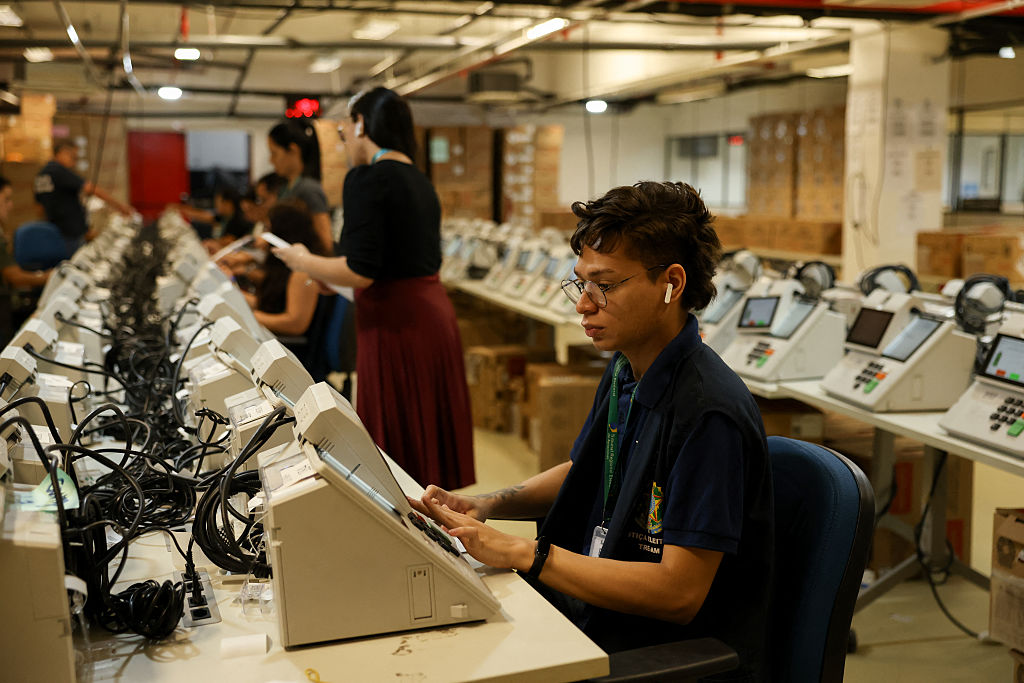
Generally speaking, Latin America holds elections well; its success navigating a major election cycle during the COVID-19 pandemic was telling. A key reason is that the region has developed some of the world’s most powerful, innovative, and sophisticated electoral authorities.
Unbeknownst to most, it has become a global leader in online voting, with four countries—Mexico, El Salvador, Panama and Ecuador—conducting recent pilots with a special focus on out-of-country voters. Its election management bodies are also at the forefront of efforts to deal with disruptive climate events, and can claim real success in setting up coordinated multi-sectoral responses to electoral disinformation, as seen, especially, in Brazil.
Warning signs
Yet, this progress is more precarious than it appears. International IDEA studies show that the credibility of the region’s elections has gradually declined for 20 years, as has trust in electoral authorities. According to Latinobarómetro, 34% of Latin America’s population trusted electoral authorities in 2024, better than the 26% of 2017 but a significant decrease from 44% in 2015 and 47% in 2006.
Moreover, Latin America has not been consistent in upholding election results, with ideological expediency too often clouding judgement. Yes, the region came together to demand respect for the popular will in Guatemala, when corrupt political forces almost succeeded in preventing President Bernardo Arévalo’s 2024 swearing in. But just a few months later, it failed to speak with one voice about Venezuela’s disastrous 2024 election, stolen in broad daylight by then-President Nicolás Maduro. Confronted with an obvious democratic transgression, the presidents of Brazil, Colombia, and Mexico, Latin America’s largest democracies, equivocated.
If this was a symptom of the region’s inability to learn from its own past, so is the increased frequency with which politicians are assailing autonomous electoral authorities. The public attacks, often veering into the worst kind of election denialism, by former Presidents Andrés Manuel López Obrador of Mexico, Jair Bolsonaro of Brazil, Rodrigo Chaves of Costa Rica and Gustavo Petro of Colombia, against their countries’ competent electoral authorities are examples of a disturbing regional trend. It has become increasingly commonplace to attempt to delegitimize democracy’s irreducible core.
Dividends at risk
“If voting changed anything, they’d abolished it,” former London Mayor Ken Livingstone once quipped. In Latin America, however, voting has changed things much more than most people realize.
This is why democratic elections unnerve so many autocrats and would-be autocrats all over the world. They are the ultimate check on power and an engine for political and social progress. Keeping them free and transparent in Latin America demands an ironclad commitment from all political actors to defending electoral integrity.
This means, among other things, protecting the autonomy of the region’s generally impressive electoral bodies; ensuring that those who undermine the credibility of elections pay a political and legal price for it; deploying coordinated, whole-of-society responses against electoral disinformation; and prioritizing the effective regulation of campaign finance, a need of the highest order in a region where organized crime looms over democracy as in no other.
As in the rest of the world, the cracks in Latin America’s electoral progress are visible and growing. This progress is the region’s most impressive political achievement of recent decades and its best mechanism to create fairer societies. It is precious, it is at risk, and it needs proactive protection.
ABOUT THE AUTHOR
Kevin Casas-Zamora
Reading Time: 4 minutesCasas-Zamora is the secretary general of the International Institute for Democracy and Electoral Assistance (International IDEA) and a former vice president of Costa Rica.
Why the Liberal Order Is Unraveling in the Americas
Citizens and leaders are abandoning the rules of liberal democracy. What can reverse the trend?
How “Centralism” Is Undermining Democracy in Latin America
Power in several countries is shifting away from mayors and governors, even though they are closest to many day-to-day issues.