



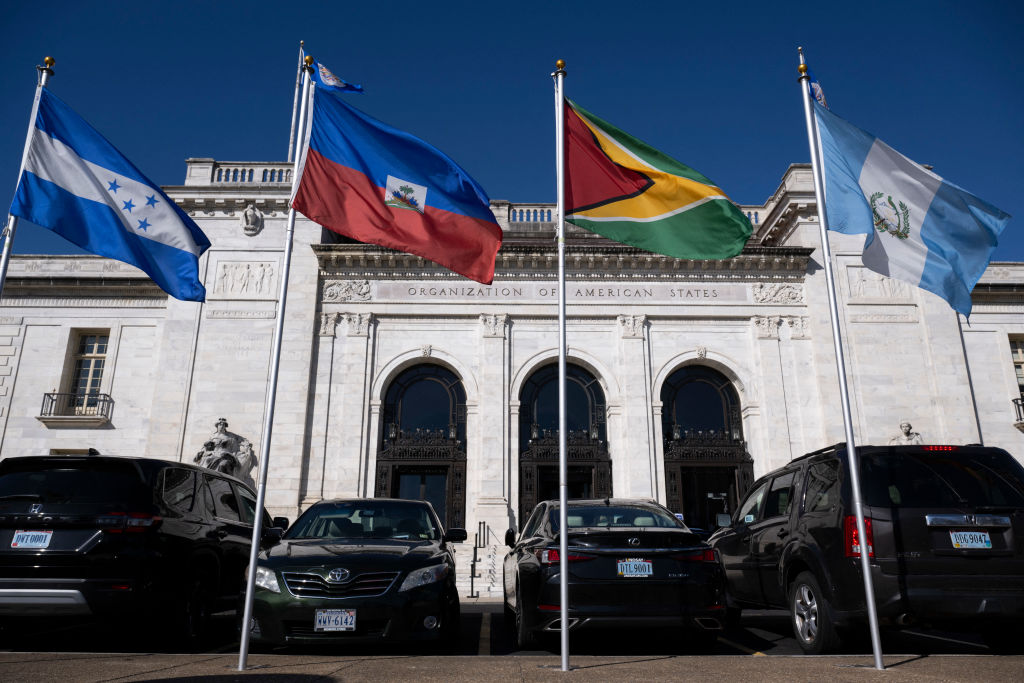

When prosecutors and judges in Guatemala attempted to nullify a clean election result in 2023, observers from the Organization of American States (OAS) remained in the country and pressed for the transfer of power to proceed. Along the Belize-Guatemala border, decades of OAS-sponsored mediation have kept a territorial dispute from escalating. In Colombia, the OAS Mission to Support the Peace Process has monitored and verified commitments that have strengthened confidence in a decades-long peacebuilding effort.
These are not ceremonial achievements. They are the kind of concrete, unglamorous work that keeps democracies functioning in the Western Hemisphere — work that has no obvious substitute if the institution performing it ceases to function, or even worse, to exist.
That scenario is now a real possibility. The Trump administration’s fiscal year 2027 budget proposes zero funding for the United States’ assessed contribution to the OAS, the world’s oldest regional international organization. The U.S. accounts for roughly half of the organization’s regular budget—about $46 million of approximately $91 million—and that budget has seen little real growth in a decade, aside from the modest increase in 2023-2024. The OAS itself runs on fewer than 500 staff. If enacted, the proposal would leave the organization, as currently constituted, unable to survive.
So far, the hemisphere has largely been silent, especially the small and medium-sized states, which have received attention and support from the Inter-American system since its origins in 1889. Their silence is not prudence; it is a warning. The system should not be defended as nostalgia, ceremony, or moral decoration, but rather as shared infrastructure based on national interest.
A Caribbean or Central American foreign minister reaches for the OAS because he or she understands power. A multilateral forum is one of the few places where a small country can build a coalition, put its concerns on a shared agenda, slow a unilateral impulse, and oblige a larger actor to speak where others can hear.
Cooperation is not idealism
Two centuries after Simón Bolívar first convened the nations of the Americas at the Congress of Panama, the hemisphere once again faces a defining question: Can it manage democratic erosion, migration pressures, transnational crime, climate shocks, and intensifying great-power competition without a credible regional framework?
China is now South America’s top trading partner, and Washington’s commitment to the hemisphere’s institutions is under strain. The Americas’ current challenges have only made the Inter-American System more necessary.
Critics wrongly dismiss multilateralism as naïve idealism or as a relic of a liberal order in decline. Cooperation is how power becomes more predictable in a world where no country can manage migration, organized crime, economic disruption, or climate-related disasters alone. Institutions make asymmetry visible, negotiable, and, at times, manageable.
Moreover, the Inter-American Democratic Charter gives the region a shared language for defending democracy. The Inter-American Commission on Human Rights and the Inter-American Court of Human Rights provide citizens with channels that no subregional forum can replace.
The U.S. also benefits
The U.S. also has concrete interests at stake. The case for the Inter-American System is usually made on behalf of small and medium powers. It should also be made on behalf of the strong.
A hemisphere that manages its own crises is one that sends fewer of them north. Venezuela’s collapse did not stay in Venezuela. It became one of the world’s largest displacement crises, and its pressure stretched across the region’s borders. Haiti’s institutional collapse has produced violence, migration pressure, and rising doubts about the hemisphere’s ability to act before crises spill outward.
For Washington, the OAS is one of the least expensive and most effective tools for managing regional crises, sharing burdens, and competing with outside powers within a system it helped create. China is already deepening its presence across the hemisphere, helping to erode elements of an order the U.S. spent decades building. The Inter-American System remains the only institution where Washington can convene the entire region. Abandon it—through defunding or indifference—and the U.S. forfeits a forum it can lead in exchange for a series of strategic contests it may not always win.
A great power can impose short-term outcomes, but durable influence rests on legitimacy and consent. Power exercised through shared rules lasts longer; power exercised alone invites resistance and counter-coalitions. The choice for Washington is between power that stands alone and power that lasts.
Haiti is the test. The system cannot supply the security Haiti needs; that requires other commitments and a clear division of labor. But for elections, human rights, institution-building, and governance, the OAS has real tools that can lay the civilian foundation on which any security gain must stand. Serious engagement there would serve Haiti, the region, and the U.S., which bears the downstream costs of collapse.
A new bargain
None of this is a defense of the status quo. The system needs a new bargain built on reciprocity rather than tutelage: reliable funding, democratic and human rights standards applied consistently to friends and adversaries alike, sharper early warning, flexible coalitions on migration, climate security, democracy and digital governance, and a development agenda that treats the Caribbean and Central America as the places where climate, debt, security, and external competition converge.
In a multipolar world, the alternative to a renewed OAS is increased fragmentation. Small states need rules because rules give them agency. Powerful states need rules because rules make their power more legitimate, less costly, and more durable. But rules do not defend themselves. The burden does not fall on Washington alone; it falls to smaller states to defend the system out loud, in their own interest. The first act of agency is to break the silence.
ABOUT THE AUTHORS

Frank O. Mora
Reading Time: 4 minutesMora is Professor of Politics and International Relations and Senior Research Scientist at the Jack D. Gordon Institute for Public Policy, Florida International University. He is a former Deputy Assistant Secretary of Defense (2009-2013) and U.S. Ambassador to the OAS (2023-2025).
Josué Fiallo
Reading Time: 4 minutesFiallo is a former diplomat of the Dominican Republic and served as his country’s Ambassador to the OAS.