



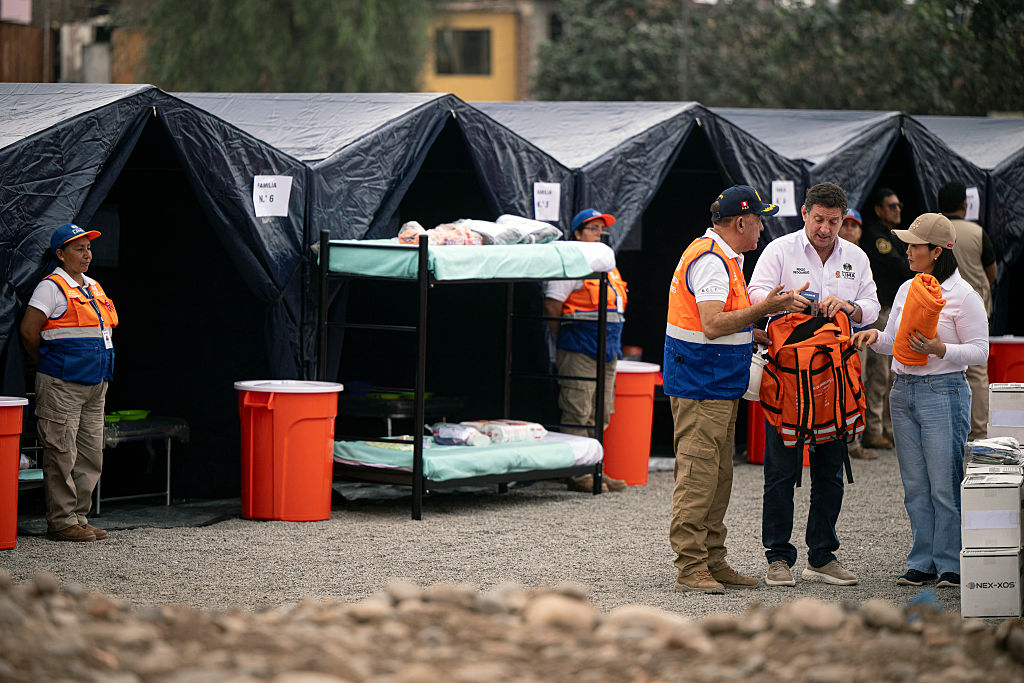
LIMA—This year El Niño, potentially the worst ever recorded, will be a challenge all over Latin America. But it will pose special risk to two right-wing presidents who won by narrow margins, and they take office just as the phenomenon begins to bite.
Near the city of Paita, in northern Peru, water temperatures were already a stunning 14.2 degrees Fahrenheit above average in June. Peru’s climate agencies expect this year’s El Niño to be especially strong from November to next March, foreseeing flooding in the north, drought in the south, and disruptive heat on the coast.
In Colombia, a country where hydropower supplies more than two-thirds of electricity generation, forecasters predict droughts that will deplete reservoirs and threaten the electrical system. This raises the specter of rationing and blackouts, like the rolling outages that rocked Ecuador in 2024.
These challenges will greet new governments in both countries. Keiko Fujimori takes office on July 28, and Abelardo De La Espriella does so on August 7. If most El Niño models are correct, the two presidents’ first six months in office are likely to see intense climate events. How they prepare for and react to these disruptions could define their political fortunes over the coming year, especially given their narrow margins of victory.
A range of threats
Fujimori will start her term with an optimistic Peruvian business class, according to the central bank’s June Macroeconomic Expectations Survey. Many expect GDP growth above 4%, but those hopes could be dashed by El Niño.
Peru’s BRCP, as the central bank is known, estimates that El Niño could subtract nearly a full percentage point—0.9%—from GDP growth in 2027, while the Instituto Peruano de Economía projects the impact at 0.8%. High ocean temperatures have already disrupted harvests of major export crops including mangos, blueberries and avocados.
By early March, they had destroyed roughly 6,000 hectares of fruit in the northern part of the country, and they have likewise hurt the fishing industry. The Lima Chamber of Commerce has estimated that El Niño could generate potential losses of more than $80 million per day across seven exposed regions later this year.
These current effects are the work of the “Coastal El Niño,” which is expected to overlap with the broader oceanic El Niño later this year. If together they become severe, they would batter the infrastructure that sustains Peru’s domestic and international trade.
Businesses would contend with damaged assets, delayed shipments and higher transport costs, with the broader economy absorbing lower production and exports, rising food prices and additional public spending on emergency responses. Moreover, a serious drought in the south—a risk that has received less attention from policymakers—could inflate food prices further.
The 2017 El Niño left several cities under water, and all these years later, northern Peru remains just as vulnerable to flooding because recovery efforts have been beset by delays, weak oversight, and irregularities. The Comptroller General reported in 2023 that 120 reconstruction projects representing over $900 million in investment were stalled nationwide, while a separate review in Piura identified 131 officials with potential criminal, civil and administrative responsibility for irregularities.
In the south, drought would create less demand for rebuilding than for keeping food and water supply chains functioning, problems that would be difficult for a new government to address quickly.
All this could stymie growth across Fujimori’s first two years in office. It will test her relatively weak mandate; she won the June presidential runoff by less than three-tenths of a point over her leftist rival. To complicate matters, Fujimori will be governing with a fragmented Congress, precisely when disaster management demands speed.
Colombia’s risks
El Niño threatens Colombia with drought that could disrupt hydroelectric plants and pose an acute challenge to President-elect De La Espriella. He also won his election narrowly over a leftist opponent and will face deep polarization and a divided legislature.
El Niño conditions are already present, and climate models assign a 99% chance that they will persist through September and a 63% probability that they will intensify from November to January. The electricity rationing and blackouts they threaten would impose immediate visible costs on households and businesses, while highlighting failures of planning and infrastructure management.
The government’s weather agency warns that reduced rainfall and higher temperatures could also restrict drinking-water supplies, damage crops and livestock, increase wildfires, and worsen health risks related to air quality, heat, and mosquitoes. Meanwhile, Environment Minister-designate Fabio Arjona has indicated that the administration will permit limited fracking. If acute water stress materializes, that position could become an additional political flashpoint.
The risks are especially high for Colombia because its macroeconomic situation is more delicate than Peru’s. Having lost its investment grade in 2021, Colombia has little room to borrow with cheap credit, while Peru has maintained investment grade despite its ups and downs.
A parallel problem
Graft is likely to present another open flank for the new presidents. Natural disasters can trigger emergency purchases, budget reallocations, and expedited borrowing, contracting, and reconstruction programs that are especially vulnerable to graft and fraud.
And simple clientelism has its own tempting logic. Funds can be driven toward electorally valuable districts, allies can be awarded with resources, and public initiatives can be portrayed as personal favors granted by the president.
After the devastating 1997-1998 El Niño, Keiko’s father, former President Alberto Fujimori (1990-2000), placed himself at the center of the government’s response through highly publicized visits and aid deliveries. Polls initially showed his approval rising three to four points, but as flooding intensified and the failures of the government’s highly centralized and personalized approach to aid became more apparent, public perception in affected areas deteriorated. Today, given Keiko Fujimori’s and De La Espriella’s fragile mandates, responses organized around personal visibility and clientelism could backfire even more acutely.
Reconstruction efforts can be either a boon for governments if they are perceived to perform well, or a source of rapidly eroding popularity. For both presidents-elect, the stakes will be high. How they face the climate challenges of their first months in office could have political and economic effects that last years.
* Andrea Mejía of the Instituto de Estudios Peruanos (IEP) contributed to this article.
ABOUT THE AUTHOR

Jorge Morel Salman
Reading Time: 4 minutesMorel Salman is executive director and a senior researcher at the Instituto de Estudios Peruanos (IEP).
Keiko Fujimori’s Defining Choice in Peru
Will Peru’s likely president-elect seek revenge, or build a democratic legacy?
How Will De La Espriella Govern? Previous Newcomers Offer Clues
History shows that newcomers often pursue a maximalist approach once elected. That can be dangerous—including to the leaders themselves.