



A recent phone call between U.S. Secretary of State Marco Rubio and Brazilian Foreign Minister Mauro Vieira was publicly framed as a diplomatic routine. It was not. The central issue, according to officials in Brasília, was whether the Trump administration intends to designate Brazil’s Primeiro Comando da Capital (PCC) and Comando Vermelho (CV) as Foreign Terrorist Organizations (FTOs). Brazil resisted similar pressure last year. The pressure has returned, and it is sharper.
Washington will present any such designation as a counternarcotics measure. That framing is not wrong. The PCC and CV are two of the country’s most powerful criminal organizations, central to drug trafficking, territorial control, and extreme violence – not just inside Brazil, but across Latin America to Africa, Europe and beyond.
However, the designation would carry additional consequences that extend well beyond law enforcement. It could alter the legal and diplomatic context in which Brazil manages its own security while widening the reach of U.S. sanctions, prosecutorial pressure, and financial compliance into the Brazilian economy. It could, in fact, carry greater consequences for other actors, including banks, companies and Brazilian politicians, than for the gangs themselves.
The limits of the label
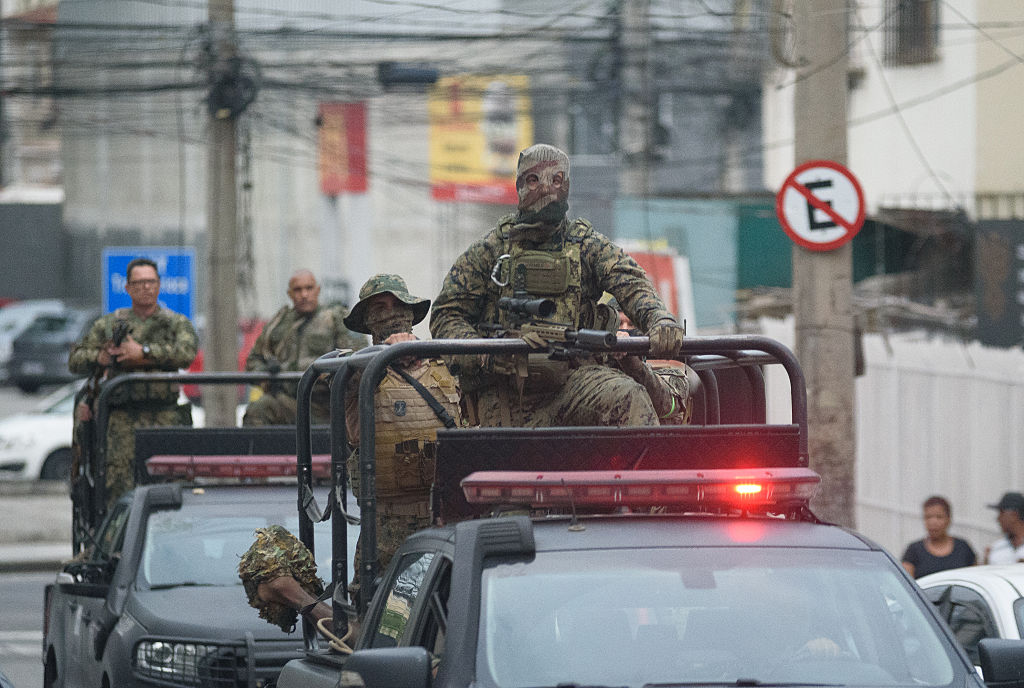
The PCC and CV are formidable by any measure. Brazilian prosecutors and investigators describe the PCC as the country’s largest and most transnational criminal organization, deeply embedded in cocaine trafficking to Europe, with sophisticated money-laundering structures, prison-based command chains, and international partnerships, including with Italy’s ‘Ndrangheta. The CV, Brazil’s oldest major criminal faction, has exercised territorial control in Rio de Janeiro’s favelas for decades and was the target of the country’s deadliest police operation in October 2025.
What is less clear is whether an FTO label would significantly weaken either group. Proponents contend that it creates stronger legal tools, raises the costs for criminal intermediaries, and deepens intelligence co-operation. There is truth to this. But both organizations have shown unusual sophistication, repeatedly adapting to pressure by fragmenting operations, expanding front companies, and moving further into opaque financial channels.
The likelier outcome is not collapse, but adaptation. Designation could accelerate precisely the sophistication it seeks to disrupt, driving more transactions routed through crypto and trade-based laundering, deepening penetration of legitimate sectors, and increasing investment in state capture as insurance against enforcement. Other countries where drug gangs have been designated as FTOs, including Mexico, Colombia and Haiti, have not seen a material decline in violence.
Indeed, the PCC that emerges from this pressure may be leaner, harder to trace, and more resilient than the one that entered it. Designation is not meaningless. But its practical effects may fall as heavily on the legal and financial environment surrounding these groups as on the groups themselves.
A geopolitical instrument by another name
The Trump administration has been more willing than its predecessors to reach for terrorism designations against cartel and gang actors in the Americas. That pattern is significant. Whatever the counternarcotics logic, the cumulative effect is to recast organized crime in the hemisphere through a counterterrorism lens, aligning criminal governance with Washington’s broader strategic posture in the region.
The 2025 National Security Strategy ties that posture to state weakness, external influence and the spread of Chinese power and influence. In other words, geopolitics is explicitly part of the policy.
The domestic political dimension in Brazil sharpens that reading. Trump hit Brazil with tariffs and sanctions in July 2025 in an effort to help his political ally, former President Jair Bolsonaro. While Trump dialed those efforts back late last year after they largely backfired, he may still be seeking to influence Brazilian politics ahead of this October’s presidential election.
Eduardo Bolsonaro, Jair’s son, has actively lobbied Washington for the FTO designation. The issue would hand the Brazilian right — with Flávio Bolsonaro, another son, now a presidential candidate — a potent weapon in a 2026 campaign in which voters have identified security as one of the top issues.
President Luiz Inácio Lula da Silva faces a difficult choice: embrace the designation and appear subservient to Washington, or resist it and be painted as soft on narcoterrorism. Either way, the terms of the race are being set partly outside Brazil. Officials in Brasília are calling it interference in a sovereign electoral process.
Meanwhile, Brasília has been watching the American playbook in Venezuela with close attention, and considerable alarm. They see a familiar sequence: Designate groups as narco-terrorists, impose financial sanctions, and then act. The Cartel de los Soles was listed as an FTO in late 2025 amid escalating naval strikes on suspected Venezuelan trafficking vessels. In January 2026, U.S. forces captured Nicolás Maduro. Lula condemned it as an unacceptable crossing of lines. He was not alone.
Brazil is not Venezuela. Its economy is far larger, its institutions more robust, and its integration into global finance far deeper. Direct U.S. military action is not a serious scenario. But the comparison matters at the level of legal architecture and political signal. Once an organization is designated, U.S. authorities gain stronger grounds to pursue sanctions, material-support investigations, and intelligence collection against persons or entities alleged to be linked to that organization wherever those ties touch the U.S. or the dollar-clearing system. Washington does not need boots on the ground to reshape the operating environment for a sovereign ally.
The financial system in the crosshairs
The economic consequences of designation may be the most significant — and least appreciated — risks in play.
Knowingly providing material support to an FTO carries criminal penalties under U.S. law. But for most Brazilian companies, the greater exposure lies in the sanctions regime that typically accompanies designation. In recent cartel cases, the Trump administration has paired FTO designations with sanctions under Executive Order 13224. Where there is a U.S. nexus — dollar clearing, U.S. assets, U.S. persons or transactions through the American financial system — companies that never knowingly dealt with a criminal group could still face investigations, asset-blocking risk, or costly compliance action if they transacted with an intermediary later alleged to be linked to a sanctioned network. Claims of ignorance may offer limited protection if U.S. authorities conclude that warning signs were ignored.
The scale of that exposure is not easily dismissed. Brazilian federal revenue authorities have linked the PCC alone to an estimated 52 billion reais ($10 billion) in investment funds and assets embedded across agribusiness, construction, logistics, and real estate, all sectors that are the backbone of the Brazilian economy. Any company that used PCC-linked contractors, moved goods through controlled corridors, or operated in markets where organized crime functions as landlord and protection provider could face scrutiny from U.S. regulators, correspondent banks, investors, and civil litigants under U.S. anti-terrorism law.
The correspondent banking implications are particularly acute. Brazil is deeply reliant on dollar clearing and U.S.-linked financial channels for trade, investment, and debt servicing. Latin America lived through one sharp de-risking cycle when correspondent banking relationships fell by roughly 30% between 2011 and 2018. A terrorism designation covering Brazil’s most powerful criminal organizations would not necessarily reproduce that shock in full, but it could trigger a new round of caution among U.S.-linked financial institutions. That could translate into slower transactions, higher compliance costs, more intrusive due diligence, and rising friction for every Brazilian company doing international business.
The precedent from countries where Washington has already deployed FTO designations offers a blunt warning. When Washington designated six Mexican cartels as foreign terrorist organizations in February 2025, the first casualties were not the criminal groups but compliance departments of financial institutions. FinCEN cut cash-reporting thresholds to $200 in parts of the border region and later moved against three Mexican banks, showing how quickly an FTO label spills into correspondent banking, payments, and cross-border finance.
For Brazilian firms with U.S. operations, dollar liabilities, American investors, or cross-border supply chains, this is not a diplomatic abstraction. It is a live compliance question. Counterparty reviews, beneficial-ownership checks, and access to sanctions counsel should be in motion before any designation is formalized. The companies that weather this best will be those whose compliance systems are credible before the pressure arrives, not those assembled in haste once it does.
Designating the PCC and CV as foreign terrorist organizations would not solve Brazil’s organized crime problem. It would create new instruments of pressure, but also new legal uncertainty, compliance costs and diplomatic strain. And while the case for designation is straightforward, the measure would expand U.S. leverage over Brazil, and complicate life for a variety of actors including the private sector, more predictably than it would weaken the criminal groups themselves.
ABOUT THE AUTHOR

Robert Muggah
Reading Time: 5 minutesMuggah is a co-founder and research director of the Igarapé Institute, a leading think tank in Brazil. He is also the co-founder of the SecDev Group and SecDev Foundation, digital security and risk analysis groups with global reach.