



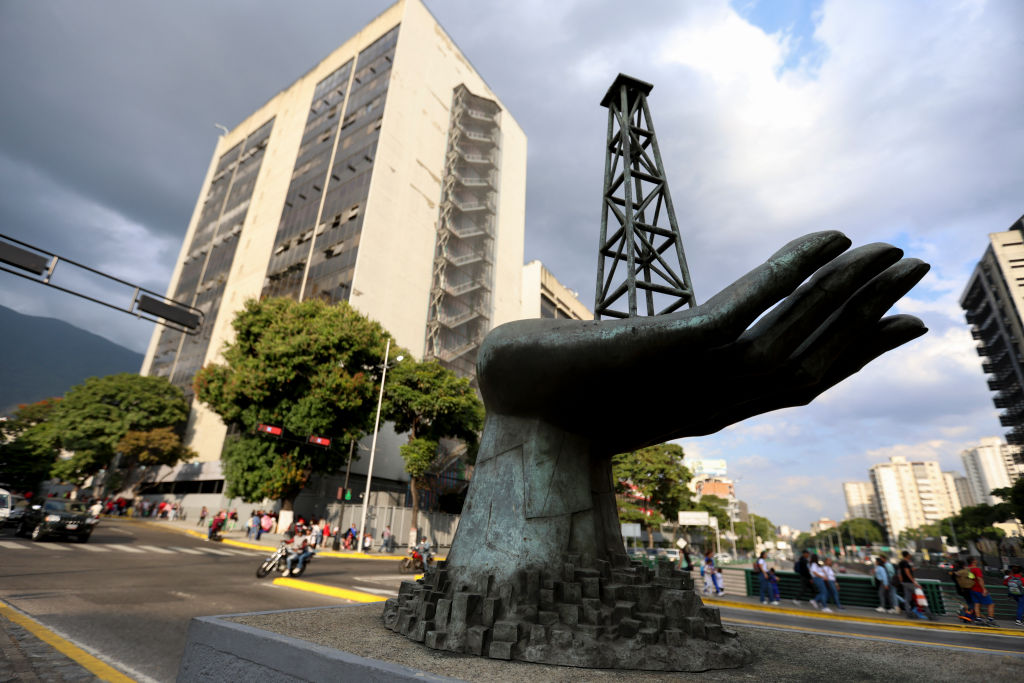

The capture of Nicolás Maduro by U.S. forces carries potentially dramatic consequences for Venezuela – including in its oil, gas and mining sectors. A partial recovery could come more quickly than some pessimists have contended. But this optimistic scenario depends on what kind of political leadership comes next.
Despite holding the world’s largest oil reserves, Venezuela’s oil industry has seen production decline over the decade-plus of the Maduro regime by almost 2 million barrels per day to its current level of about 1 million b/d. Oil is not the only natural resource in the country that has experienced this decline. Having the largest natural gas reserves in Latin America, Venezuela was wasting an amount equivalent to Colombia’s annual natural gas consumption by venting it into the atmosphere.
Venezuela is also believed to possess reserves of critical minerals and rare earth elements. However, the country’s exploitation of its mineral resources is conducted through irresponsible mining practices and rampant illegality, resulting in significant environmental and biodiversity loss and social damage.
As of this writing, it is unclear what kind of government will emerge following Maduro’s capture, or how it will operate Venezuela’s resources. President Donald Trump seemed to suggest on Saturday that he sees Vice President Delcy Rodríguez governing the country, at least in the short term. Opposition leader María Corina Machado, whose coalition won an election in 2024, also signaled her team is ready to take power and has a plan for the recovery of Venezuela’s extensive natural resource sector.
Despite the uncertainty, it is worth asking: What would an optimistic scenario for Venezuela’s oil and mining resources in a post-Maduro era look like? Dramatic changes to the country’s investment regime and governance are needed for Venezuela to capitalize on its resources. But under an effective and trustworthy government, the nation could potentially return to the peak oil production of 3.5 million bpd it achieved in the 1990s, become a natural gas exporter to both Colombia and Trinidad, develop its critical minerals potential, and become a responsible steward of its vast biodiversity wealth.
Maximizing oil revenues
Ramping up oil production will require truly massive investments which would need to be borne entirely by private oil investors, given the country’s significant humanitarian needs, the severe shortage of foreign-currency revenues, the enormous debt overhang for both the government and state oil company, Petroleos de Venezuela, PDVSA, as well as the loss of technical capacity in the sector over the past two decades.
Attracting these investments requires an overhaul of the country’s institutional and legal framework, as well as dramatic improvements in safety and environmental standards. It will also require restructuring approximately $190 billion in outstanding foreign obligations, with a menu of options that could potentially align such debt resolution with the recovery of the oil and mining sector and even consider the use of novel instruments such as debt-for-climate or (methane) swaps to finance some of the much-needed environmental remediation.
Even without a new law, a trustworthy government could increase oil production to 2019 pre-sanctions levels of 1.5-2 million bpd within a two-year horizon. Current international operators still present in the country (e.g., Chevron, ENI, Repsol, Maurel and Prom) could boost spending within their existing licenses, operating below capacity.
Venezuela can see a significant relief in its cash position from a redirection of oil exports to the U.S. Gulf Coast, potentially tripling annual revenues in the very near term. Its exports are currently estimated at around 800-900k bpd, but most of it flows to China through shadow fleets and black-market routes at highly discounted rates.
The wasted (vented) natural gas potential
Venezuela’s natural gas reserves are estimated at almost 200 trillion cubic feet (TCF), representing more than 60% of Latin America’s natural gas reserves. Yet the country has failed to monetize its substantial reserves and is instead venting substantial levels of methane. Approximately 40% of the country’s 3 bcf/d production is vented or flared by PDVSA, resulting in an annual opportunity cost of roughly $1 billion in natural gas revenues (using Henry Hub prices).
Venezuela could potentially export natural gas to both Colombia and Trinidad, but mismanagement and misplaced nationalism have impeded this, likely forgoing about $1-1.5 billion in annual revenue. Given a legal framework for non-associated natural gas that permits 100% private-sector participation, U.S. sanctions have played only a minor role in Venezuela’s failure to capitalize on its resources.
ENI and Repsol produce about 0.5 bcf/d of natural gas from an offshore field (Cardon IV) in Western Venezuela, sold entirely to the domestic market. Originally expected to reach a maximum capacity of 1.2 billion cubic feet per day, the project could export a portion of the natural gas by reactivating the 141-mile Trans-Caribbean pipeline between Colombia and Venezuela.
For a decade, Trinidad and Tobago has been trying to finalize a deal with Venezuela to have Venezuela’s offshore gas exported through T&T’s gas infrastructure (dwindling gas production from T&T has left the country operating below its full LNG export capacity). Such a solution requires a 10-mile (16 km) pipeline connecting the Shell-operated Dragon Field in Venezuela with Trinidad’s natural gas infrastructure and can be executed within an 18-month time frame.
Seizing the country’s critical minerals potential
Venezuela was a relatively large regional producer of aluminum, cement, gold, iron, bauxite, and steel. Mining exports accounted for approximately 6% of its total exports in the 1990s. However, most of the country’s mining production has collapsed following the government’s expropriations of private operators in the 2000s.
The country also has potential for other critical minerals, such as nickel, given prior production and identified reserves, and for coltan (columbite-tantalite), which is key to clean energy technologies, telecommunications, and defense. The Maduro regime sought to leverage the country’s reserves of nickel and coltan, with limited success due to poor governance of mining operations.
The opacity of the country’s mining practices dates back to the Maduro government’s designation of approximately 12% of the territory as a special zone called the Mining Arc. This area, larger than Portugal and Panama, encompasses vast biodiverse ecosystems, including Venezuela’s Amazon basin. Very limited transparency, governance, and environmental oversight have allowed illegal mining to flourish, resulting in significant deforestation of Venezuela’s Amazon forest and dramatic social repercussions.
Venezuela has substantial oil, gas, and even mining resources that could play a key role in the country’s economic recovery, social development and for the region’s energy security. Whether the development of these resources will benefit the entire country remains to be seen in the months ahead.
ABOUT THE AUTHOR

Luisa Palacios
Reading Time: 4 minutesPalacios is an Adjunct Senior Research Scholar at Columbia University’s Center on Global Energy Policy, Adjunct Faculty at Columbia’s School of International and Public Affairs, former Chairwoman of Citgo Petroleum, and a member of AQ‘s editorial board

REACTION: Trump Says U.S. Will “Run” Venezuela After Maduro’s Capture
The historic military operation raises numerous questions about what’s next for Venezuela, and for U.S. relations with Latin America as a whole.
A Roadmap for Venezuela’s Future Transition
The U.S. should prepare humanitarian assistance and take other steps to help support a free Venezuela, two experts write.