


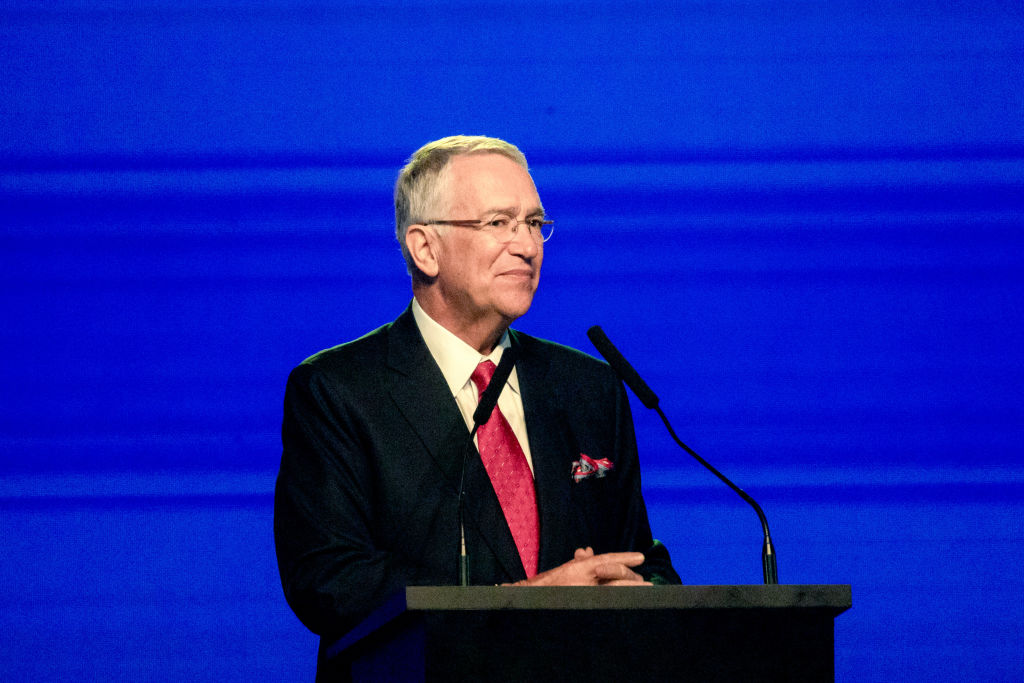
MEXICO CITY—He has appeared on Fox News, attended White House galas, and met with El Salvador’s President Nayib Bukele.
Indeed, Ricardo Salinas Pliego has in recent months seemed more like a presidential candidate than the retail, banking and media mogul who is often described as Mexico’s fifth-richest man. While members of his team strongly denied to me that their boss has any interest in running for office, Salinas has become perhaps the most vocal opponent of Mexican President Claudia Sheinbaum, recently referring to them as zurdos de mierda (“piece of shit leftists”), an insult taken directly from Argentine President Javier Milei’s playbook.
In its wall-to-wall coverage of Salinas Pliego, Mexico’s media has mostly focused on the reasons that supposedly pushed him into politics. These include a worsening relationship with the government and his debt of nearly $3 billion with Mexico’s tax authority, part of which Salinas recently agreed to start paying.
Much less has been said about how the vacuum of Mexico’s opposition landscape has allowed new and unexpected figures like Salinas Pliego to step into the limelight.
The death of the old Mexican right and the emergence of new alternatives lie at the core of my book La derecha no existe (pero ahí está), published late last year. While most foreign media focus these days on President Sheinbaum, and her relationship with both her predecessor and Donald Trump, the story of Mexico’s conservatives also speaks volumes about today’s politics—and Mexico’s diverse and often surprising ties with the United States.
The catastrophic collapse of the ancien régime
No one disputes that Mexican politics today is in uncharted territory.
Decisive victories by the relatively new, left-wing Morena party in 2018 and 2024 devastated the party system that had existed since the 1990s. Today, Morena and its allies are busy transforming the Mexican state with control of the courts, the presidency, and a supermajority in Congress that allows them to all but bypass the opposition.
Most parties explicitly pivoted to the left in reaction to being electorally steamrolled. This, in theory, left the right vacant for the National Action Party (PAN), Mexico’s traditional right-wing party. But the PAN has been wholly unable to capitalize on the situation, namely because it is caught in a spiral of ambiguity.
In late October 2025, the PAN announced that it had emerged from a period of post-electoral soul searching. Their conclusion was that, in their desire to beat Morena, they had joined with ideologically incompatible parties and lost their way. In a re-launch event, the PAN presented Mexicans with new branding and a new slogan—“Fatherland, Family, and Freedom.” The tagline, reminiscent of Franco’s Spain, indicated that the party had pivoted decisively back to the right.
It soon became apparent, though, that the transformation was barely skin deep. It turned out that the party’s members were nowhere near to being in agreement as to what they actually believed. Did a belief in “family” mean that abortion or “gender ideology” were to be rejected? Did the defense of the “fatherland” entail a rejection of Donald Trump’s interventionist zeal? These sorts of questions piled up and, instead of picking a lane, the PAN—still desperate to secure as many votes as possible—prevaricated.
Ultimately, the relaunch all but added up to the creation of a new app that allowed anyone to sign up to the party and, with enough support, become a PAN candidate—no matter their beliefs.
The PAN’s inability to position itself politically has infuriated both party members and non-members who want to see a proper right-wing alternative in Mexico. It has also allowed others to try and seek to replace panismo.
The many renewals of the Mexican new right
Salinas Pliego is only the latest personality to occupy the spotlight as Morena’s opponent-in-chief. The long string of previous contenders and their failure to consolidate momentum are a testament to the division of Mexico’s political opposition and the difficulties that the country’s electoral system poses to any upstart—no matter how rich, powerful, and influential they may be.
The first big box office contender was Eduardo Verástegui. The telenovela actor who later found God was politicized when he happened across influential members of the MAGA movement as a producer for the film Sound of Freedom. In my book, I quote José Mireles, the president of Verástegui’s Viva México movement, who told me that President Trump and his officials often consult them on Mexico, and that it was MAGA that revealed to them the noxious influence of the “globalist deep-state.”
Verástegui was unable to form a coherent organization, lacking discipline and focus, former Viva México activists told me. After his failed presidential run in 2024, many of these went on to form their own movement, the Republicanos de México. These remnants of Verástegui’s first team aspired to be more organized, but they lacked a charismatic leader.
What the Republicanos do share with Verástegui is a love of Trump’s Republican Party. In fact, Larry Rubin, a Republicanos de México co-founder, is currently running as a MAGA Republican in Texas.
These close links with Trump and his supporters is no coincidence. The U.S. is seen by the Mexican new right as the last great springboard into politics. To them, Mexico is no longer seen as a viable space to launch a new political movement. The organizations of the new right claim it is because the Morena party regime stifles them. This was somewhat confirmed this month when an interview with Verástegui was censored by a state television channel.
But someone like Salinas Pliego—the newest face of the Mexican new right—should have no such issues. He has everything the Viva México and Republicanos don’t have: the media empire, the money, the charisma, the social media following, the political know-how. But he is still missing what has really held the Mexican new right back: a vehicle with which to enter politics.
Long before Morena’s rise, Mexico was and continues to be dominated by what has become known as the partidocracia (the partyocracy), which makes it virtually impossible for anyone outside of an existing party to run for office. It also makes it virtually impossible to create a new political outfit. The Mexican partidocracia is the ultimate pro-incumbent system.
It took former President Andres Manuel López Obrador—the most powerful political figure of the 21st century—years of concerted work from within a pre-existing party to create Morena and take it from social movement to the ballot box.
López Obrador’s roadmap is not all that different to what happened to the PAN decades before. Salinas Pliego could well find his path to power by following the precedent of the 1980s takeover of the PAN by businessmen—detailed fully in my book.
Today’s PAN leadership has flirted with the idea of Salinas Pliego leading them as their candidate in the presidential race of 2030. Whether the media and retail mogul will be able to stay atop the treadmill of new right political figures is another matter.
ABOUT THE AUTHOR

Alex González Ormerod
Reading Time: 4 minutesGonzález Ormerod is the founder of The Mexico Political Economist, which covers Mexican politics and policy for a global audience. Most recently he has published a book on the fall and rise of the Mexican right, La derecha no existe (pero ahí está).