


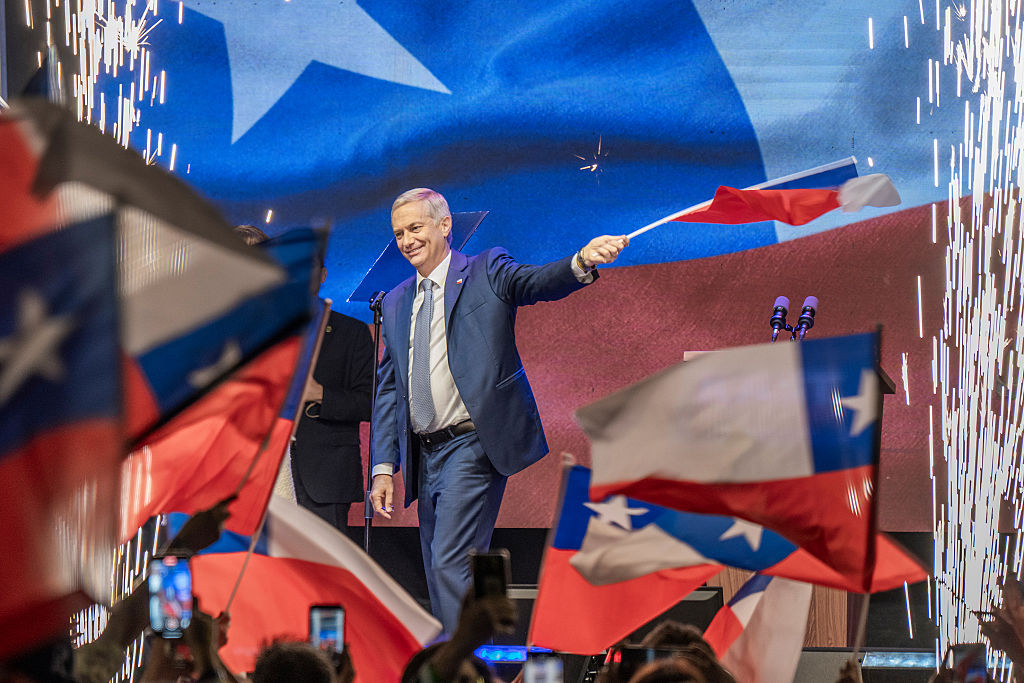
Chileans voted in a presidential runoff on December 14, electing right-wing José Antonio Kast of the Republican Party with 58.16% of the vote in his third bid for president. His opponent, former labor minister Jeannette Jara of the Communist Party, secured 41.84%. She wrote on social media that “democracy spoke loud and clear” and that she contacted Kast to “wish him success for the good of Chile.”
With crime and immigration among voters’ top concerns, Kast was widely favored to win following a first round election on November 16 in which the combined vote share for right-wing candidates was just over 50%. He will take office on March 11. Kast has proposed cutting $6 billion in spending, but it remains unclear how he will carry that out and which programs or entities will be affected.
AQ asked analysts to share their reactions and perspectives.

Patricio Navia
Professor of liberal studies at NYU and a professor of political science at Diego Portales University in Chile
As broadly anticipated, José Antonio Kast comfortably won the presidential election with 58.2% of the vote. His long victory speech dissipated many doubts about what kind of right-wing government he will lead starting on March 11, 2026. With a call to demonstrate civility and respect for those who disagree with him, and with considerate words toward previous governments, Kast clearly distanced himself from the combative, polarizing rhetoric of other far-right leaders.
Doubling down on Chile’s open-market economic model, Kast also drew a clear contrast with the more protectionist approach of other radical-right governments. Although he did not talk much about his foreign policy priorities, his calm and conciliatory demeanor sharply contrasts with the divisive and aggressive style of the leaders that Kast has associated himself with in recent years.
In his speech, Kast called on Chileans to get up early and work hard, to be courteous to one another, to respect institutions, and to express their political views without using violent means. In short, he seemed to embrace the message Make Chile Boring Again. Underlining the need to work hard, respect the rules, and respect each other, Kast sounded much more like a traditional right-wing conservative than a pugnacious far-right zealot. He talked about state capacity, good governance, law and order, and civility.
A church-attending Catholic, married to the same woman for 34 years and father of nine, the 59-year-old former legislator will take office in March. Kast will need to form a coalition with the traditional right-wing parties and centrist groups to secure a majority in Congress. He extended an olive branch to the right-wing rivals he defeated in the first-round vote in November.
Although some of his most prominent campaign promises and his international political allegiances suggest that he embraces illiberal democratic values, in his victory speech, the president-elect conveyed the message that he wants to be a measured, reasonable, sensible, and common-sense, plain-old conservative and traditional right-wing leader.

Cristóbal Rovira
Professor at the Institute of Political Science at the Pontifical Catholic University of Chile
With the election triumph of José Antonio Kast, the far-right wave has reached Chile. The main driver of this outcome is the growing salience of crime and migration—two issues on which far-right actors have proven particularly effective at mobilizing support. Kast’s campaign was heavily centered on these themes, while he strategically avoided emphasizing the ultraconservative elements of his broader ideological agenda.
To fully understand the magnitude of his victory, it is important to note that this was the first presidential election held under compulsory voting. This reform mobilized a large segment of the electorate that is generally disengaged from politics and deeply distrustful of political elites. From this perspective, it would be misleading to interpret the nearly 60% of voters who supported Kast as committed adherents of the far right. While many of these voters are clearly concerned about crime and migration, on moral issues and economic preferences the Chilean electorate remains, on average, closer to progressive than to conservative positions.
Whether Kast will be able to sustain high approval ratings and ensure governability will therefore depend on his capacity to contain the illiberal tendencies inherent in his political project. This will be no easy task. His long political career in Congress has not been marked by flexibility or a strong willingness to compromise. The decisive factor will thus be the role of mainstream right-wing leaders and parties. It seems unlikely, however, that they will ultimately be effective in moderating Kast and his cadres; when mainstream right and far-right forces collaborate, recently it has typically been the latter that prevail, often reshaping the former in their own image—as the evolution of the U.S. Republican Party, for example, illustrates.
After all, Kast himself built his political career within the mainstream right before breaking away, precisely because he regarded its programmatic moderation as a constraint. The new electoral vehicle he created has enabled the promotion of far-right ideas akin to those advanced by figures such as Bolsonaro in Brazil, Milei in Argentina, and Orbán in Hungary. Turbulent times likely lie ahead for Chilean democracy.

Paz Zárate
Lecturer at Chile’s Andrés Bello Diplomatic Academy
“Chile despertó”, Chile woke up, was a phrase frequently used as an explanation of sorts during the violent social uprising or “estallido social” that the country experienced in 2019. It was understood as an expression of exasperation at social injustices stemming from a system that was entrenched in the 1980 Constitution. Six years later, Chile has woken up again, this time due to fears over the lack of security. Consequently, the country has decided, by a very large margin, to give the keys to La Moneda to José Antonio Kast, a far-right, ultraconservative politician.
Chile’s idiosyncratic style of presidential campaigns used to be quite formal: Candidates would present a very detailed program that listed policy proposals in every area of state action, and TV and radio debates were opportunities to explain how those proposals would be implemented. By contrast, in this election most manifestos were extremely brief, with some areas totally absent from the texts, debates were uninspired, and ideas were simplified to the extreme, reduced to short slogans that were suitable for social media.
President-elect Kast has not presented proposals on foreign relations and trade. In previous presidential runs, Kast has expressed views against multilateralism—even some distrust of free trade agreements—and nurtured ties to far-right figures with a similar stance (Bolsonaro, Orbán, Abascal, Milei). His admiration for Italian Prime Minister Giorgia Meloni, whose foreign policy leans centrist rather than extreme right-wing, is more recent.
Chile certainly owes much of its social and economic development to its deep commitment to international institutions and to its large network of free trade and investment protection agreements. This is the result of a strategic policy decision that all administrations have maintained since the return of democracy in 1990. One can only hope that the president-elect’s plans for Chile’s foreign relations will be clarified soon.
AQ Podcast | A New Rightward Wave in Latin America?
A regional realignment appears to be taking shape. How durable could it be?
Chile: From Rebellion to Resilience
After six years of political turmoil, there are reasons to be optimistic about the road ahead.