


In his Americas Quarterly article published on July 29, Under Secretary of War for Policy Elbridge Colby slams the administration of former President Bill Clinton for its “highly aspirational abstractions,” “liberal internationalism,” and “Peace Corps vision of American policy toward Latin America.” Having served as the senior director for Inter-American Affairs on the National Security Council during that era, I assume that Colby’s harsh words were targeted at me! I am also a proud former Peace Corps Volunteer. Hence, I feel obliged to respond.
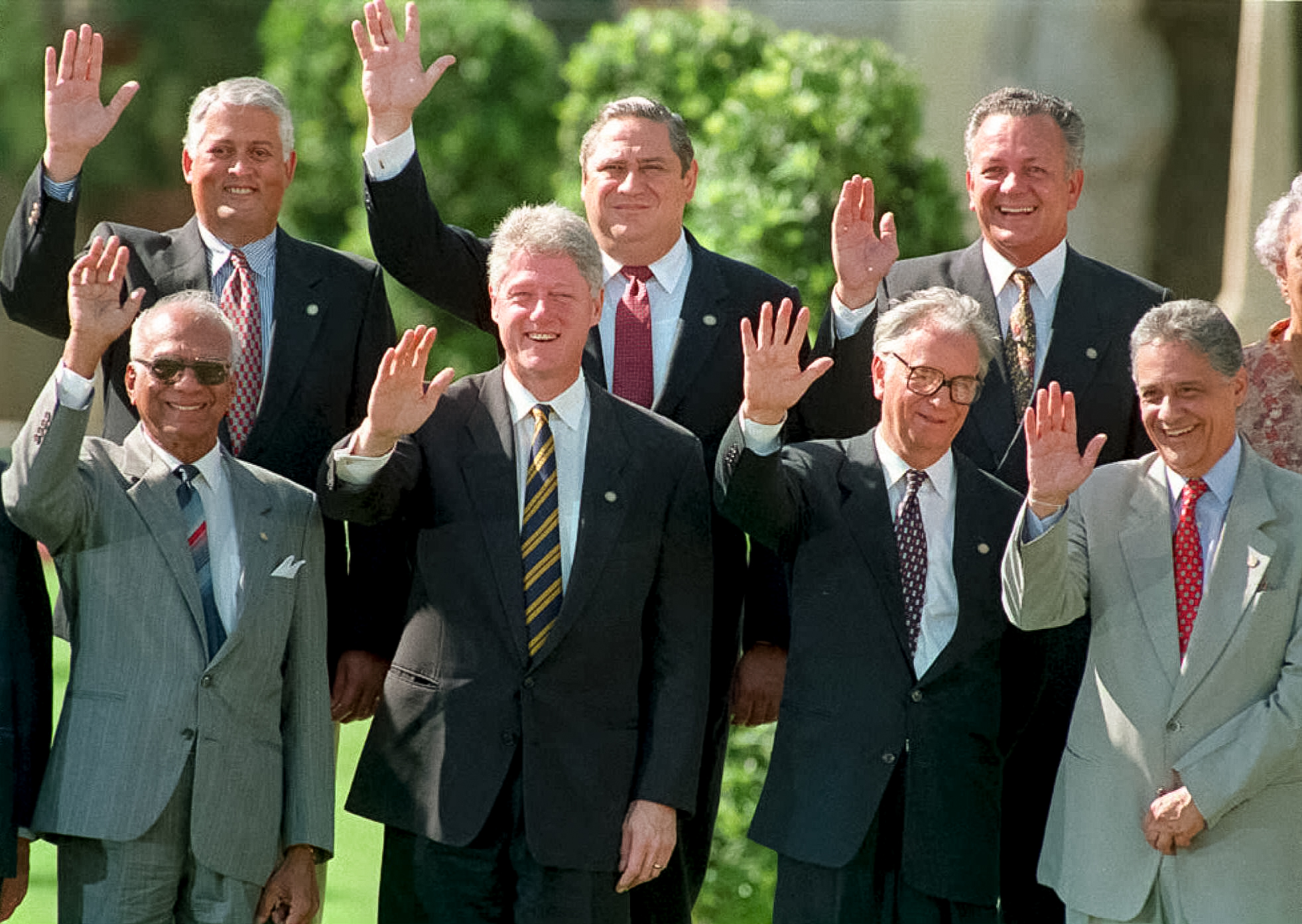
Ironically, Colby was reporting on his participation in Cusco, Peru, at the 17th Conference of Defense Ministers of the Americas—a forum we initiated in 1995, as a follow-up to the Miami Summit of the Americas. In Miami, we were focused on the consolidation of civilian democratic rule and felt that a visible presence of U.S. and regional military officers could muddy the waters. But we recognized that the hemisphere’s defense establishments had important roles to play in supporting civil institutions, combatting organized crime and international terrorism, and reducing border tensions between states through confidence-building measures. Hence, our launch of the periodic defense ministerials.
Colby also asserts that we failed to recognize geography and the importance of our regional neighbors. U.S. foreign policy is always a tussle between the general and the particular, the global and the regional. But it was the Clinton administration that initiated the Summit of the Americas and its associated Free Trade Area of the Americas (only partially realized)—over the objections of many of the globalists in the government. We also passed the North American Free Trade Agreement (NAFTA), initiated by President George H.W. Bush, and intervened to assist Mexico in righting its financial system after the collapse of the peso. Throughout the region, we worked with local allies to stabilize friendly, democratic governments—manifestly pragmatic, realistic policies in the U.S. national interest.
Rather than degrade his predecessors, Colby would have done well to recognize their achievements that laid the foundations for his own aspirations. Alas, such generosity would not be characteristic of those who serve at the pleasure of President Donald Trump.
— Richard E. Feinberg is currently at work on a memoir of his life-long engagement in inter-American affairs. He has worked at the National Security Council and U.S. Departments of Treasury and State, at numerous public policy institutes, and as a Peace Corps Volunteer in Chile.