


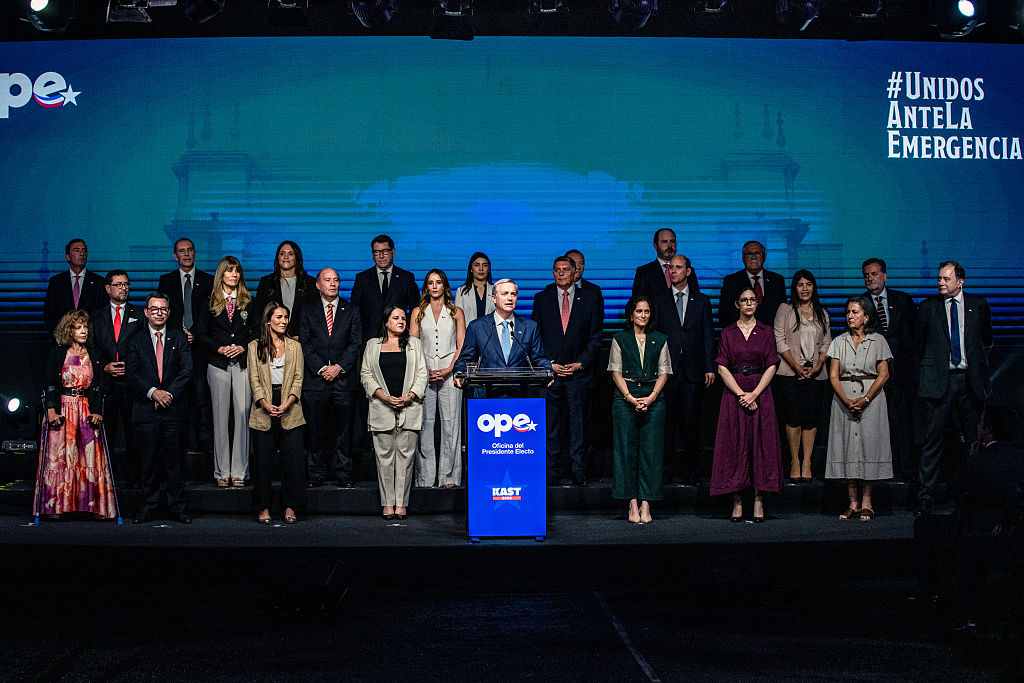
SANTIAGO—Since his magnanimous (and somewhat unfocused) speech on election night back in December, observers have noted that Chilean President-elect José Antonio Kast has made an apparent move towards pragmatism. This broad-tent approach appears to be a shift away from the ideological hardline figure voters came to know in the past. Kast’s recently announced Cabinet appointments seem to reflect this new strategy.
Political parties, even those who firmly supported the Kast candidacy, have taken a back seat. Just 8 of the 24 ministers are members of a political party. Ideological signaling is largely muted. Appointments tend to emphasize technical expertise, managerial experience, or professional credibility over partisan pedigree. To some, this looks like a welcome departure from polarized politics: execution over slogans.
But as Slavoj Žižek has famously argued, there is no politics without ideology, and the claim to be “beyond ideology” is itself one of the most powerful ideologies of all. Presenting decisions as purely technical or managerial does not eliminate ideology; it just conceals it.
Kast’s Cabinet resembles a Board of Directors, reflecting a worldview in which markets are trusted, politics is treated as an obstacle to efficiency, and governance is framed as a problem of administration rather than power. That is not an absence of ideology. It is a distinct ideological position, one that prioritizes order, predictability, and economic rationality while relegating conflict, representation, and mediation to the background.
Key ministries are concentrated in the hands of individuals deeply embedded in Chile’s major business conglomerates and associations. Foreign affairs, the economy, mining, education, and the environment have all been entrusted to figures whose professional trajectories run through corporate boards, business lobbies, and economic think tanks closely aligned with Kast’s interests.
In other ministries, Kast has opted for lawyers with close ties not only to big business, but who were active in the defense of dictator Augusto Pinochet, either during his extradition hearings in London (Minister of Defense Fernando Barros), or for accusations of financial misdeeds (Minister of Justice and Human Rights Fernando Rabat and the Riggs case). These appointments are a nod to Kast’s more hardline supporters.
Herein lies a risk for the administration taking office on March 11: Relying on business experience as a proxy for governing capacity rarely works. To address today’s most pressing challenges in Chile, from security to economic stagnation, Kast and his Cabinet will have to seek political solutions.
Chile’s swing to the right
It is not hard to see why Chileans have opted for this approach. The country is exhausted. Over the last five and half years, Chilean society has undergone a violent uprising, a pandemic, two presidential elections in which a Communist candidate had a fairly decent chance at winning, two failed constitutional conventions, several referenda, and a sluggish economy made worse by the notion that withdrawing money out of pensions savings (about $50 billion in total) would be a smart thing to do.
At the same time, voters have perceived (rightly or wrongly) a rise in violent crime and uncontrolled immigration. For four of those five and a half years the government has been led by former student leaders, convinced, as one of them claimed, that their “values differ from those of the generation that preceded us,” and bent on designing a new kind of progressivism for the 21st century.
The political pendulum has now swung towards a pro-market, pro-order, socially conservative approach, and this is reflected in Kast’s cabinet choices. As the columnist Daniel Matamala pointed out last weekend, the defining characteristic of the cabinet is economic power.
Deep-seated political challenges
The problem is that Kast’s pro-business Cabinet may not be well-positioned to address the demands and underlying conflicts of Chilean politics. Political representation is still in crisis, as the traditional political parties appear to be imploding. Unemployment remains stubbornly high. Public services are excellent in regional terms, but often involve top-up fees and long waiting lists. Pensions remain too low. All in a global context in which shifting priorities, loyalties, and hegemonies are causing extreme uncertainty.
The idea that the solutions to these challenges can be achieved by managerial competence alone risks misunderstanding how power actually functions in democratic systems. Leaders who come from the private sector often assume that government is simply a larger, slower firm—one that needs better incentives, tighter controls, and clearer hierarchies. Experience suggests otherwise.
As Max Weber warned, the state is supported not by efficiency but by legitimacy. Decision-making in government is not about maximizing returns—it is about managing conflict within the constraints that institutions (financial, legal, technical) impose.
Business leaders frequently struggle in office not because they lack intelligence or discipline, but because they underestimate the political nature of government, indeed, of life. As President Donald Trump is now discovering, while markets reward bold decisiveness, politics punishes unilateralism. Companies can declare bankruptcy, but governments must absorb failure.
Looking ahead
So what can we expect in the coming months? Almost every recent administration has had to make a cabinet adjustment in its first year, usually in the early winter when students begin to demonstrate or the first mistakes of government become known. Presidents from Michelle Bachelet to Gabriel Boric were forced to bring in more experienced hands, people who could negotiate with Congress, who understood that communications matters, or who knew how to navigate the complicated waters of public bureaucracy.
Kast has already proven that he is eager to get going, able to cut losses when necessary, and willing to correct course when required. His job is now to turn his Board of Directors into a Cabinet, and convince them that while shareholders can be ignored, citizens cannot.
ABOUT THE AUTHOR
Robert L. Funk
Reading Time: 4 minutesFunk is an associate professor of political science at the University of Chile’s Faculty of Government and a partner in Andes Risk Group, a consulting firm.