


This article is adapted from AQ’s special report on Mexico’s path forward
Find a bookshelf, close your eyes, and ask it a question. To get an answer, choose any book and land your eyes on the passage that feels right.
In Valeria Luiselli’s new novel, Beginning, Middle, End, a recently divorced novelist plays this game with her daughter. With so much to say about this book, I played the game, too. I landed on this passage, a conversation between the two of them about the characters in the mother’s new novel:
Is that mother and daughter you and me? Or you and your mother?
Neither. It’s a narrator and a character.
Is it a ghost story?
No.
Is it about time travel?
No, it isn’t.
Three denials that Beginning, Middle, End overturns. It is them; it is a ghost story; and they will travel in time. The novel follows a mother and her 12-year-old daughter across Sicily as they drive to return a mosaic that Nanna, the girl’s great-grandmother, dug out of a Roman villa and carried to Mexico in the 1920s. In a narrative that spans four generations, Luiselli reflects on how a story moves across places and people.
Geographic borders are one of Luiselli’s long subjects. Born in Mexico City but now based in New York, Luiselli writes in both English and Spanish. Her 2019 novel Lost Children Archive is set on the U.S.-Mexico border and follows the children crossing it. Now, in Sicily, the crossing between Africa and Europe, migrants are waiting “to be either seen or ignored by asylum officers.” The park they walk in is near the port Nanna left from, headed for Latin America, along with other Europeans fleeing poverty. “So that’s a contradiction,” says the daughter.
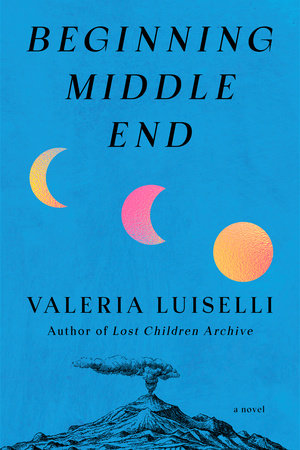
Beginning, Middle, End
Valeria Luiselli
Knopf
July 2026
464 pages
That border isn’t the only one they cross while trying to reconfigure their family after divorce. The story moves between countries, generations, memory, fiction and reality. The first denial—that the story isn’t about them—comes undone when the mother realizes her daughter has borrowed memories from her books. The daughter is certain that at five, she almost drowned in a swimming pool shaped like a guitar in Memphis. It isn’t a memory, though. It’s a scene from one of her mother’s novels. Imagination and memory flow together “in such a way that we will not know how to tell things apart one day.”
Forgetting runs in the family, too. Nanna lost her mind, and the girl’s grandmother is on the same path. These two women are the book’s ghosts, leading the story from afar and underscoring the importance of female lineages and inheritance. The mother, who read that translation could slow the erosion of the mind, asks the grandmother to memorize passages from books and translate them—“a dike, even if temporary, against forgetting.” The grandmother then sends the girl one of those fragments with a mission: find the book it’s from. Playing the bookshelf game, eyes shut, the daughter pulls down a book and, surprisingly, finds the same one. “That cannot be a coincidence,” the daughter says. It’s a sign, which, in this book, is how you talk to ghosts; how you continue their stories.
More than coincidences or predictions, the book portrays these moments as consequences. The past never stays behind. That’s how the last denial, time traveling, falls. “Someone from the past can show up in the future,” says the daughter, “because their soul can travel and become different things.” What seemed distant keeps collapsing into the same story because the present is in constant conversation with the past.
What Beginning, Middle, End never denies is that a story belongs to whoever picks it up next. It succeeds in portraying four generations of women, and how they inherit each other’s unfinished work. “The soul of our story, mother and daughter, had always been driven by me, my decisions,” the mother admits, “but it’s no longer clear to me whose breath it is that animates it, our story.” An inheritance only moving downward would be an ending. This one runs both ways, which is why the book can only be a middle.
ABOUT THE AUTHOR
Daniela Ordoñez Delgado
Reading Time: 3 minutesOrdoñez Delgado is a Colombian writer, literary translator and editorial assistant at Sundial House. Her translation of 69 38 78, by Juan Carlos Méndez Guédez, is forthcoming in October.

Greek Mythology and Mexican Corridos Collide in a Startling Short Story Collection
Dahlia de la Cerda’s latest book takes on what it means to be a woman living through Mexico’s security crisis.
A Classic Cortázar Novel Is Back
"A Certain Lucas" gets a new edition at an opportune moment.