


GUAYAQUIL—At a private shooting range on the edge of Ecuador’s largest city, helicopters touched down, and government officials climbed out of black SUVs. Former Noboa government Cabinet minister José de la Gasca, in tan tactical gear, took aim at a bullseye and fired. Behind the firing line, beside a bar whose sign read We don’t call 911, we use COLT, a champion sport shooter told me his bulletproof-vest company was thriving.
The same afternoon, 20 minutes away, families gathered for lunch in a backyard beneath a different sign: ¿Dónde Están? They had come from across the country to help one another search for relatives who, they said, had been disappeared by the police or military. Sara Castillo told me about her intellectually disabled son, Bruno Rodríguez, who had been digging a drainage ditch outside their home in the coastal city of Esmeraldas when a military patrol took him and his brother-in-law, Fardi Muñoz. They never appeared in any jail. When Castillo sought official records of their arrests or whereabouts, she was told they were classified. She had never stopped searching. “No one else took them,” she said. “It was the state.”
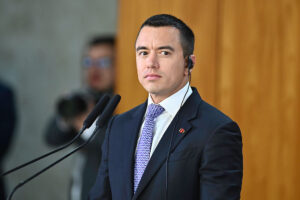
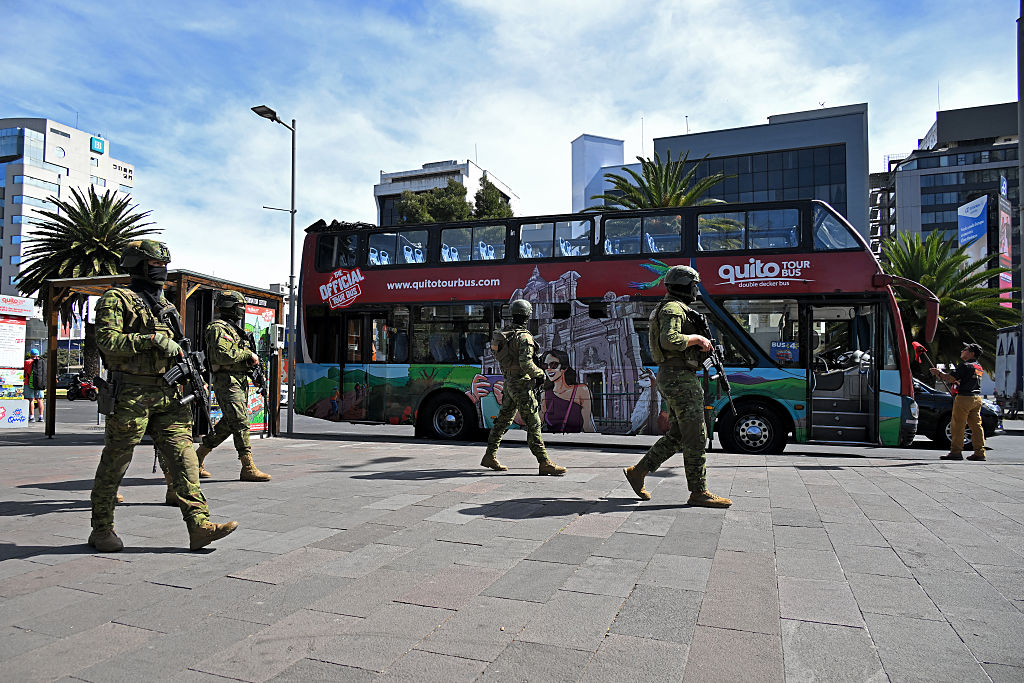
These are the faces of Ecuador under President Daniel Noboa as his security crackdown moves into its third year. A militarized state has, with U.S. assistance, decapitated some of the gangs responsible for South America’s highest homicide rate and reduced murders 11% from last year, according to official statistics. But these tentative gains sit uneasily alongside concerns about democratic erosion, human rights abuses, and unresolved impunity: the factor that, more than any other besides international drug demand, allows criminality to thrive in Ecuador.
Noboa, 38, took office in a special election in 2023 and was reelected last year, inheriting a country that had gone from one of South America’s safest to its most violent over the last decade, as gangs battled over its trafficking routes. Having promised to pacify the nation and boost growth, Noboa’s supporters—around 40% of the country—believe he may now be inching toward success. The past year has seen the capture or death of roughly 14 major gang leaders at home and abroad, and prison massacres, once common, have abated.
The U.S. is sending military advisors and increased security assistance, while Italy is supporting prison reform. Meanwhile, Ecuador’s long-struggling economy has shown signs of recovery following a steep recession in 2024: Growth was 3.7% last year, and the IMF projects 2.5% this year. Country risk, a measure of financial health, has fallen from over 2,000 at the time of Noboa’s re-election to under 400 today, and his government has substantially reduced long-untouchable gas subsidies.
However, even with murders apparently down, 2026 is still on course to be Ecuador’s second deadliest year ever. Rotating deployments of Ecuadorian security forces may be simply fragmenting and scattering gangs, not dismantling them, as the joint command of Ecuador’s military indicated in February.
Noboa’s Ecuador has drawn comparisons to Nayib Bukele’s El Salvador. For now, the two models are more different than similar. Bukele dismantled all checks and balances on executive power, eliminated due process, and turned his country’s prisons from revolving into one-way doors—roughly tripling their population and releasing less than a tenth of all those originally detained in his crackdown. Noboa does not have the same total control of all branches of government, has lifted fewer legal guarantees, and his government has released most of the detainees picked up in sweeps for lack of evidence, increasing Ecuador’s prison population, on net, by only a few thousand in his time in office.
Still, Ecuador faces the question: what if the crackdown isn’t really improving security, while civil liberties and democracy slip away in the process?
The costs of the crackdown
In Noboa’s second term, disturbing scandals have gone unanswered: More inmates now die of starvation, tuberculosis, and other causes in prisons—over 1,000 last year—than in the worst years of the massacres. The interior minister, John Reimberg, deemed the June death of anti-corruption activist Monika Silva a suicide before an autopsy showed she had been beaten and strangled. A judge, Carlos Serrano, fled into exile after rebuffing pressure from the chief of the judiciary to go easy on a Serbian money launderer (facing pressure, Noboa later called for the chief’s resignation, which he tendered). Fishing crews are being tracked by mysterious foreign aircraft, bombed, and disappeared off Ecuador’s coast—survivors believe, by the U.S. military or private military contractors—without a meaningful domestic investigation to determine what is happening. The list goes on.
Doubt about the country’s direction extends beyond the leftist opposition. Luis Altamirano, a retired general who once commanded the army, told AQ he fears the anti-gang war has become an end unto itself—a self-perpetuating means of justifying opaque, expanding budgets without a larger strategy. “They sell us the idea of walking toward the horizon,” he said, “but every step you take, the horizon stays the same distance away.”
In the interim, Ecuador is paying a cost. The UN documented at least 51 alleged cases of enforced disappearances by state security forces in 2024 and 2025. Only one set of cases—that of four minors in Guayaquil whose burned bodies were later found—led to convictions, of 16 Air Force personnel. Having initially blamed their disappearance on gangs, the government later seized control of the municipal camera system that had captured key evidence.
Democratic backsliding
Democracy is eroding on multiple fronts, with little pushback. This spring, three opposition parties—including Citizen’s Revolution, the party of former President Rafael Correa (2007-2017) and the largest bloc in Congress—were suspended or dissolved over alleged irregularities or criminal probes, with a fourth under investigation. The electoral authority then moved local elections up to November, effectively blocking these political organizations from participating.
Prosecutors have raided, summoned, and jailed the mayors of Cuenca, Quito, and Esmeraldas, respectively; Guayaquil’s mayor, Aquiles Álvarez, has been in a maximum-security prison since February, after promising to expose “the truth about drug trafficking and the ports” in the city. Many interpreted this as a reference to the repeated cocaine seizures in the Noboa family firm’s banana shipments, and the president’s potential involvement. Noboa insists he and his family were not aware of the contaminated containers and have cooperated with police. Some of these cases may have merit, but their timing suggests an effort to weed out competition.
The Constitutional Court, the country’s top tribunal for constitutional review and a rare check on executive power, is under pressure, too, since a government-aligned comptroller announced audits of its judges, two of whom now face criminal investigations.
Ecuador was once a nation that protested, ousting several presidents in the 1990s and 2000s and paralyzing the country repeatedly since. Less so lately. The government responded to major demonstrations last October with prosecutions of civil society leaders, asset freezes, and a police response that left dozens injured. There have been no equally large protests since. Fear may be one factor. Another is that opposition takes energy, and with over 300,000 Ecuadorians internally displaced—the third-highest total in the Americas—and countless more contending with daily extortion and violence, that is in dwindling supply.
Noboa may be vindicated if homicides, extortion, and disappearances fall. What looks like rudderless militarization and mere gang fragmentation may prove to be the start of slow pacification. And if opposition candidates win significant cities in the November elections, and the government respects those outcomes, Ecuador’s democracy may be more resilient than it appears.
But if yet more critics are jailed, more journalists flee, and more people like Sara Castillo’s son disappear, Noboa may end up emulating the most criticized parts of Bukele’s model without any of its benefits.
ABOUT THE AUTHOR
Will Freeman
Reading Time: 5 minutesFreeman, Ph.D., is a fellow for Latin America studies at the Council on Foreign Relations.

Ecuador: A 2026 Snapshot
AQ tracks key indicators and political and economic trends to watch in 2026.
The Ecuador-Colombia Trade Spat Is a Zero-Sum Game
Both countries stand to lose as their economies take hits and criminal groups benefit from a breakdown in cooperation.