


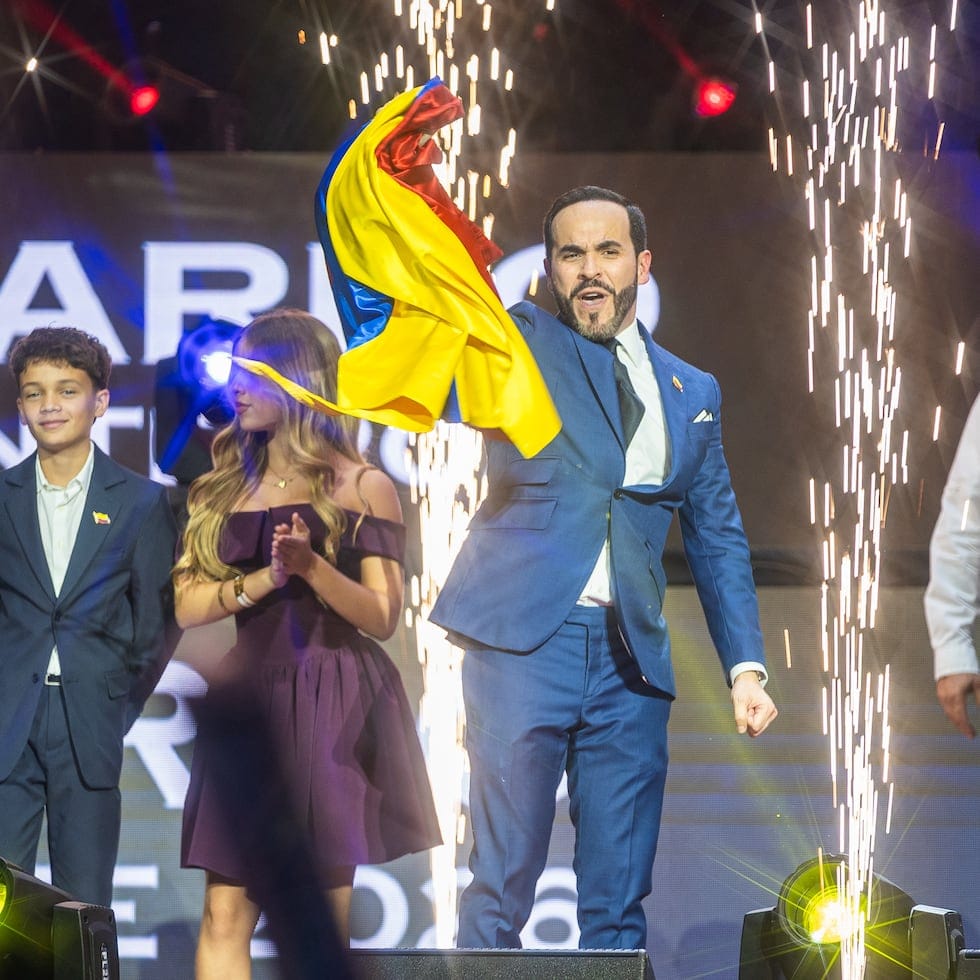
BOGOTÁ—He calls himself “the tiger,” a nickname that, according to him, signifies a big heart, strength, endurance, and character. Another recurring theme in his campaign is la patria: in speeches, interviews, and social media posts, the 47-year-old criminal lawyer talks constantly about the homeland. On these occasions, or when greeting potential voters, he salutes and then yells, “Stand firm for the Nation!” These are parts of the public image that Colombian presidential frontrunner Aberlardo De La Espriella is cultivating, aiming to win the nation’s first-round election on May 31.
It seems that this strategy—which includes sending a “defender of the homeland” kit to anyone who asks for it on his website—is working for De La Espriella. According to a poll published by Colombia’s leading political magazine Semana on February 7, his name led voters’ preferences with 32%, followed by Senator Iván Cepeda of the ruling Pacto Histórico, the coalition that brought current President Gustavo Petro to power.
“Abelardo is clearly the main outsider in this race, the one who claims he differs from politics as usual,” Miguel Silva, a well-known local political strategist who has worked throughout Latin America, told AQ. “He has been very effective in building a credible campaign with a very smart use of modern techniques.”
Silva also highlights De La Espriella’s resemblance to Nayib Bukele, the president of El Salvador. “This goes beyond the goatee and includes an emphasis on security and many elements from the extreme-right playbook, beginning with restoring order and letting people prosper,” he explained.
Amid his recent surge in the polls, De La Espriella’s hardline security policies, as well as his controversial former client list as an active Miami-based lawyer, have worried some observers. His background as a criminal lawyer, his lack of experience in government, a private jet and a lavish lifestyle, and his unorthodox campaign have all shocked the establishment. But being different is his strength in a country that almost elected runner-up Rodolfo Hernández in 2022 (who lost to Petro by 0.6 percentage points). Clearly, Abelardo is not politics as usual.
Nothing ensures that De La Espriella will be able to maintain his present position. Running on a conservative platform that seeks to take advantage of the recent victories of right-wing candidates in Latin America, De La Espriella’s case is also relevant because he is running without a formal political party supporting his bid. He recently visited Madrid, meeting Santiago Abascal, the leader of VOX, Spain’s largest far-right party, and also participated in the so-called Foro de Madrid, an alliance defending conservative ideas following the steps of Argentina’s President Javier Milei, Chile’s José Antonio Kast, and Italy’s Giorgia Meloni.
Colombia will hold three presidential primaries, ranging from the center-left to the center-right, on March 8, when legislative elections will also take place. The primaries’ contenders include former Bogotá Mayor Claudia López and Senator Paloma Valencia. Sergio Fajardo, former governor of Antioquia province, has announced that he will go directly to the first round of the presidential election.
On May 31, voters will pick between two big names from the right, two from the center, and two from the left. No candidate is likely to earn more than 50% of the vote, so the election will probably go to a second-round runoff, scheduled for June 21. The field is still quite open, according to Silva.
It will not be until the primaries take place that things will be more defined. In the case of the right, the big question is whether Paloma Valencia (who represents Álvaro Uribe’s Centro Democrático) will win, and by how many votes. A strong showing might weaken De La Espriella, who in the past has sought Uribe’s blessing.
For the center, Claudia López, Bogotá’s former mayor, could be revitalized by the primaries, and Fajardo is betting that his decision to go straight to the first round will appeal to independent voters who might appreciate his consistency. On the left, Iván Cepeda could be challenged if Roy Barreras—a political operator, former senator, and former ambassador to the UK—beats his opponents in the primary of the Frente por la Vida coalition that comprises some of Colombia’s left-wing parties. Cepeda and the ruling coalition were barred from participating in this primary, as he won the one held by Pacto Histórico last October.
Key proposals
In the meantime, De La Espriella has picked up his pace. Committed to visiting each of Colombia’s 32 provinces, he is focused on making his proposals known, from “saving” the health system in fewer than 90 days after taking office, to stabilizing public finances and imposing “democratic authority.” This would be a reformulation of Uribe’s 2002 “seguridad democrática” policy, which is described as imposing order using the strength of Colombia’s state.
“The first thing we have to do in order to retake control of security is to eradicate coca crops using different means, including fumigation. Cocaine is our worst cancer,” the candidate told AQ in an interview in Bogotá last week. With more 262,000 hectares cultivated in 2024 (a record), Colombia’s cocaine production likely surpassed the 2,664 tons calculated by the United Nations for 2023, also a record high. Fumigating coca plants with glyphosate, however, was prohibited by the Constitutional Court in 2015.
De La Espriella wants the country to have stronger ties with the U.S., both to fight drug trafficking and promote investment. “I fully agree with Trump’s actions on interdiction because for them, and for us, narcotrafficking is a national security issue,” he added.
When asked about the leaders he admires, the list is long. Past figures include Winston Churchill, Margaret Thatcher, Ronald Reagan, and Silvio Berlusconi, and De La Espriella cites Álvaro Uribe, Georgia Meloni, Nayib Bukele, Javier Milei, and Donald Trump as admired leaders from the present.
Regarding Latin America, De La Espriella believes that the region is headed in the right direction. “It is not a matter of labels like left or right, but what common sense dictates,” he told AQ. “We are returning to sanity,” the lawyer added.
It was during a TV interview aired on February 24, 2019, that De La Espriella first publicly toyed with the idea of running for Colombia’s highest office. At that time, he said that any decision was contingent on “the nation being in danger.” When he finally jumped into the arena last year, he said that the time for standing firm for the homeland had finally come. Soon after, he began to receive high marks in the polls, but it was not until last week that he polled in first place in Semana‘s survey.
A flamboyant personality
The holder of Colombian, American, and Italian passports, De La Espriella lives in Miami with his wife and four kids. Although he was born in Bogotá, the candidate presents himself as a costeño, a nickname for people from Colombia’s Caribbean region.
Despite his security detail—considered a must after presidential hopeful Senator Miguel Uribe Turbay was assassinated last year—he greets people on the streets, makes jokes, and speaks colloquially to any audience, sometimes using foul language. De La Espriella also loves dancing and singing (with three records already produced), and wears expensive clothes and watches. Several years ago, he launched De La Espriella Style, a fashion brand.
On a tougher note, De La Espriella insists that life is like a boxing match. As a founder of a successful law firm, he has amassed a fortune that allowed him to buy a private plane.
“Acting discreetly is not one of his trademarks,” said someone who knows him well. “Marketing is what he is successful at, besides being a ferocious lawyer and adversary,” that person added. “One of the great things in life is giving my enemies envy,” the candidate has often said.
Controversial clients
The list of people who have retained his legal services includes artists, politicians, and individuals with alleged links to paramilitary groups. Probably the most controversial is Alex Saab, the Colombian national who was particularly close to Nicolás Maduro and served as a minister in Venezuela until recently. Arrested in Cape Verde in 2020 and then held in the U.S. on bribery charges, Saab was part of a prisoner exchange for the release of Americans held in Venezuela in 2023. According to some reports, Saab is now detained in Caracas.
When questioned about that relationship, the candidate denies any wrongdoing and does not avoid the subject. “The last time we spoke was six years ago,” he explained in an interview with AQ. De La Espriella also said that the professional relationship took place when Saab was living in his native Barranquilla, before moving to Venezuela. “After he went to Caracas, I even sat him down with the Americans, but he refused to cooperate. I never saw him since that time,” he added.
Although he has spoken openly to the media, he has had a contentious relationship with many journalists. From 2008 to 2019, De La Espriella filed more than 100 insult and slander complaints, according to Colombia’s Foundation for Press Freedom (FLIP).
An “odd fish”
Warnings about De La Espriella are easy to find. “He does not represent a democratic alternative,” Professor Juan David Rivero wrote last year as De La Espriella’s name started to gain public traction. “He represents, on the contrary, a latent danger for the future of our freedoms,” Rivero, a supporter of left-wing contender Iván Cepeda, added in his article. Others have expressed more direct warnings. Fellow candidate Sergio Fajardo wrote to De La Espriella on X: “If you become president, it would be a calamity for Colombia.”
Confronted with these opinions, the candidate responds briskly. “I am not an authoritarian, I am a firm believer in democracy, respectful of the Colombian Constitution and the law,” he told AQ. “When I am president, we will have free and fair elections, and I will transfer power to whoever gets elected in 2030,” he added.
De La Espriella describes himself as an odd figure in the race. “I am not a politician but a businessperson who prospered because of hard work,” he said. “I have beliefs and principles, not ties. And I know I’m an odd fish, but not a dangerous one,” he added.
As the campaign enters its final stretch, it’s highly possible that the temperature will rise even more, especially if De La Espriella continues leading the polls. But this lawyer-turned-politician does not seem worried about it. “Another stripe for the tiger” is his response.
ABOUT THE AUTHOR
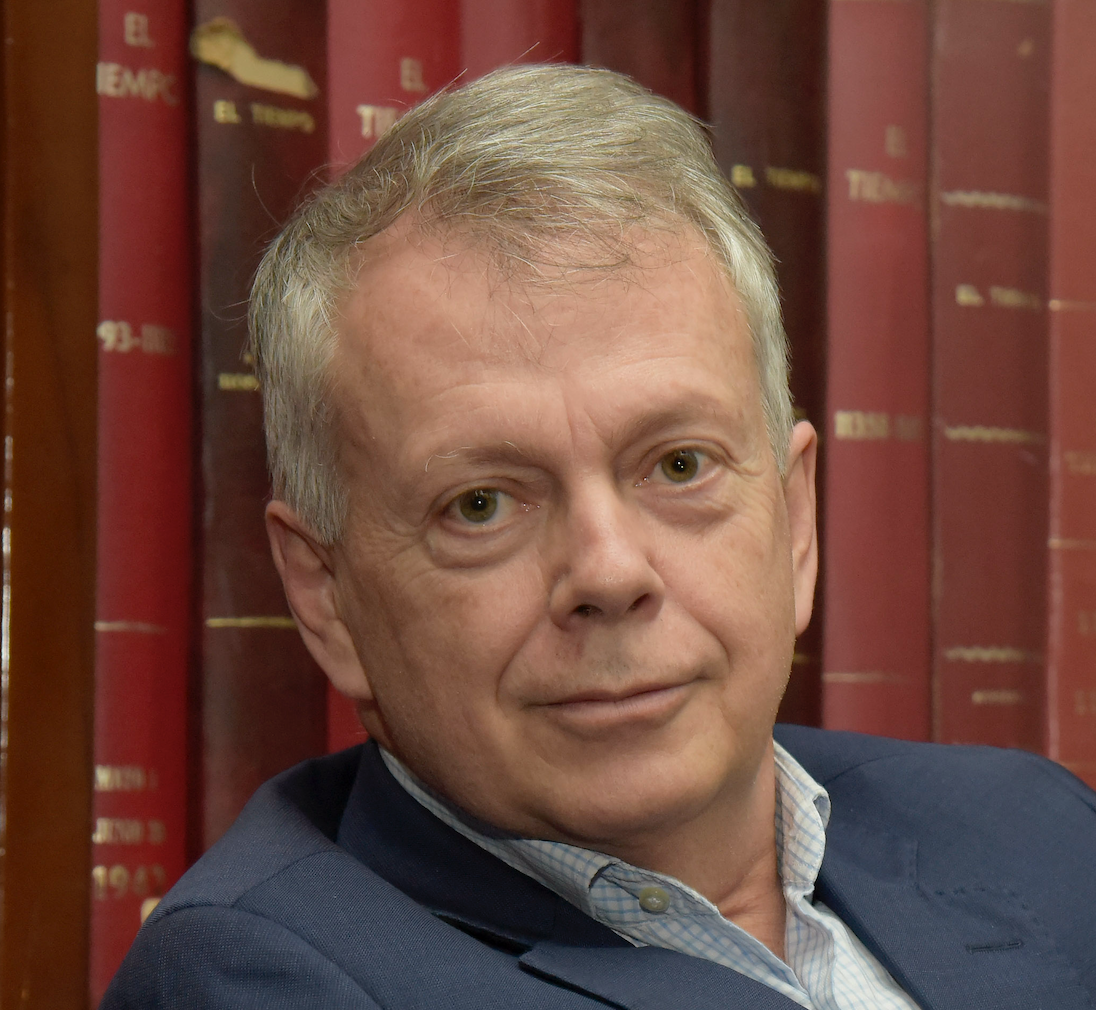
Ricardo Ávila
Reading Time: 6 minutesÁvila is a senior analyst at El Tiempo and a political consultant in Bogotá, Colombia.

Colombia: A 2026 Snapshot
AQ tracks key indicators and political and economic trends to watch in 2026.
The Ecuador-Colombia Trade Spat Is a Zero-Sum Game
Both countries stand to lose as their economies take hits and criminal groups benefit from a breakdown in cooperation.