


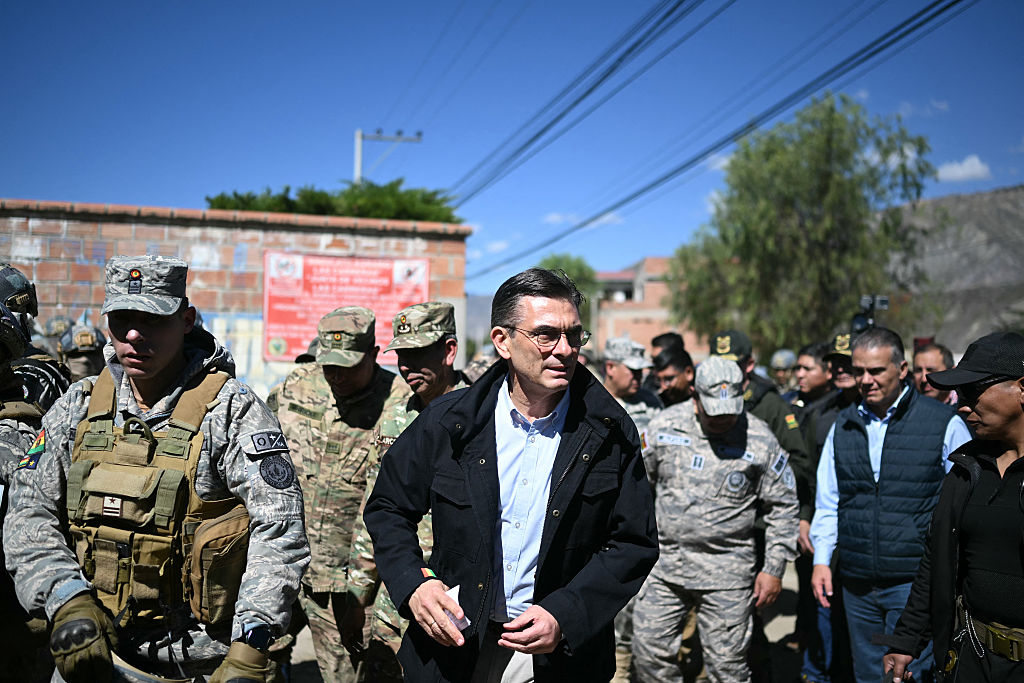
Nine months ago, Rodrigo Paz Pereira’s new presidency seemed to signal a fragile yet real opening in Bolivia.
The former senator and son of former President Jaime Paz Zamora had ended the two-decade dominance of the Movement Toward Socialism (MAS) party. Paz survived an extraordinary initial test, even after inheriting a severe economic crisis. He confronted powerful social movements, eliminated long-standing fuel subsidies, and restored relations with Washington and international financial institutions. His government appeared willing to make difficult decisions that its predecessors had deferred.
That assessment now requires substantial revision.
Bolivia is not stabilizing. It is entering a combined crisis of governance, economic credibility, and public safety. Fuel shortages have returned. The government has failed to turn its election victory into a sustainable legislative coalition, and Congress has become an arena of paralysis rather than reform. Social movements recently subjected the country to 53 days of blockades demanding Paz’s resignation. His own vice president, Edmand Lara, increasingly acts as a political adversary rather than a governing partner.
More ominously, organized crime is becoming more visible. Bolivia has long been an important cocaine-producing and transit country, but the proliferation of contract killings and sicariato-style violence suggests a disturbing new normal.
In short, despite Paz’s efforts to prevent this, the personalism, corruption and institutional weakness that characterized the MAS years have endured, and are now seriously undermining state capacity. If Paz fails to right the ship, the country could enter a downward spiral of instability that will become increasingly difficult to escape.
A scandal of state vulnerability
The scandal surrounding Argentine political consultant Fernando Cerimedo and the extraordinary allegations that he orchestrated a sicario-style hit on his pregnant girlfriend, who was also his legal adviser, have shaken the country. She survived the alleged attack, which took place in Santa Cruz, and Cerimedo denies wrongdoing. But the case reinforced a public perception that powerful consultants and special interests are manipulating informal channels in government for their own ends.
This is particularly troubling because Paz took office promising to rebuild the country’s institutions after the MAS era. Evo Morales, Bolivia’s president from 2006 to 2019 and founder of the MAS, built a political machine based on harnessing patronage, social movements, and the concentration of presidential power. His successor, Luis Arce, inherited this system but eventually fought Morales for control of it. Their fracture helped destroy the MAS electorally.
Paz’s victory showed that Bolivians wanted change. Yet removing the MAS did not remove the political practices that the MAS ingrained in the state. Regardless of whether the Cerimedo allegations are true, they have put a spotlight on a serious problem: Bolivia’s crippled institutionality.
This problem is compounded by Paz’s failure to build a governing coalition. His Christian Democratic Party won the presidency but not the legislative strength to govern alone. Yet nearly a year later, Bolivia still lacks the agreements needed to confront structural problems.
Bolivia’s energy crisis is a good example. Paz managed to remove fuel subsidies, which was a major step forward. But investment and domestic production are still far too low. This is deepening the country’s dependence on imports and causing foreign currency reserves to dwindle. Long lines at gas stations have returned, providing a visible reminder that the dramatic measures of Paz’s first months left underlying issues unresolved.
The same may be true of his efforts to tackle organized crime. Bolivia occupies a strategic position in the South American cocaine economy, connecting production zones with Brazil, Paraguay, Argentina and ultimately European markets. The Brazilian criminal groups Primeiro Comando da Capital and Comando Vermelho, for example, seem to have expanded their reach in Bolivia. Increasingly brazen killings raise the possibility that Bolivia could begin experiencing a security breakdown like that of Ecuador or Colombia.
Pyrrhic victories
This raises uncomfortable questions for Washington. The U.S. understandably welcomed Paz’s election. Morales had expelled the U.S. ambassador and the Drug Enforcement Administration in 2008, and Paz reversed that trajectory, restoring close relations with Washington and renewing counternarcotics cooperation. These are positive steps, but without concerted efforts to shore up institutionality, they could have little impact.
The public’s reaction to the Cerimedo allegations highlights the dangers surrounding the internationalized world of campaign consultants and ideological political entrepreneurs. Cerimedo moved within right-wing networks that included figures connected to Donald Trump’s political operation and other conservative movements in Latin America.
This should provoke reflection in Washington. Political consultants can help win elections, but they cannot substitute for political parties, professional bureaucracies or functioning institutions. If they do try to take on these roles, they will deliver only Pyrrhic victories.
The danger now is that if Paz fails to right the ship of state, the next administration could be even more damaging than the MAS governments that came before. Vice President Lara is positioning himself as a populist opponent to the president. Morales remains a destabilizing presence. The traditional opposition is fragmented. Social movements retain the capacity to paralyze the country. Organized criminal networks are becoming stronger.
Paz still has time to reverse course and prevent a descent into instability. He will need to stand up a governing coalition, pass credible legislation, institutionalize anti-corruption mechanisms, and lay out a national security strategy commensurate with the growing threat posed by organized crime.
He can do so only if he focuses on rooting out the personalism, corruption and institutional weakness that have become so ingrained. The coming decade may depend on it.
ABOUT THE AUTHOR

Eduardo A. Gamarra
Reading Time: 4 minutesEduardo A. Gamarra, PhD, is a professor of politics and international relations at Florida International University, and associate director for basic research at the Jack D. Gordon Institute. He writes from Miami.
Bolivia’s Crisis Is About More Than Evo Morales
Current unrest reflects fractured political alliances and broader social changes, with existential implications for President Rodrigo Paz.
Bolivia’s Reform Agenda Is Moving, but Slowly
President Rodrigo Paz promised to turn the country around, yet he is shying away from his own agenda.