


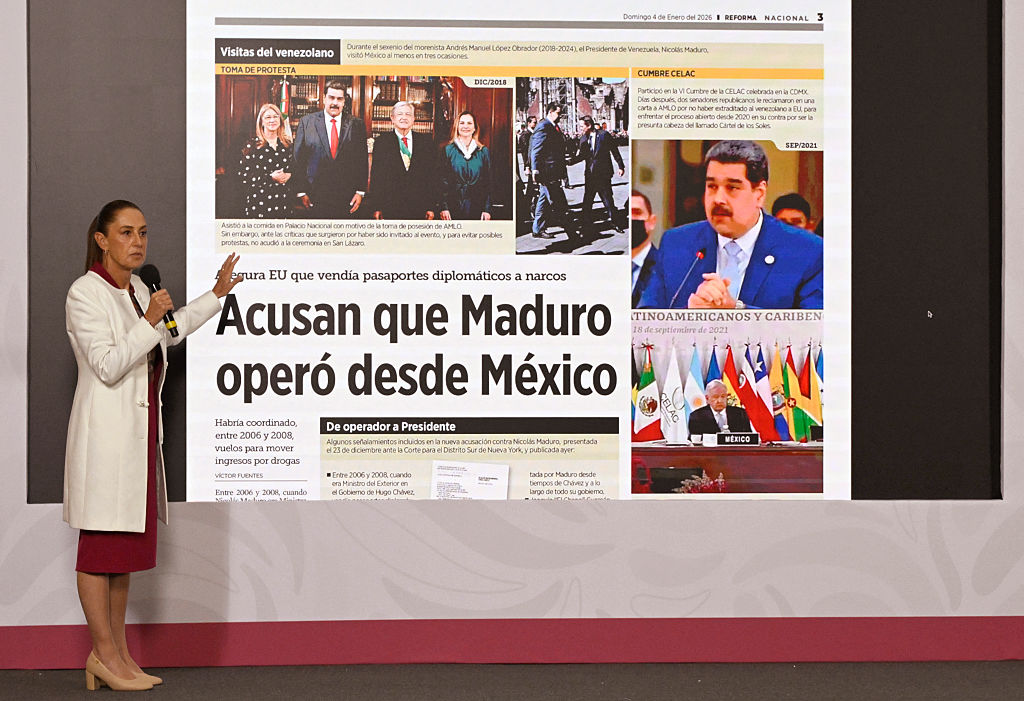

MEXICO CITY—Months of naval blockade culminated in the capture of Nicolás Maduro, unleashing a vortex of centrifugal shockwaves that threaten to alter the established order in Mexico. The political aftermath of the military operation, a spectacular logistical and intelligence success, could be enormous and deeply consequential throughout the region.
Some of the strategic considerations that led to the detention of the former Venezuelan dictator remain unknown, particularly whether there were understandings with global powers such as China or Russia—factors that would be highly relevant for other geopolitical flashpoints like Ukraine and Taiwan. Nonetheless, the potential effects on the northern region of the Western Hemisphere—the Caribbean, Central America, and Mexico—are unmistakable.
Venezuela’s internal political evolution will be complex, given an already unsustainable situation, but the first external victim will undoubtedly be Cuba, whose economy cannot survive without Venezuelan support. Until recently, Mexico had been a secondary actor in this equation, but the figures on Mexican oil shipments to the island, as the Financial Times recently documented, suggest that the kinds of pressures once applied to Venezuela will now shift toward Mexico.
A crucial question remains unresolved, especially for Central America and Mexico: How effective does the (historically formidable) Cuban security and intelligence apparatus remain? This matters for three reasons. First, because it has been essential to preserving the Cuban regime; second, because just like the so-called Russian Mafia that emerged after the Soviet collapse brought havoc to Europe and other developed countries, a “Cuban Mafia” could easily overwhelm the already frail security services of nations in the Caribbean, Central America, and Mexico; and third, because of what lies ahead for Venezuela.
Ultimately, the Maduro regime appeared to be sustained by Cuban intelligence and security forces. Maduro’s rapid capture suggests either that those security structures have deteriorated dramatically and lost functionality, or that collateral arrangements rendered them inoperative. Given the fragility of security in Central America and Mexico, this question is anything but irrelevant.
It will be important to observe how key power centers within Venezuela (and by extension Cuba) react: whether they adjust or rebel. Adjustment would mean accepting the blow as a fait accompli, followed by efforts to build a viable political arrangement. Rebellion would mean challenging Maduro’s removal to carve out space for any future settlement. Listening to statements from various Venezuelan military figures, it is clear that both options have backers. As Secretary of State Marco Rubio suggested, this is not an easy moment for Havana.
Ideological noise
No one can doubt that the Chávez–Maduro project is dead, but the interests behind it are not. Consequently, what can be expected is a great deal of ideological noise, but far more action aimed at “saving one’s own skin”—which may involve power, positions, money, or simply refuge. Some will choose to join new currents; others will resist. Much of the outcome will depend on how the U.S. government channels its efforts and how successful those efforts are. For Cuba, there is no more relevant issue than this.
Mexico is the final rung in the scheme conceived by the Trump administration and laid out in black and white in its recent National Security Strategy. The U.S. government knows it must proceed cautiously with Mexico, because any miscalculation would have repercussions directly on U.S. territory. At the same time, precisely because of the border that unites the two nations, all the virtues—but also the vices—that characterize the region converge in Mexico, many of them aiming to reach what was once the Promised Land. This is true of goods, services, and ideas, but also of illegal migration, corruption, drugs, and more.
American officials have so far been very cautious in their dealings with Mexico, and Mexico has been cooperating on security. However, discussion about unilateral American operations in Mexico has now, after Venezuela, gained new strength. Still, it would be a grave mistake: What Mexico needs is a strengthened security structure, which unilateral American actions would serve only to further undermine. Both nations should work out an arrangement to cooperate on security to both develop a professional security structure in Mexico and deal a devastating strike against not only drug cartels, but organized crime at large.
Mexico in the crosshairs
The current Mexican regime is not like that of Chávez–Maduro, but rather a very Mexican version of old PRI practices combined with new centralism. Although ideological discourse is ubiquitous (and fully embraced by certain factions within the governing coalition), Morena politicians, like their predecessors, adopt the rhetoric and adhere to dogma to preserve their positions, but never neglect their own pockets—especially when the leader guarantees impunity. The countless corruption cases that emerge daily speak for themselves. These are pragmatic politicians who adapt to the world as it is while exploiting the surrounding opportunities.
Yet it is precisely that pragmatism that is now in the sights of the U.S. government. This attention, given the initial success of the Maduro operation, will almost certainly intensify. It has been this pragmatism that has facilitated the growth of drug trafficking, of extortion that destroys the lives and futures of millions of Mexicans, and of organized crime more broadly. The same pragmatism that, unlike that of the old PRI, has led to the dismantling of key principles and institutions—such as judicial independence—threatens to paralyze, if not undermine, the future of the country’s economy. Pragmatism without limits and mores has its virtues, but its consequences can be devastating.
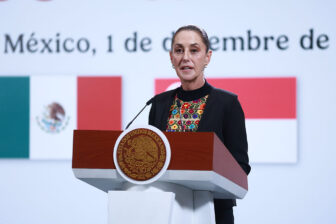
Interesting times lie ahead, as the Chinese curse goes. This is because the status quo is unsustainable—especially when its vices are being peeled away, leaf by leaf, in various U.S. courts, where scores of leading Mexican narco capos are on trial, likely disclosing unfathomable alliances with key politicians, without which organized crime could never function. The great question is whether Mexico’s president, Claudia Sheinbaum, will seize this as an opportunity to truly transform the country, or whether she will attempt to resist an unstoppable force.
ABOUT THE AUTHOR

Luis Rubio
Reading Time: 4 minutesRubio is chairman of the think tank México Evalúa. He writes a weekly column in newspaper Reforma, and is the author and editor of dozens of books, including Unmasked: López Obrador and The End of Make-Believe, published by the Wilson Center.