


This article is adapted from AQ’s special report on Mexico’s path forward
Take people unaware of who Ana Mendieta is to her exhibit at Tate Modern in London, and they will think she is a product of the present. Mendieta’s work is in tune with today’s sensitivity to themes of ecology and our relationship with the environment, yet she was most active in the 1970s and early 1980s. The Tate’s expansive retrospective, featuring over 120 of her works and running until January 17, 2027, shows how relevant Mendieta’s work remains, and what a trailblazer she was for the field of performance art.
Born in Havana in 1948, Mendieta was sent to the United States at the age of 12, one of thousands of unaccompanied Cuban children exiled as part of Operation Pedro Pan, a joint CIA-Catholic Church initiative to “save” them from communism. Like so many others, the experience defined her; she never felt she belonged anywhere.
“Having been torn from my homeland during my adolescence, I am overwhelmed by the feeling of being cast out from the womb,” she wrote in a statement about her work in 1981.
Her art was deeply intertwined with nature, inspired by it and created in it. Her most famous series is Siluetas, in which she left imprints—usually of her body—on sand, snow, earth, trees, or leaves, camouflaged in the landscape. She carved, molded, and literally played with fire, using gunpowder and fireworks to scorch her outline onto the earth as an expression of belonging. By fusing with nature, she explored the deep spiritual connection between body and ground, honoring nature’s power and meditating on her displacement after exile from Cuba. “I have no motherland, I feel a need to join with the earth,” she wrote in 1981.
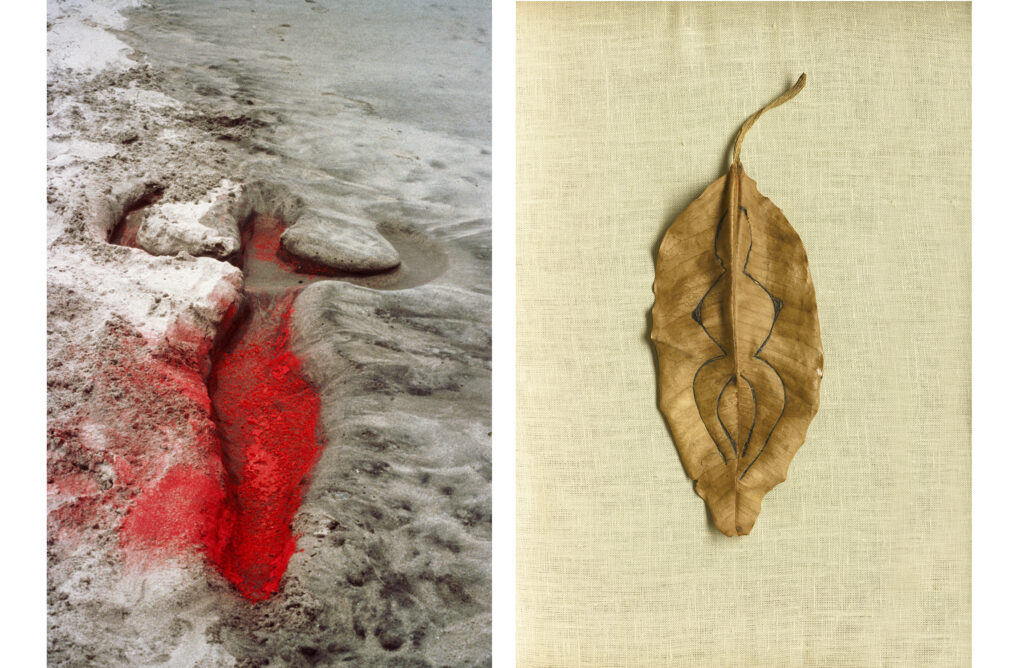
Her work was intentionally ephemeral, designed to be washed away or decay or dissolve through nature, but it was also filmed and photographed in her determination to preserve it. Mendieta made over 100 films in different formats, many of which have been digitally remastered for the Tate exhibitions. In one of them, she pours blood over her naked body and then rolls in white feathers, emerging as a new creature. In another, her silhouette in the sand, marked with red paint, is washed away by the waves. The Tate shows the full multidisciplinary range of her work, displaying paintings and drawings, sculptures and installations, performances and films, writings and photographs.
In 1980, when she returned to Cuba for the first time, she created her famous series Esculturas Rupestres, in which she carved Indigenous goddess figures into the limestone rock. Using her interest in cave art and Neolithic sites, she drew a continuous line between the art of the past and the present, while simultaneously connecting her personal identity to the island’s roots and tracing a reunion with her homeland.
Throughout her career, Mendieta pushed the boundaries of artistic expression in ways so prescient they feel more relevant than ever, especially in light of today’s environmental crisis. Her groundbreaking legacy, as the Tate puts it, “changed the course of contemporary art.”
The Tate’s exhibition is the largest yet of Mendieta’s work in the U.K., a thorough, thoughtful, life-affirming retrospective closely supervised by Raquel Cecilia Mendieta, her niece and the head of her estate.
Ana Mendieta died in 1985 at the age of 36. Her then-husband, sculptor Carl Andre, was charged with her murder but was later acquitted in a controversial trial. Both the museum and her estate made a deliberate choice not to mention Mendieta’s death and not to refer to the controversy surrounding it. It is a decision that sends a clear message: Her death does not define her, and, above all, it was not the end. As the exhibition shows, Mendieta’s art lives on in triumph.
ABOUT THE AUTHOR

Nicol Degli Innocenti
Reading Time: 3 minutesDegli Innocenti has been a London-based correspondent for Il Sole 24 Ore since 2004, covering politics, economics, arts and culture. Before that she worked for The Financial Times in Johannesburg and London. She has a Ph.D from the London School of Economics.
Frida and Diego Get New Life in New York
A collaboration between The Met Opera and The Museum of Modern Art gives the famed Mexican artists a fresh treatment.
Showcasing a Venezuelan Star of Conceptual Art
An exhibition in New York City displays Claudio Perna’s radical 20th-century experiments in mixed media.