



This article is adapted from AQ’s special report on Latin America’s space race
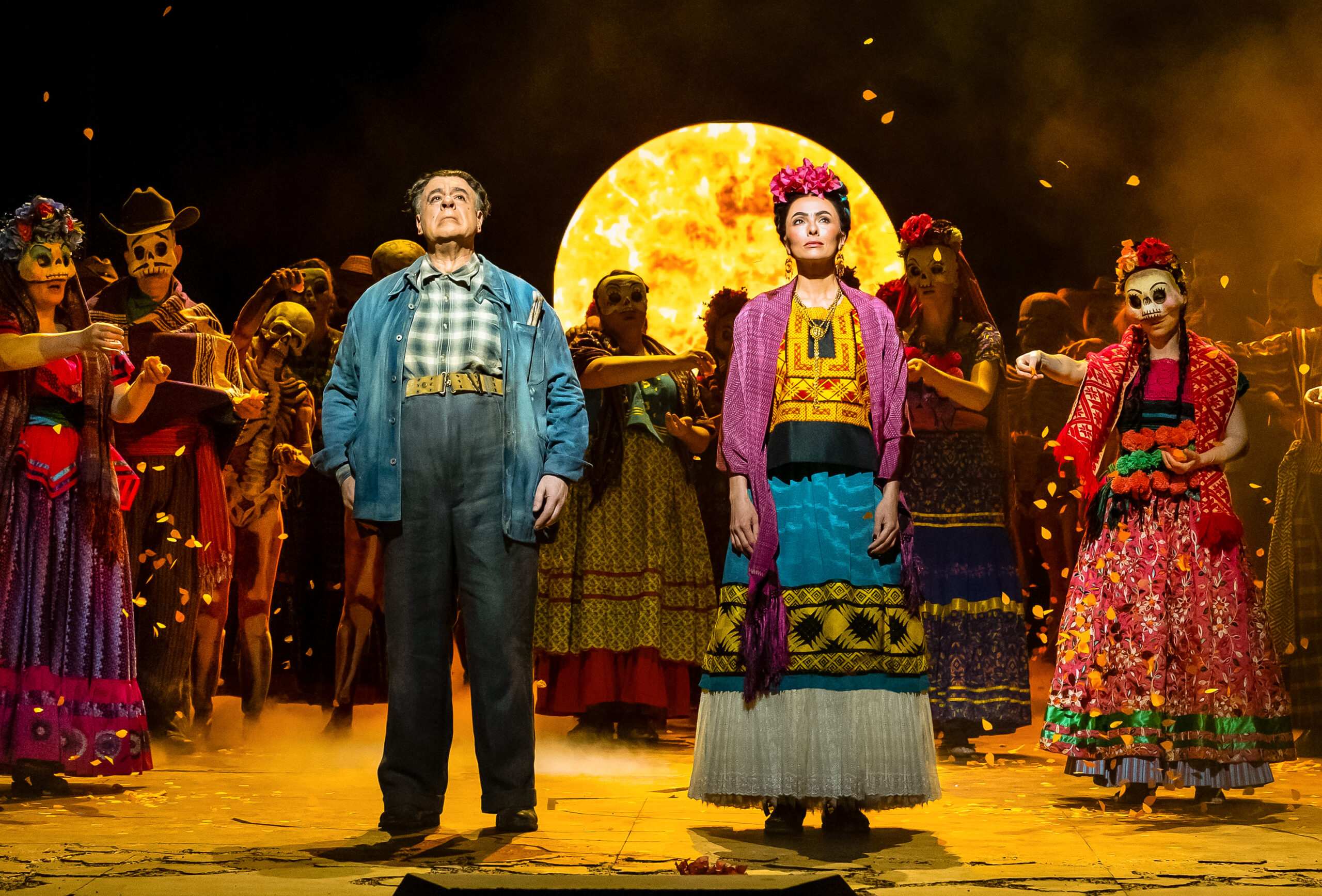
Set on Day of the Dead in 1957, the new Metropolitan Opera production of El último sueño de Frida y Diego, with a score by Gabriela Lena Frank and a libretto by Nilo Cruz, is a play on the Orpheus myth. Instead of the living descending to reclaim their dead, it’s Frida Kahlo who rises from Mictlán, the Aztec underworld, to retrieve Diego Rivera from the living. Tortured with grief after Frida’s death, Diego summons her from the underworld. For Frida, though, the world was nothing but agony.
Isabel Leonard brings Frida to life through her mezzo-soprano, which fills the theater with anguish, a representation of the entrapment of pain that followed Frida for much of her life. The tumultuous relationship with Diego Rivera is also palpable throughout the piece, as Frida decides whether it’s worth coming back for him or not. Diego is played by Carlos Álvarez, whose baritone commands the imposing authority befitting Rivera without losing the emotional weight brought about by grieving his wife’s death.
The score includes traditional Mexican instruments—marimba and mariachi trumpets, for example—without over-imposing them, creating music that feels visceral and mystical. The eerie pangs fit well not only with the backdrop of Day of the Dead, but also with the main tension throughout the story: whether Frida will give in and come back for Diego. Eventually, she says, “Mi arte me invita a regresar.” Her art invites her back. And so, she travels from Mictlán back to Mexico City, pursuing the promise of a life without pain and the possibility to return to painting.
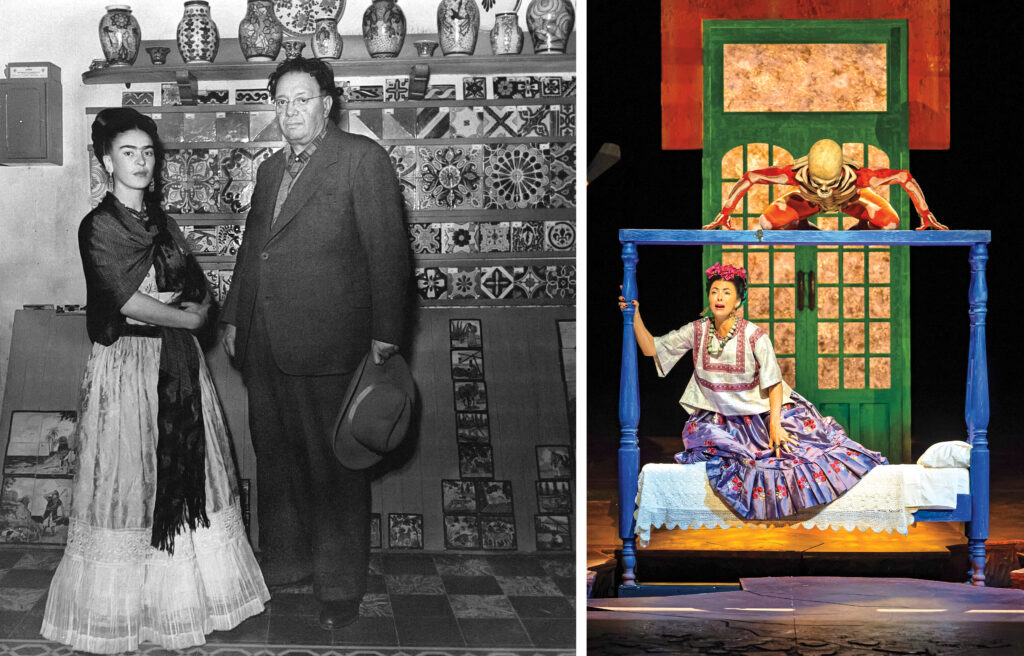
Right: Isabel Leonard as Frida. Marty Sohl/Met Opera.
Although this balance was struck carefully with the music, I can’t say the same of the storyline, which felt tenuous and slow at its best and utterly confusing at its worst. Almost all the subplots or supporting roles—a character dressed in drag as Greta Garbo coming back from the underworld, Frida singing about poverty in Mexico, and Diego refusing to eat fruit because he’d gain weight—felt arbitrary and cartoonish, disconnected from the opera’s otherwise careful cultural architecture.
To judge it merely on its narrative fortunes, however, would be to do it injustice. Its most striking element is indeed the set design, created by Jon Bausor, which brings a whole new world to life. At moments colorful and lively, inspired by the Day of the Dead decorations, and at other points dark, unearthly and surreal, the set elevates what could have been another retelling of an overdone story into something inventive. The real world contains papel picado, marigolds, and a chorus of laborers; and in the underworld, jagged tree roots evoke Frida’s broken back, and from their cracks a chorus of dancers dressed as muscle skeletons emerges in sync with the music.
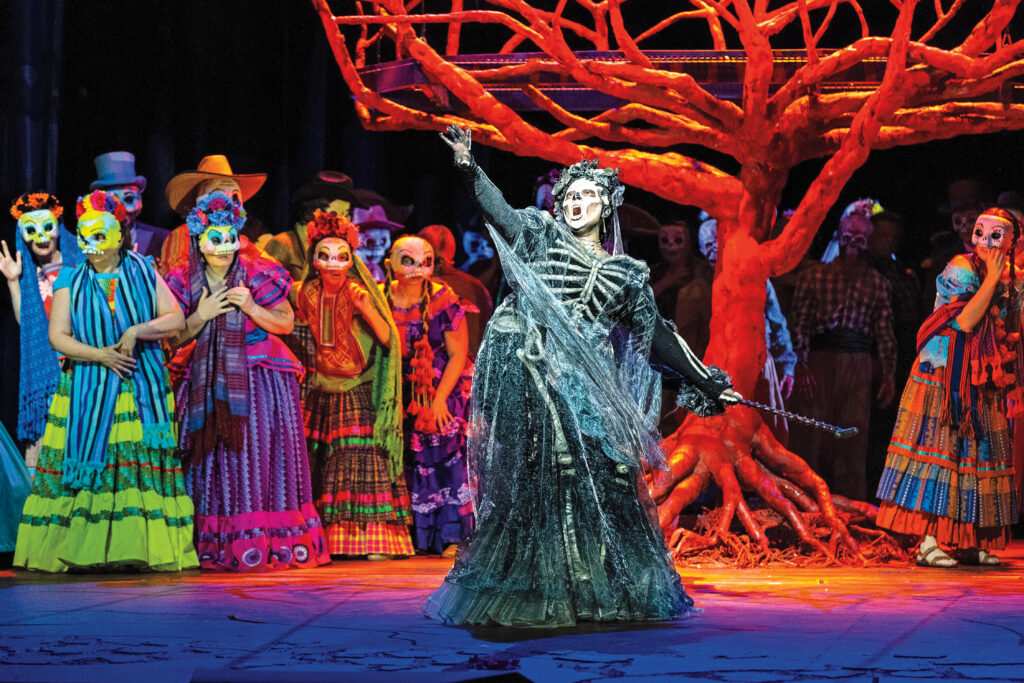
Vibrant and magical, but also eerie and palpable, the chorus of dancers accompanies the characters throughout the entire show, reminding us of the constant presence of death, the way it steps on our toes even when we don’t see it. This set doesn’t quite work logically—both worlds bleed into one another and bodies spill from one to the next without any clear structure—but it’s precisely that porousness that gives it the intriguing mix between a Greek myth and a magical Latin American story.
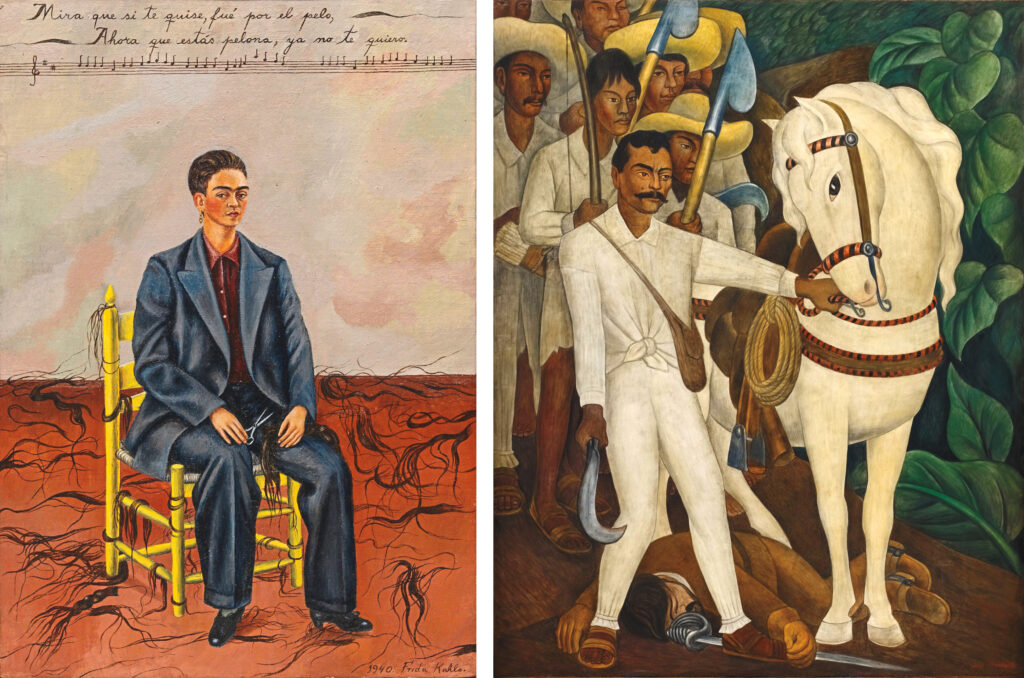
Part of the artistry of the set design is that it recalls Frida and Diego’s artworks, some of which are on view in New York City’s MoMA until September. This collaboration with MoMA extends Bausor’s world beyond the stage—blue curtains, the bare tree, the mural’s scaffolding, even the ominous red lighting—and recreates the surreal feeling for those unable to see the full production on stage. Surrounding it is a selection of iconic works from the couple: Frida’s Fulang-Chang and I (1937) and Self Portrait with Cropped Hair (1940), and Diego’s Agrarian Leader Zapata (1931).
In real life, Diego’s final dream was for his ashes to be mixed with Frida’s upon his death. Because his wish was denied by his family, The Met gives him this world in which spending eternity with Frida was possible. Yet, the title of the opera implies that the dream was shared. Given their history, though, that seems unlikely. What did Frida really dream of? In her last journal entry, she wrote: “Espero alegre la salida … y espero no volver jamás…” (I hope the exit is joyful … and I hope never to return). Her last words suggest another dream entirely, one of freedom—of leaving this world that gave her so much pain.
At its heart, The Met’s opera production is a love story, between the artists, of course, but also of Frida’s devotion to her art. Frida and Diego, the art world’s most beloved couple, might be overproduced, their art commercialized to the point of fatigue. But to reimagine their stories in different settings, different disciplines and expressions, is to allow their art to live on. Perhaps, then, that’s how The Met gives Frida her dream as well: a life where her art outlasts her pain.
ABOUT THE AUTHOR

Miranda Mazariegos
Reading Time: 4 minutesMazariegos is an editor at AQ.
A Brazilian Artist Exalts in Color at New York’s MoMA
Tadáskía explores transformation and the power of community as the first artist to paint the museum’s walls.
Showcasing a Venezuelan Star of Conceptual Art
An exhibition in New York City displays Claudio Perna’s radical 20th-century experiments in mixed media.