


LIMA—Peru has long been one of Latin America’s more puzzling cases. While its neighbors lurched between economic booms and busts, the country quietly compounded growth, accumulated reserves, built a credible central bank, and maintained macroeconomic orthodoxy across governments of wildly divergent ideological standings. Presidents came and went—some impeached, some fleeing justice, one staging a failed self-coup—and the economy kept growing. Eight presidents in ten years, yet the currency held strong, inflation and spreads remained among the lowest in the region, and the mining sector kept producing. This decoupling of economic performance from political dysfunction is, by any regional standard, remarkable.
It is also, increasingly, fragile.
While official results are not yet final at the time of writing, and the margins remain razor-thin, the first round of the 2026 election closely resembles that of 2021. Once again, Keiko Fujimori—daughter of former president Alberto Fujimori and three-time presidential candidate—appears set to face an extreme leftist, Roberto Sánchez, a former minister in Pedro Castillo’s Cabinet, in the June 7 runoff. Sánchez is a serious threat to stability. His hardline ideological stance and alignment with radical factions (such as the nationalist, previously convicted Antauro Humala) could push Peru toward a governing model that breaks sharply with the institutional continuity that has anchored the economy for two decades. The race, in effect, looks like a stress test of whether the guardrails that protected Peru during past turbulence can hold against a government actively working to dismantle them.
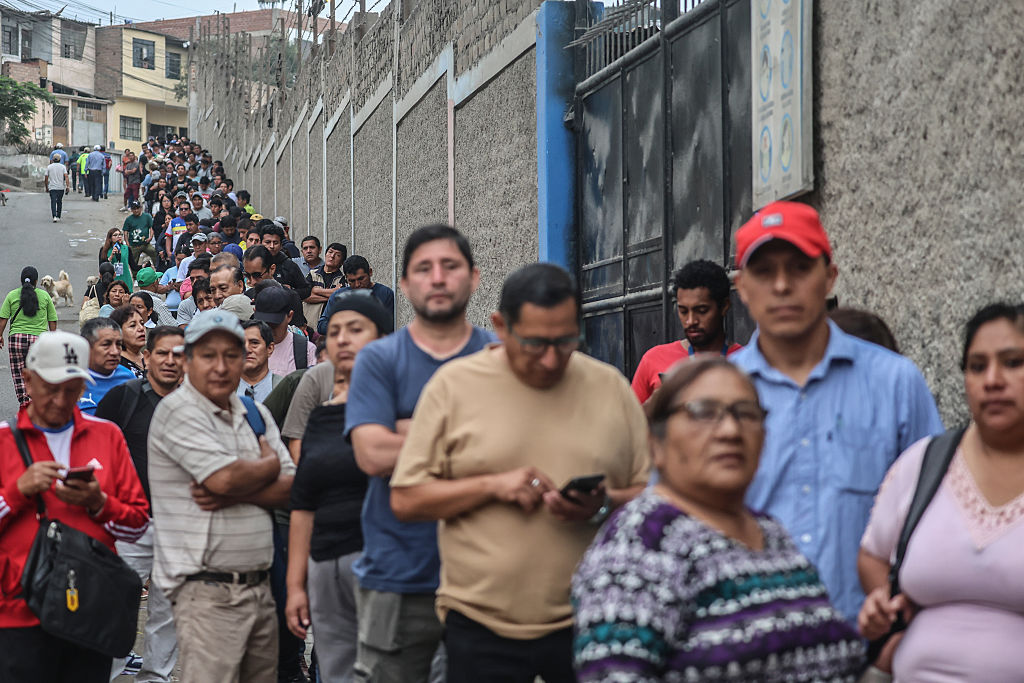
The legitimacy of the outcome is already contested. Rafael López Aliaga, the right-wing conservative former mayor of Lima who finished third, has denounced rigged elections. Investigations into the electoral authorities’ handling of the count are ongoing. Whoever wins the ballotage will begin governing under a cloud that makes it harder to build the coalitions needed to govern. Peru’s institutions have been losing credibility for years, and an election that cannot cleanly resolve its own first round does not rebuild it. A legitimacy deficit is not merely a political inconvenience—it is a structural constraint on what any government can actually do.
There is some room for guarded optimism on the legislative side. The newly elected Senate has the capacity to contain the most damaging unilateral impulses of any new president. Right-wing parties hold a narrow majority in the 60-member chamber, and a centrist bloc headed by former Defense Minister Jorge Nieto—with eight senators—holds meaningful swing power. That composition makes calling for a constitutional assembly to introduce a statist regime practically impossible and should protect key appointments at the Central Bank and other autonomous institutions, such as the Constitutional Tribunal. A third of the Senate will be in the hands of leftist parties—presenting a significant obstacle, although not necessarily an insurmountable one, to the express impeachments that destabilized previous recent Peruvian administrations.
The two candidates could not offer more divergent economic visions. Fujimori proposes a consolidation of the existing model. Sánchez proposes a constitutional assembly and a new charter, renegotiation of natural resource contracts, an aggressive tax reform, and changes to the central bank’s mandate. In practice, however, what either candidate can actually deliver will be shaped by Congress. Keiko Fujimori would likely find legislative support for her pro-investment agenda. Sánchez, for his part, would face an immediate congressional wall. The asymmetry in what each could realistically accomplish matters: Fujimori, whatever her political baggage, has the capacity to assemble a competent technocratic team and the incentive to reach a working arrangement with Nieto’s bloc, giving her at least a plausible path to governing within the existing institutional framework. Sánchez, by contrast, would arrive with a program so at odds with the establishment that the resulting confrontation would risk not merely policy paralysis but the kind of institutional crisis that ends presidencies early. Indeed, even with the new balance of power in Congress, it is possible to imagine a scenario in which the president loses the support of even his own base—as happened to Castillo when he attempted to close Congress.
The external environment remains supportive, for now. Peru’s terms of trade are near historic highs, copper and gold prices remain elevated, and growth is projected at 3.2% for 2026. These are conditions under which a government with a genuine mandate could make real progress—on infrastructure, on formalization, on the investment climate, on the rampant crime that costs the country between 2% and 3% of GDP annually. But the same geopolitical forces producing favorable commodity prices are generating serious headwinds. Oil has spiked sharply as Middle East tensions deepen, threatening to erode Peru’s terms-of-trade advantage while inflating import costs for fertilizers and fuel. The tailwind is real, but it will not wait indefinitely for the politics to stabilize.
The structural challenges that politics has consistently failed to address have grown more acute. Illegal gold mining has multiplied sixfold in four years, reaching an estimated $12 billion dollars—dwarfing narcotics in reach and corroding governance in the very sector that underpins fiscal stability. Legislative bills equivalent to 5% of GDP over five years, with no identified financing, drifted through the electoral campaign without serious scrutiny. Productivity growth remains chronically weak. None of these problems resolves on its own, and all of them require exactly the kind of sustained political leadership that chronic presidential turnover has made nearly impossible to secure.
What Peru needs from this election is leadership that enough of the political spectrum can accept as legitimate, and an executive-legislative relationship functional enough to pursue at least some of the reforms that have been deferred for years. That is not a high bar. It is, at this point, the minimum condition for Peru’s underlying strengths to keep doing the work that its political class has largely left undone.
Looking forward, Peru sits on a commodity endowment that the energy transition and the U.S.-China competition for critical minerals make strategically valuable for a generation. Capturing that opportunity requires investment, rule of law, and a government capable of pursuing reform. None of that is possible without political stability—and political stability begins with an election that all sides can accept. The cost of failing that test, in a world this volatile, has rarely been higher. Chronic instability condemns a country of great potential to managing crises rather than seizing opportunities. Peru has avoided that fate longer than most. It cannot afford to keep treating that as a permanent condition.
ABOUT THE AUTHOR
Luis Miguel Castilla
Reading Time: 4 minutesCastilla is president of the Hágase Instituto and a senior visiting fellow at London School of Economics. He previously served as Peru’s minister of economy and finance, and ambassador to the United States.
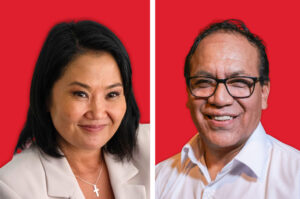
Peru: Meet the Candidates 2026
Keiko Fujimori and Roberto Sánchez will compete in a polarizing runoff on June 7, with crime and protracted political instability top of mind for voters.