



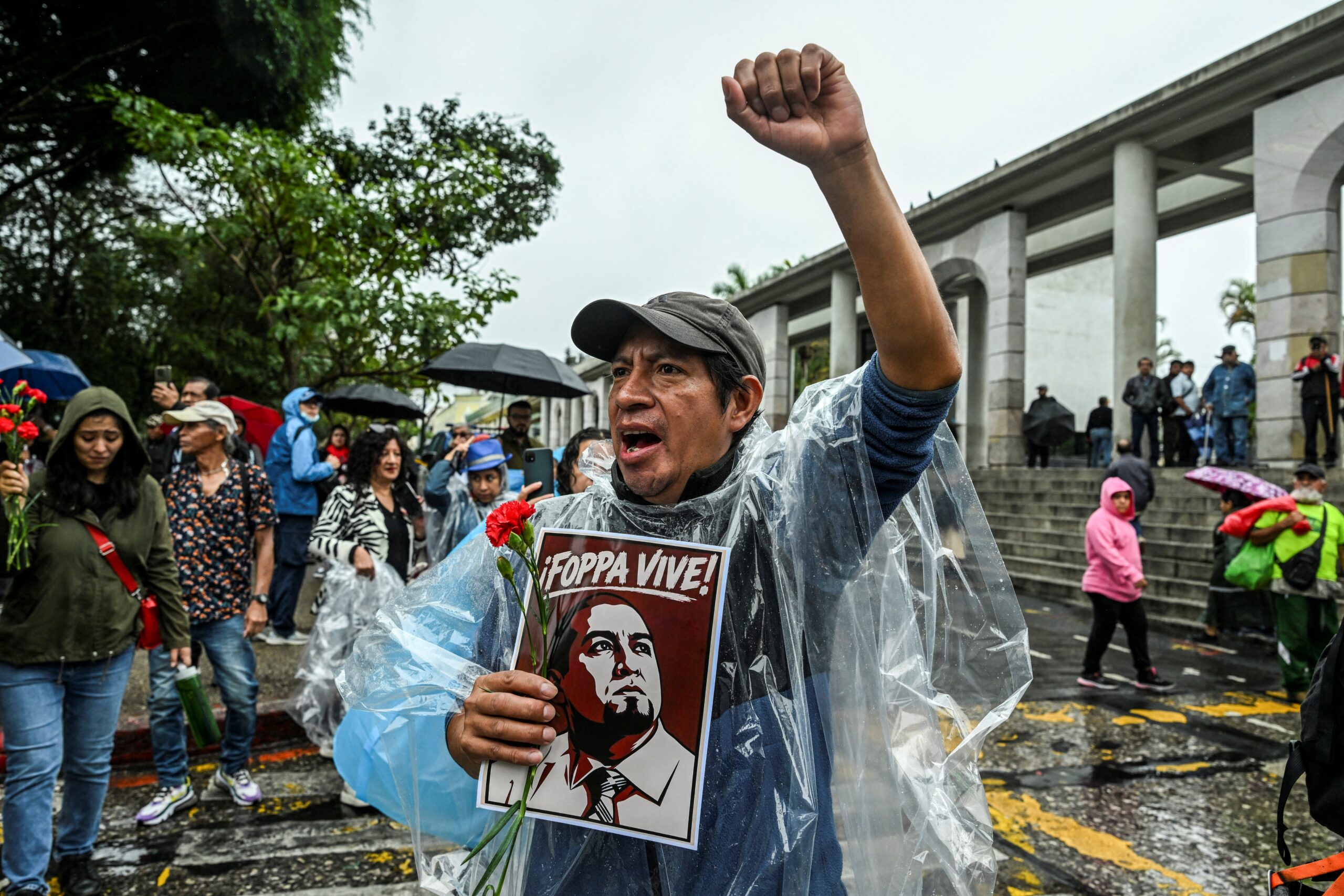
The Oct. 17 killing of Juan Francisco Solórzano Foppa, a former prosecutor who helped convict gang leaders and investigate high-level corruption, has renewed debate in Guatemala over one of the country’s most intractable problems: public security.
The incident, which took place at a sports complex in Guatemala City three months before the country’s electoral process officially begins ahead of the June general vote, has raised doubts about President Bernardo Arévalo’s government’s ability to fight organized crime. In September, eight civilians were killed in the eastern part of the country in an alleged military operation; in January, prison riots sparked gang attacks that killed 11 police officers and prompted the administration to declare a state of emergency; and last year, 13 people were killed in attacks in Nahualá.
Recent violent deaths are not the only source of concern. A year ago, 20 members of the Barrio 18 gang escaped from a maximum-security prison near Guatemala’s capital. Prosecutors have since charged a former interior minister and two officials for allegedly failing to perform duties and for complicity in the prison break.
Although the government touts lower homicide rates, tighter control of prisons, and stronger cooperation with the U.S. as achievements of the national strategy, the implementation of the security plan has frustrated the population, who expected more tangible results nearly three years into its term. Arévalo, like other presidents in Latin America, faces a stiff challenge to fulfill citizens’ expectations, and Solórzano Foppa’s killing revives memories of the assassination of prominent figures, such as Colombia’s Miguel Uribe or Ecuador’s Fernando Villavicencio.
“If this case remains unresolved, it will become a stain on the Arévalo administration,” Raquel Zelaya, a political analyst and former president of the local think tank ASIES, told AQ. “It would be a major failure on the part of both civilian and military intelligence that they lack the capacity to uncover any leads. Certain events will forever scar a leader’s legacy.”
A lawyer by profession, Solórzano Foppa previously worked at the Attorney General’s Office criminal analysis unit, where he handled high-profile corruption and criminal cases. He was particularly active on social media, often denouncing gang violence, corruption, and the collusion of politics and criminals to his thousands of followers. Minutes after his murder, two brothers were arrested but were later released amid allegations that police officers had planted evidence. Since then, at least seven policemen have been placed under investigation, as the Interior Ministry is conducting an “in-depth review of the structure, leadership and operations of the National Civil Police.”
The fact that the crime was so blatant—in broad daylight, in the capital city, despite Solórzano Foppa having state protection—has worried the population. Although the motive remains unknown, Juan Carlos Zapata, the executive director of the Foundation for the Development of Guatemala (FUNDESA), sees a deliberate warning: “They’re sending a clear message: Killing is easy, cheap and simple.”
An insufficient security strategy
Analysts point to several reasons for the lag in implementing the government’s security strategy. An inexperienced, unprepared cabinet; fragmented public policies; failure to clean corruption from government mechanisms; and a prosecutor’s office hollowed out under the previous administration. They all agree on one thing, though: It hasn’t been nearly enough.
On paper, under a plan advertised as “democratic security,” the government’s strategy centered on preventing violence, modernizing intelligence and surveillance systems, and strengthening the police force. Some of these have shown results, but, in practice, the most impactful security moves have been reactive: using a state of siege to contain the fallout of violent incidents, a new anti-gang law and plans for maximum security prisons. Neither of the two prisons proposed has been built: One in Izabal broke ground this year but was stalled for months in the courts, and the other in Escuintla has yet to go out to bid after years of delays.
On the other hand, the government has collaborated with the U.S. to boost its efforts to combat organized crime, and some observers point to better coordination among justice-system organizations. Earlier this year, Arévalo appointed Gabriel García Luna as the new attorney general, a win for his administration after Consuelo Porras’s term, who was sanctioned by the U.S. for alleged corruption and whose animosity during the first two years of the administration consumed Arévalo’s political capital. Porras denies wrongdoing.
Edgar Ortiz Romero, a Guatemalan lawyer and constitutional law activist, calls the advances “palliative measures,” comparing the situation to a diseased patient. “They’ve made progress because they’ve given the patient medicine. But this patient is so sick that unless you give it shock therapy, it won’t make any real advancements.”
Zapata says the problem is more about execution. “They never really figured out how to establish indicators or a policy for monitoring the actions being taken, and that is what has ended up slowing down many processes,” he said. He adds that even the slow but steady progress in security is part of broader strategies that predate this administration, rather than specific policies it has implemented.
Old wounds
In Solórzano Foppa’s case, many details are still unknown. The next question is whether the state has the capacity and the independence to solve the crime. It’s “a litmus test for the judicial system,” Ortiz Romero said. Several organizations and even the government itself have raised concerns about increasing ties between criminal networks, Guatemalan institutions, and even political candidates.
The murder has also recalled other cases of violence that have marked a before and an after in the country’s judicial history. Most notably, in 2007, three Salvadoran members of the PARLACEN were killed in Guatemala. Four police officers were arrested and jailed, accused of participating in the crime. They were killed a few days later in prison. According to Zelaya, that case forced authorities, especially then-President Óscar Berger, and the public to reconcile with how to move forward; how to reform what was so obviously broken.
“Fixing this takes a lot of time because it requires training personnel. It requires tactical equipment,” Walter López, coordinator of the violence observation unit at Diálogos, a local think tank focused on public policy research, told AQ. “In the case of the police, it involves investigative capabilities that are not currently in place, and getting that sorted out within a year and a half [before the term is up] is a complicated matter.”
The short-term implication of Solórzano Foppa’s assassination may reverberate in the general elections scheduled for next June. “I think this will add uncertainty to the political scenario,” Ortiz Romero said. “It’s hard to see that amid this chaos, people will opt for something normal. We are facing a generalized mistrust,” he added.
Zelaya hopes that Solórzano Foppa’s case will somehow unify Guatemala’s society. Or, at the very least, it will show the country that his killing extends beyond ideological lines. “I hope that all these hard blows help us unite forces; I hope we understand where the real common enemy is,” she said.
ABOUT THE AUTHOR

Miranda Mazariegos
Reading Time: 4 minutesMazariegos is an editor at AQ.

In Arévalo’s Guatemala, It’s Not “Spring” Quite Yet
The center-left president’s approval has fallen to 35% amid disappointment with public security and infrastructure.
Arévalo’s Narrow Path to Change in Guatemala
President Arévalo will pick the next attorney general from a list of six candidates by May 16.