



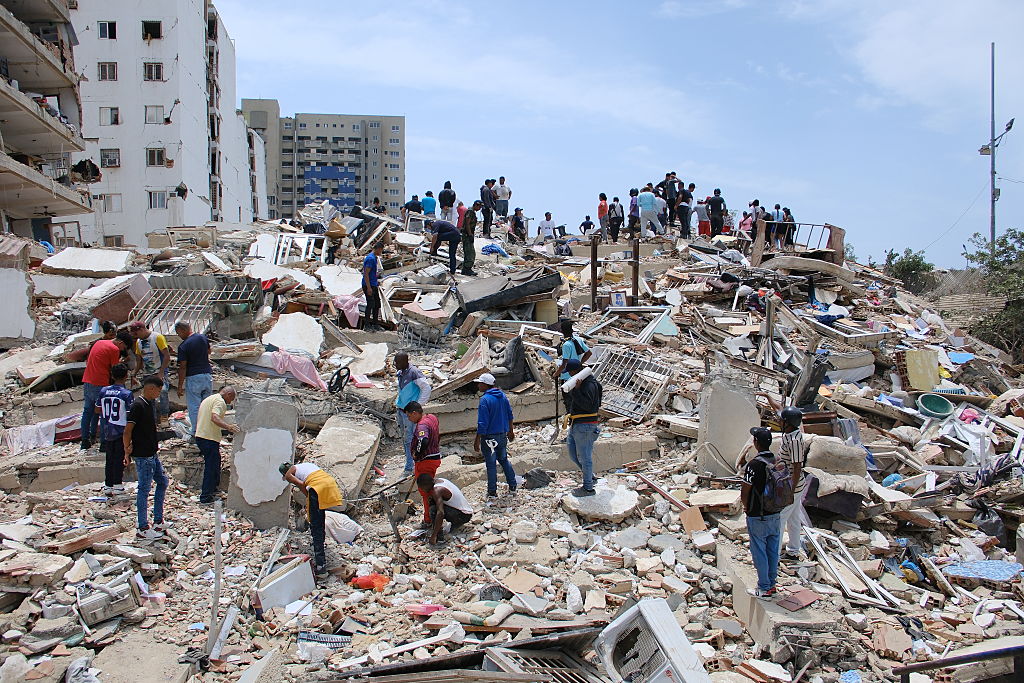
On the night of December 23, 1972, an earthquake measuring 6.2 destroyed most of Nicaragua’s capital, Managua, and killed somewhere between 5,000 and 10,000 people. What happened next is now a textbook case of how a government can turn a disaster into its own undoing. Anastasio Somoza Debayle and his National Guard diverted international relief aid, turning a humanitarian catastrophe into a personal enrichment operation. The earthquake did not bring Somoza down right away. But it pushed business owners, labor unions, and the Catholic Church into the same anti-Somoza camp for the first time, and when the Sandinistas took power in 1979, the seeds had been planted in Managua’s rubble.
Mexico City in September 1985 produced a variation on that pattern. The 8.0 quake that hit on the 19th killed thousands and laid bare how hollow the PRI had become after nearly six decades in power. Miguel de la Madrid’s government was slow and visibly out of its depth, and for a regime that justified its rule by claiming it could manage anything, looking helpless was its own kind of catastrophe.
So, Mexicans did the work themselves. The topos, ordinary people who dug through collapsed buildings by hand, became the symbol of a city that had stopped waiting for its government. Neighborhood groups that cut across class lines kept organizing long after the aftershocks ended, and that energy fed directly into Cuauhtémoc Cárdenas’s 1988 presidential run, which marked the beginning of the end of PRI dominance.
Haiti in 2010 is the cautionary tale. The January earthquake hit a state that was already barely functioning, and the international response made the underlying problem worse. Billions of dollars flowed through NGOs and foreign contractors rather than Haitian institutions. The reasoning was understandable, since the government genuinely could not manage the money. But routing everything around the state guaranteed the state would remain weak, and the resulting dependency has been very hard to undo.
Hurricane Mitch in 1998 showed a slower version of the same lesson. Governments that handled the immediate emergency reasonably well banked some political goodwill, then watched it drain away as reconstruction dragged, and the corruption stories piled up. In Honduras and Nicaragua, the storm exposed how little the state reached the rural poor it claimed to serve.
Not every disaster ends this way. When an 8.8 earthquake hit Chile in 2010, far stronger than the one that leveled Haiti, the state managed the recovery competently and rebuilt most of what was lost within a few years. The civil-protection systems Mexico built after 1985 sharply cut the death toll when a comparable quake hit in 2017.
What ties these cases together, even when they end in very different places, is simple. Disasters force a government to show what it can actually do, and what it has been doing all along with public money. State capacity stops being something academics talk about and turns into a test everyone can see in real time. In Venezuela, where the June 24 twin earthquakes struck infrastructure deeply degraded over two decades, that test now falls to acting president Delcy Rodríguez, who was already governing under popular pressure before the ground shook.
The historical record is consistent: How governments respond to disasters of this magnitude shapes political trajectories long after the immediate emergency passes.
ABOUT THE AUTHOR

Orlando J. Pérez
Reading Time: 2 minutesPérez is a professor of political science at the University of North Texas at Dallas. He is the author of Civil-Military Relations in Post-Conflict Societies: Transforming the Role of the Military in Central America.