



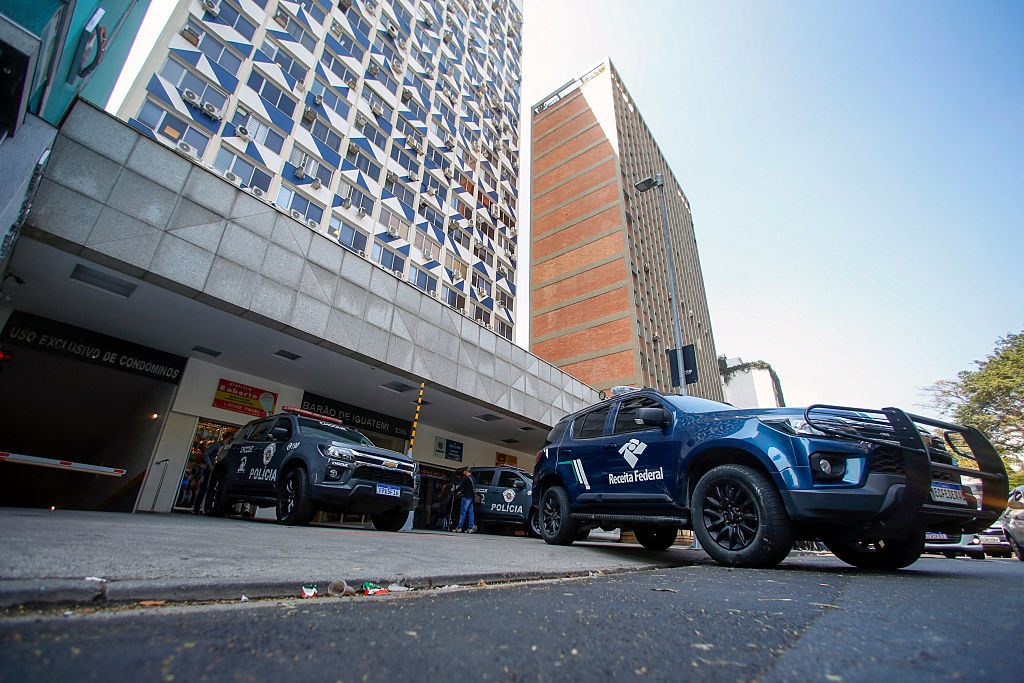

To appreciate the significance of the U.S. designation of two Brazilian criminal organizations—Comando Vermelho and Primeiro Comando da Capital—as Foreign Terrorist Organizations (FTOs), effective June 5, one need only consider Brazil’s most iconic city: Rio de Janeiro.
Comando Vermelho (CV) is said to control much of the cidade maravilhosa. Like so many other Latin American criminal organizations, CV is heavily involved in drug trafficking and uses violence, kidnapping, and extortion to maintain power. But in certain parts of Rio and beyond, CV goes further, performing a quasi-governmental function.
It wields strong ties to government officials and security forces and even operates its own parallel systems of government. Its factions monopolize internet, cable TV, public transport, and real estate in parts of the city. The organization demands inflated prices for services, finances construction projects, and even sells apartments. It can be difficult to live and work in the city without interacting with CV in some way.
This means that companies working in Brazil’s second-largest city—including those that deliver goods, operate warehouses, or provide critical services, for example—likely transact with CV in some form. Though the CV has national reach, the Primeiro Comando da Capital (PCC) is an even bigger criminal organization. In São Paulo, the hemisphere’s largest city, its infiltration of the legal economy is just as expansive as the CV’s is in Rio.
In these cities, but also throughout the country, ostensibly normal business activities could now constitute civil and criminal offenses under U.S. law as interactions with terrorist organizations. Some might view the designations as mere saber-rattling by the Trump administration or as temporary measures that could be quickly undone. But the trend lines are unmistakable; the moves are unlikely to be a transient blip on the radar, and they create significant new risks for businesses.
Take the fallout from the first wave of FTO designations enacted last year, targeting other parts of Latin America. Dozens have been arrested, convicted, agreed to guilty pleas and subject to civil forfeiture based on material support to FTOs. Hundreds have been charged for cartel-related activity. Ten current and former Sinaloa state officials in Mexico were recently indicted for narcotrafficking-related offenses. Treasury added hundreds of new cartel-related entities and individuals to the Office of Foreign Assets Control Specially Designated Nationals list.
The trend toward stricter enforcement is clear, and so are the challenges for Brazilian companies from now on.
How companies can protect themselves
In the wake of the Lava Jato bribery enforcement crackdown, more companies in Brazil are embracing internal compliance protections. Compliance trainings, policies, and due diligence on counterparties are commonplace. The 2024 Latin America Corruption Survey shows that high percentages of surveyed companies in Brazil say they implement such protections, especially compared with other countries in the region.
But FTO-related risks are in many ways distinct, new, and evolving, so companies operating in Brazil will have to build on the compliance mechanisms they’ve already developed. The scale of that work will become more apparent as targeted enforcement continues and U.S. officials make their expectations known. Companies will likely need to vet broader universes of entities, since FTOs frequently contaminate supply chains, business partners, and even customers. They will also need to deepen counterparty due diligence strategies, as the usual protocols of prohibited party screenings and media and public records reviews may not be enough.
Companies will also need to probe new potential vulnerabilities. They might have to investigate whether any employees affiliated with FTOs have infiltrated their companies; whether theft of company assets is linked to cartel operations; or whether the local officials they are dealing with are linked to FTOs, for example.
Other emerging best practices for FTO compliance include performing formal risk assessments to map a company’s particular exposure, and designing crisis response protocols to manage not only supply chain contamination but also extortion attempts and other physical dangers. This is especially important: Managing FTO risks inevitably requires security considerations. If a whistleblower tip suggests a company is providing support to an FTO, following up could require asking sensitive questions of people whose affiliations are unknown. And if a company identifies a problematic relationship, unwinding that relationship can put decisionmakers in danger.
Helpfully, the U.S. government’s expectation is that a company designs its compliance measures in consideration of relevant risks on the ground; there is a recognition that companies do not have unlimited resources to dedicate to FTO compliance. (This is similar to the norms of FCPA enforcement.) But a meaningful risk-based strategy requires an understanding of the sectors, geographies, and business lines most affected by FTOs, which varies greatly throughout the region. Companies operating in Brazil will have to understand their local contexts in greater detail.
A broader U.S. strategy
The designations give the U.S. government powerful tools to prosecute entities and individuals alleged to be providing FTOs “material support.” Importantly, the conduct at issue need not have a significant jurisdictional link to the United States. Companies based anywhere in the world could see consequences if they violate U.S. antiterrorism laws. To the extent that non-U.S. companies are viewed as supporting FTOs in a way that directly threatens national security interests, one can expect them to be an enforcement priority for the Trump administration. Various U.S. laws are in play, including the Foreign Corrupt Practices Act (FCPA), the Antiterrorism Act, economic sanctions laws, and anti-money laundering laws.
In Brazil, the designations appear to be at least partly political. As Brazil’s October presidential election approaches, President Luiz Inácio Lula da Silva has been gaining in the polls over his opponent Flávio Bolsonaro. Bolsonaro has reportedly been lobbying the Trump administration for help and took credit for the FTO designations. The designations could impact the election by underscoring the country’s problems with organized crime and denting economic activity. Lula responded to the move by saying, “We will not accept being treated like children.”
But the new risks to businesspeople cannot be dismissed. The CV and PCC designations are part of the Trump administration’s broader “Total Elimination of Cartels and Transnational Criminal Organizations” policy, first articulated in a memorandum published by then-Attorney General Pam Bondi on February 5, 2025.
Some companies might think the “total elimination of cartels” agenda will fade after the Trump administration leaves office. But they need to realize that it is much more difficult to remove an FTO designation than to add one. What future U.S. president would want to be tagged as soft on organized crime?
Brazilian public opinion also appears to support strong measures, including FTO designations, to take on organized crime. An April study by Ipsos Global Advisor found “crime and violence” to be Brazilians’ top concern. If FTO designations are perceived to weaken the CV or PCC, Brazilians are likely to support them.
The trends are clear: Companies operating in Brazil will have to adapt to new compliance risks.
ABOUT THE AUTHOR

Matteson Ellis
Reading Time: 4 minutesEllis is the Latin America practice lead at Miller & Chevalier.
Trump’s FTO Policy Creates New Risks for Doing Business in Latin America
Companies operating in the region must now pay closer attention to the concept of “material support,” two experts write.