


This article is adapted from AQ’s special report on Latin America’s demographic transformation
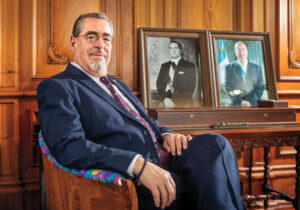
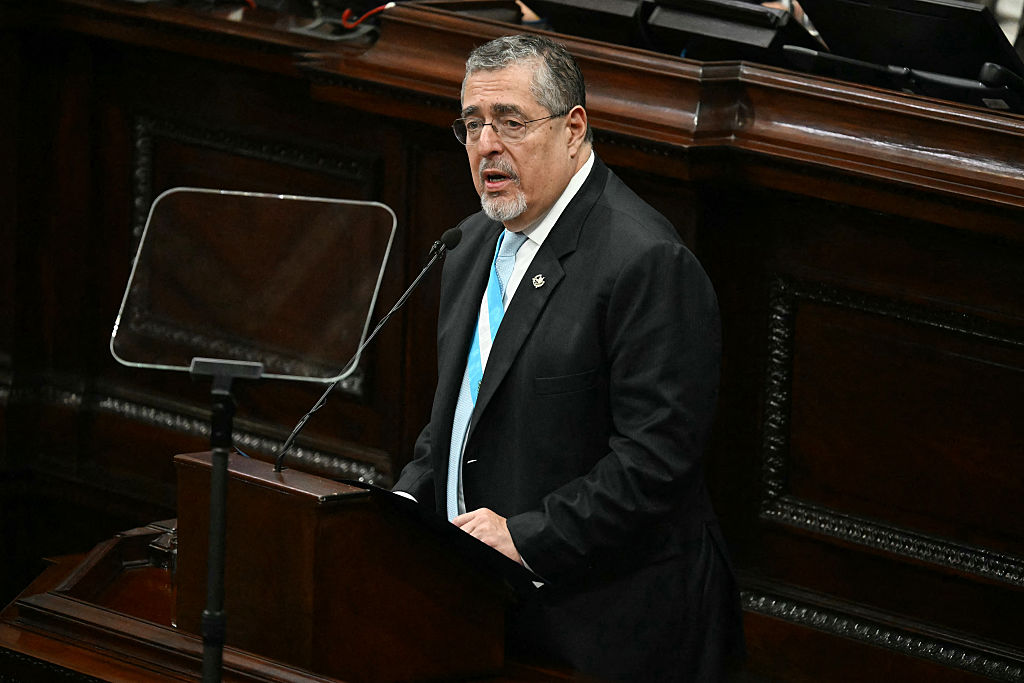
From the moment he took office, President Bernardo Arévalo raised expectations with his talk of a “democratic spring”—bringing not just prosperity, but a sense of institutional calm to Guatemala.
In some respects, the most progressive leader in the country’s recent history has delivered. Arévalo has focused on improving the nation’s education and health care systems, while leading a crackdown on organized crime and building a constructive relationship with the Trump administration. In February, the government ended a one-month state of emergency implemented after gangs killed 11 police officers, a period that saw 83 gang members arrested and a slight decline in extortion.
The economy has also put some wind at Arévalo’s back as Guatemala’s GDP grew 4.1% last year, the highest level since 2022, and well above the 2.3% CEPAL is projecting for Latin America and the Caribbean. His administration signed a reciprocal trade agreement with the U.S., reducing non-tariff barriers and restoring duty-free access for most Guatemalan goods. At the same time, Arévalo has deepened ties with Taiwan, which Guatemala recognizes instead of mainland China, including through discussions on how his country can enter the supply chain for semiconductors.
Arévalo’s mere survival as president has been an achievement of its own, after some elements of Guatemala’s establishment pulled out all the stops, including trying to dissolve his political party, to try to stop him from taking office in 2024. Since then, as Arévalo put it in an interview for a special report by AQ last year, the president has worked to “tangibly rescue (Guatemala’s) institutions from the corrupt actions of the state and put them to work for what they were created for.”
Yet for most Guatemalans, it hasn’t been nearly enough. A recent poll by Libertad y Desarrollo, a local think tank, showed that only 35% of Guatemalans approved of Arévalo’s performance. About 62% disapproved, compared with 46% in January of 2025, citing public security, unemployment, cost of living, and mobility-related issues as the main sources of concern.
Many say Arévalo has made some strides on transparency, but struggled with a lack of decisive action elsewhere, especially on the quality-of-life issues that Guatemalans care most about.
“I don’t think anyone would say this is a government of corrupt officials,” said Raquel Zelaya, president of the local think tank ASIES. “But people have high expectations; they have many needs and many issues that are not being addressed. They want health care, education, roads, and more.”
Key decisions
Arévalo has also been hamstrung by a difficult relationship with Congress—not just because of the opposition, which has the majority in the legislative branch. The president’s own party, Movimiento Semilla, which he helped found, has split in part because of divisions between its centrist and progressive wings.
In practical terms, the rupture has left Arévalo without a cohesive political structure as the party continues to contest injunctions challenging its legality. Raíces, a new organization created by former ally and lawmaker Samuel Pérez, has positioned itself as an alternative center-left option for general elections scheduled for June next year. (Guatemalan presidents cannot be reelected.)
The division has “weakened Arévalo a lot,” Zelaya said. “There’s no precedent in the world of a president ruling without a party, without a congressional caucus,” she added, pointing out that Semilla cannot take part in the Congress’s leadership nor lead any of its special committees, positions that under normal conditions help to drive bills and get them approved. Last week, the outgoing members of the nation’s Electoral Tribunal ratified the cancellation of Semilla as a political organization.
“The lack of concrete results is evident,” Elmer Palencia, congressional leader of the opposition party Valor and vice president of Congress, told AQ, emphasizing that the government continues to struggle with implementing policies and executing projects such as new roads and the expansion of ports as promised. “We have just a series of excuses, with no progress on health, infrastructure, or security,” he added.
According to Palencia, in 2026, Congress will likely pass at least three key pieces of legislation to combat money laundering, modernize ports, and establish a new framework for public procurement.
Looking ahead, Arévalo’s most significant challenge will be selecting a new attorney general on May 15. The current attorney general, Consuelo Porras, was one of the main figures who tried to stop Arévalo from taking office, and has been sanctioned by the U.S., Canada, and the European Union for alleged corruption.
A nominating commission—consisting of university deans, members of the bar association, and magistrates—will submit a shortlist of six candidates, and Arévalo will make the final decision. The list of aspiring candidates currently includes Porras herself, as well as several of her allies. Earlier this year, Arévalo said in an interview that Porras’ aspirations were “a mockery” to the Guatemalan people.
For Arévalo, completing this selection will be particularly relevant because it will fulfill some of the “processes” he considers crucial for transforming Guatemala’s state. On March 11, he completed the naming of the country’s Constitutional Court, the nation’s highest court. In addition, Congress elected magistrates to the Supreme Electoral Tribunal (TSE), the institution that will oversee the 2027 general elections.
An encouraging economic picture
Beyond short-term politics, Guatemala’s economy continues to do reasonably well. GDP is expected to grow 3.6% this year, and the central bank lowered its benchmark rate for the fourth consecutive time in February to 3.5%, the lowest level since November 2022, and last week decided to keep it unchanged. While the bank acknowledged risks arising from the war in the Middle East and protectionist measures, it reiterated a GDP growth forecast of 3.1% to 5.1% for 2026.
Shortly after AQ’s special report ran last year, S&P Global upgraded Guatemala’s sovereign rating, citing “record economic resilience” supported by the lowest level of net government debt in Latin America and despite potential bouts of political uncertainty.
In October, Fitch Ratings followed a similar path by upgrading Guatemala’s rating, although it acknowledged the country’s ratings are “constrained by governance challenges.” Arévalo’s government believes that both decisions move the country closer to achieving the coveted “investment grade,” a status currently held by only six countries in Latin America.
However, some doubt Guatemala will be able to reach that milestone during Arévalo’s term. “It’s going to be difficult,” Juan Carlos Zapata, the director of the Foundation for the Development of Guatemala (FUNDESA), told AQ, explaining that when ratings companies visit, they always ask if the changes under Arévalo are transforming the nation’s institutions. Zapata believes the government still needs to improve public procurement rules and digitalize certain processes. “We are quite far from achieving a state that is 100% digital,” he added.
Constant change has hindered efforts to meet the large infrastructure needs. In November, Arévalo appointed Norma Lissette Zea Osorio as the country’s fifth Minister of Communication and Infrastructure since his January 2024 inauguration.
After months of exploratory visits to the country, the U.S. Army Corps of Engineers (USACE) signed an agreement in January to develop conceptual designs for integrating an industrial rail system that connects the Pacific port of Puerto Quetzal with a multimodal logistics station in Escuintla, a major industrial city in southwestern Guatemala. But many projects are still pending. Arévalo’s ambitious program to connect most isolated rural areas with a plan called Rutas para el Desarrollo and a second plan, named Conecta, to recover most of the national road system, have yet to gain traction.
“The progress has been small, as some projects and roads have been assigned due to emergencies” rather than by design, said Palencia, the opposition lawmaker. An infrastructure law he authored was approved by Congress in 2024, but he said it has not met its potential because of a lack of technical capacity and the turnover at the infrastructure ministry. “The overall performance has been poor,” Palencia said.
Execution has not been an issue in social programs, according to Carlos Benitez Verdún, the resident representative of the United Nations Development Program in the country. “The government has been and continues to be quite successful in implementing programs,” to fight poverty and malnutrition, he told AQ. From his perspective, the government’s challenge is to broaden the reach of these programs—such as Mano a Mano—to as many municipalities as possible and to ensure their sustainability beyond Arévalo’s term. The government has prioritized working with 114 of the 340 municipalities based on technical criteria from the Social Household Registry. By 2025, the government has reached 75 municipalities, and for 2026, the goal is to reach 80 municipalities. Addressing Congress earlier this year, Arévalo highlighted that 50,000 households had converted their floors from dirt to cement, improving their living conditions and reducing public health care spending.
But to see the echo of these policies reflected in the national statistics will take some time, even a decade, Benitez Verdún argued. Early evidence signals that Guatemala is closing the gaps in malnutrition and poverty, for example, but “we are still in the early days of the policy implementation, and we cannot declare victory yet,” he said.
ABOUT THE AUTHOR
José Enrique Arrioja
Reading Time: 6 minutesArrioja is the managing editor of Americas Quarterly and Senior Director of Policy at the Americas Society/Council of the Americas.
Guatemala’s State of Emergency Will Test Its Democracy
President Arévalo is not channeling Bukele, but a compromised justice system makes this a dangerous moment that threatens lasting consequences.
Guatemala: A 2026 Snapshot
AQ tracks key indicators and political and economic trends to watch in 2026.