


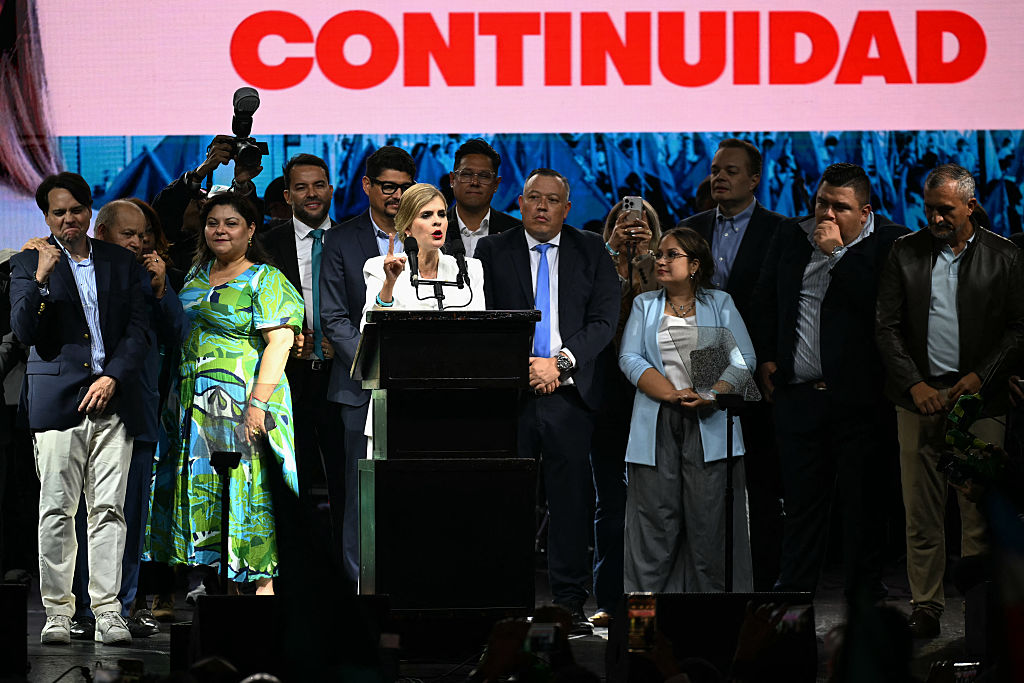
Earlier this month, Laura Fernández won Costa Rica’s presidency in one of the most decisive electoral victories in the country’s history. Fernández, the handpicked successor of President Rodrigo Chaves, secured 48% of the national vote—a landslide by Costa Rican standards—and her party, Partido Pueblo Soberano (PPSO), gained 31 of the legislature’s 57 seats, more than any political organization has held since the early 1980s. Although short of a supermajority, when Fernández takes office on May 8, she will become the first Costa Rican president to enjoy a partisan majority in Congress in over three decades.
This decisive victory has prompted a debate—fueled both by regional precedents and her own party’s history—on whether the country’s long democratic tradition is strong enough to withstand a sharp concentration of power. However, Costa Rica’s checks and balances will make the conversion of Fernández’s ambitions into real change challenging.
Friction with democratic norms
Concerns surrounding Fernández’s incoming administration stem largely from her association with President Rodrigo Chaves, whose tenure has been marked by a pattern of institutional confrontation. In the past four years, Chaves has repeatedly flouted democratic norms: He has openly “disparaged” checks and balances, repeatedly attacked the press, clashed the legislature and the courts, and sought to delegitimize the electoral authorities. He has also attempted to bypass Congress through a referendum and mobilized protests demanding the top prosecutor’s resignation—moves that critics argue put pressure on long-standing independent institutions. Chaves has been accused of violating multiple campaign laws, and the opposition-controlled legislature has twice considered stripping him of his presidential immunity. He denies wrongdoing.
Fernández, on her part, ran on a Bukele-inspired tough-on-crime platform and won the election by promising to follow in Chaves’s footsteps. Her campaign slogan was “the continuity of change.” But Fernández has also suggested that she intends to go further than her predecessor. In her victory speech, she said her election marked the end of the “Second Republic”—shorthand for the institutional framework forged after Costa Rica’s 1948 civil war, which introduced civilian rule without a standing army, competitive elections, and robust checks and balances. In its place, she promised to build a “Third Republic” through “profound and irreversible change.”
Fernández has offered few details about what a “Third Republic” would look like in practice. But her words bear a resemblance to those of two other Latin American leaders who also promised deep, “re-foundational” change on the back of major electoral victories: Hugo Chávez (who promised to inaugurate Venezuela’s “Fifth Republic”) and Andrés Manuel López Obrador (who vowed to oversee Mexico’s “Fourth Transformation”). Chávez sank Venezuela into authoritarianism, and AMLO presided over a period of less severe but nonetheless significant democratic backsliding. Costa Rica is not Mexico or Venezuela, and Fernández is not AMLO or Chávez. Yet both experiences suggest that change on the scale Fernández has promised can undermine democratic institutions.
Why Costa Rica’s democracy will survive—for now
Costa Rica’s long democratic history, strong institutions, and deeply rooted democratic culture will continue to serve as important bulwarks against executive overreach and other forms of democratic erosion. Additionally, Fernández is likely to face at least three key obstacles at an institutional level.
First and foremost is the balance of power in the unicameral Legislative Assembly. The PPSO fell seven seats short of the two-thirds majority that Fernández would need to change the constitution, name Supreme Court justices, or suspend individual rights. This will give the opposition—particularly the centrist Partido de Liberación Nacional (PLN), which will hold the second-largest share of seats—a crucial opportunity to keep the executive in check. Similarly, if she intends to deliver on some of her most ambitious campaign promises, Fernández will likely need to find a way to work with the opposition.
Fernández may also face challenges from within her own ranks. The PPSO is a broad populist-conservative movement held together primarily by Chaves’s influence and persona. Its newly elected legislators run the gamut from former Chaves officials and party loyalists to Evangelical pastors and at least one social media influencer. Many are political newcomers, and several are under criminal investigation. Maintaining internal support will test Fernández’s government—three defections would be enough to jeopardize her legislative majority.
Finally, Fernández’s close relationship with her predecessor could eventually become a liability. Chaves and Fernández are joining a growing list of populist Latin American presidents who have handpicked and then played a critical role in electing their immediate successors. Three cases—Álvaro Uribe and Juan Manuel Santos in Colombia, Rafael Correa and Lenín Moreno in Ecuador, and Evo Morales and Luis Arce in Bolivia—ended in acrimonious and costly breakups.
So far, only Mexico’s López Obrador and Claudia Sheinbaum have avoided this fate. But unlike AMLO, Chaves has no plans to retire from public life after stepping down. To the contrary, he appears set to remain as close to the presidency as possible. After winning the election, Fernández was reappointed as Chaves’s chief of staff. The president-elect, and now cabinet member, has already announced that she intends to return the favor by naming Chaves to the same post. It may well be that Fernández is happy to spend her presidency in her predecessor’s shadow. But if she isn’t—and most presidents aren’t—then the region’s recent history suggests that this will lead to an eventual fallout.
These constraints will limit the damage that Fernández can inflict on Costa Rica’s democracy. To be sure, her term, like Chaves’s, will be polarizing. She, too, will probably chafe at checks and balances and clash, at least occasionally, with Congress, the courts, and other independent bodies. In the end, she might strain Costa Rica’s democracy further than her predecessor did. But she will not sink it. Democracy will almost certainly survive Fernández’s four years in power.
What’s most important to remember, however, is that Chaves and Fernández are more a symptom than a cause of Costa Rica’s current troubles. Voters have backed Chaves’s populist project because they have a deep-seated distrust of mainstream parties, which they view as elitist, out-of-touch, corrupt, and incapable of addressing their most urgent needs. The longer-term durability of Latin America’s oldest democracy hinges on the emergence of moderate, electorally viable alternatives to both the tired establishment and Chaves’s and Fernández’s populism.
ABOUT THE AUTHORS
Manuel Meléndez-Sánchez
Reading Time: 4 minutesManuel Meléndez-Sánchez is a Postdoctoral Visiting Fellow at the University of Notre Dame’s Kellogg Institute for International Studies.

Lucas Perelló
Reading Time: 4 minutesPerelló is an assistant professor of political science at Florida Atlantic University.
REACTION: Laura Fernández Wins Big in Costa Rica
The right-wing, tough-on-crime president-elect will have a legislative majority and promises “deep and irreversible” change.