


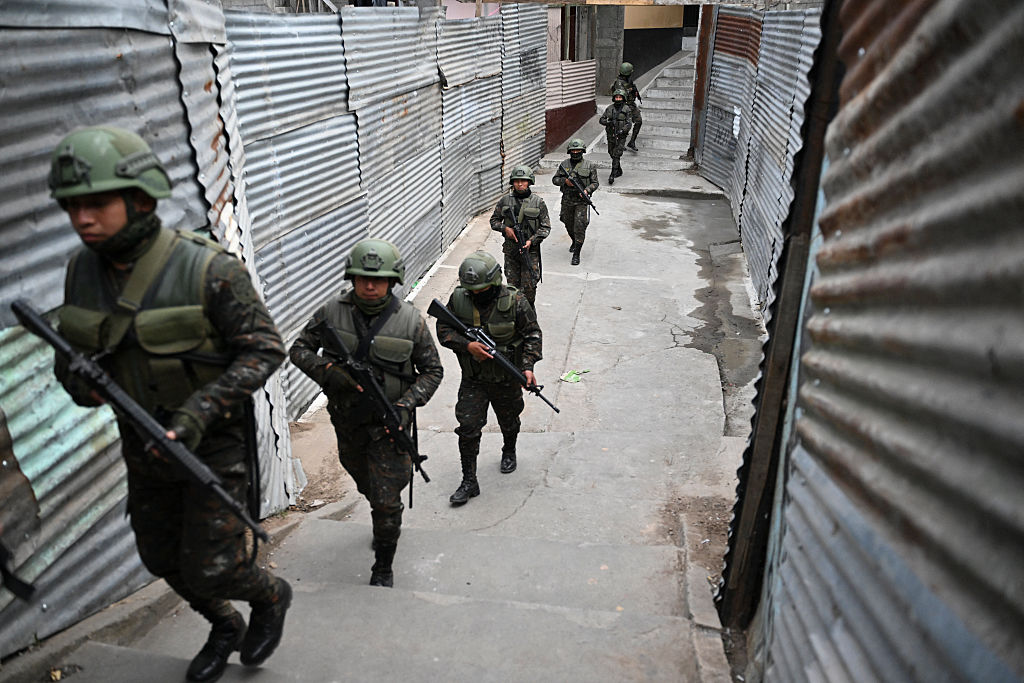
Guatemala’s state of emergency isn’t “Bukele-lite,” but it does warn of something else. The immediate trigger was blunt: Barrio 18 inmates seized control of multiple prisons and took dozens of guards and staff hostage, demanding privileges. Authorities retook the facilities and freed the hostages without casualties, but then the gang orchestrated retaliatory attacks on the streets that killed ten police officers.
President Bernardo Arévalo responded by declaring a 30-day state of emergency, expanding police and army powers, and allowing temporary restrictions on civil liberties. Congress ratified the executive decree overwhelmingly and amended its operative provisions to narrow the application of civil-liberty restrictions—clarifying that there was no general curfew, protecting routine public activities, and specifying that limits on gatherings and other police/military powers should be used only as strictly necessary.
So, is Arévalo embracing Bukele’s playbook? No, not in the way people mean when they invoke El Salvador—an open-ended emergency regime, mass detention as the default instrument, and the transformation of temporary measures into everyday governance. Guatemala’s measures are time-bound on paper, Congress has limited its scope, and the political coalition behind Arévalo is not a personalist security machine. Even critics of Arévalo inside Guatemala have emphasized that the operational reality so far looks nothing like El Salvador’s.
Yet it would be a mistake to treat the state of emergency as a clean fix. What’s happening is more complicated and more dangerous. Arévalo is squeezed between a public that wants decisive action to contain gang violence on one side, and on the other, a justice system controlled by his opponents that seems unwilling to undertake the investigative and judicial action necessary to meaningfully address the violence.
If the justice system doesn’t do its part to dismantle the gangs, emergency measures could become a crutch that the government leans into. The concern is not that Arévalo is secretly an authoritarian, but that this would push Guatemala toward “permanent temporariness”—a situation in which emergency coercive powers gradually expand in a system already lacking proper oversight. Right now, the country is still closer to a fragile democracy under siege than an elected autocracy in the making. The question is whether repeated emergencies become the new normal—and whether anyone in the system is strong enough to stop that drift.
After all, Arévalo is walking a fine line. If he appears too “soft” on gangs, he risks damaging crucial ties with the U.S. and other external partners and providing ammunition to domestic opponents who want to remove him. If he oversteps, he could also lose public support, undermining the reformist promise that brought him into office.
Prisons and veto players
With gangs flexing their muscle both in prison and in the streets, emergency measures are tempting, because they are among the few tools presidents can deploy quickly. Now add the political context Arévalo himself highlighted: He framed the violence as linked to “political-criminal mafias” that seek to influence the series of crucial judicial appointments this year that could determine the fate of Arévalo’s reform agenda.
That may indeed be accurate. Guatemala is a country where institutional veto players have been unusually effective at blocking reform—often through ostensibly legal mechanisms, such as prosecutors, courts, and networks of power brokers who can investigate, intimidate, suspend, or paralyze government initiatives.
That is why the Bukele comparison keeps coming back, even when it doesn’t quite fit. Citizens want immediate results; criminal organizations can stage spectacular acts of violence to steer policy, and the relevant institutions are too compromised or under-resourced to deal with them.
This is also why Guatemala has already moved in the direction of harder legal framing—classifying major gangs as terrorist organizations—and why Washington’s own escalation matters: The U.S. designated Barrio 18 as a Foreign Terrorist Organization and Specially Designated Global Terrorist in September 2025, just before Guatemala did.
These labels can assist with international cooperation and targeted financial tools. They can also incentivize “results theater”: aggressive sweeps, looser arrest thresholds, and a political emphasis on visible crackdowns rather than careful prison management and thorough, wide-reaching investigations that go beyond just minor charges.
This brings us to the rule-of-law issue and its implications for stability and investment. The best indicator of whether emergency measures strengthen or weaken governance isn’t rhetoric; it’s whether the state can reduce violence without turning detention into a political tool, and then quickly restore normal legal procedures.
Unfortunately, Guatemala’s justice system is beset by corruption within the courts, security forces, and prisons, as well as inconsistent prosecutorial efforts that sometimes target anti-corruption stalwarts. When the system can’t punish violence through regular channels, exceptional measures become a substitute that often persists.
Washington wants Arévalo to succeed, but it also wants hard security and migration deliverables. That tension is already visible. In early 2025, Arévalo reached an agreement with Secretary of State Marco Rubio to increase the number of deportation flights accepted by Guatemala and to accept deportees of other nationalities for onward repatriation—an unmistakable sign of pragmatic cooperation with the Trump administration. Last year, the U.S. announced a framework for a reciprocal trade agreement with Guatemala, explicitly tying economic partnership to U.S. “economic and national security.” And during the violence earlier this month, the U.S. Embassy issued security warnings while publicly backing Guatemalan security forces’ efforts to restore order. This support may vanish if Arévalo can’t bring the violence under control.
A realistic exit strategy
So what can Arévalo realistically do?
First, clearly define and communicate the scope of the state of emergency: where it applies, the objectives, the reporting requirements (such as searches, arrests, detentions, seizures), and the timeline for rollback. If the government wants public trust, it must demonstrate that exceptional powers are being used precisely, not for political purposes.
Second, treat prisons as the center of gravity. If the state cannot control communications, contraband, staff corruption, and inmates inside, it will keep fighting fires outside. That means vetting and rotating custodial staff, securing control of communications, implementing credible external monitoring, and developing a prosecution strategy that targets networks rather than simple foot soldiers. None of this requires a suddenly purified justice system. It requires executive control, transparency, and a narrow, vetted prosecutorial pipeline that targets coordinators and financial nodes rather than relying on mass arrests that rarely stick.
Third, build cases, not just raids. Citizens will understandably demand arrests after police are killed. But “short-term orders” that collapse in court or that yield only minor charges feed cynicism and empower exactly the veto players and criminal actors Arévalo says are trying to destabilize the state.
For its part, the U.S. should be cautious about what it incentivizes. Cooperation on deportations and trade is genuine, and Arévalo has demonstrated he’s willing to negotiate. However, Washington should not reward superficial crackdowns that come at the expense of fixing institutions. The more Guatemala’s security policy becomes performative, the more it will mirror the region’s worst patterns—even if Arévalo has no intention of becoming Bukele.
The state of emergency, then, doesn’t show that Guatemala is “turning into El Salvador.” Rather, it’s a test of whether Guatemala can restore basic public order without trading away the thin procedural guardrails that make democratic recovery possible.
ABOUT THE AUTHOR
Orlando J. Pérez
Reading Time: 4 minutesPérez is a professor of political science at the University of North Texas at Dallas. He is the author of Civil-Military Relations in Post-Conflict Societies: Transforming the Role of the Military in Central America.
Guatemala: A 2026 Snapshot
AQ tracks key indicators and political and economic trends to watch in 2026.
The President Who Almost Wasn’t
Guatemala’s Bernardo Arévalo was nearly prevented from taking office. Now, can his drive to reform the country succeed?