


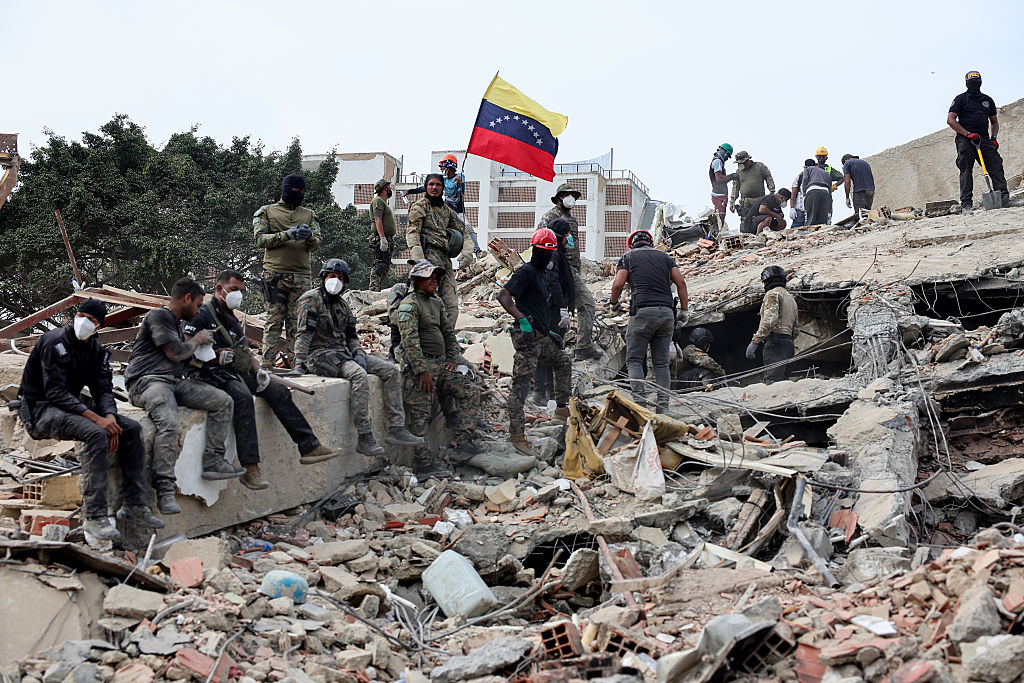

CARACAS—Twin earthquakes opened the earth beneath Venezuela a week ago, killing almost 3,000 people. As international and local rescue workers continue to sift through debris to find 40,000 missing people, 11,000 have been reported injured and many are still unaccounted for. Devastation of this magnitude would be painfully tragic for any nation, and in today’s Venezuela, it is proving unbearable.
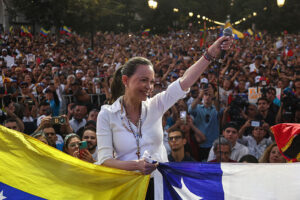
The interim government led by Delcy Rodríguez has been heavily criticized for its slow response and lack of coordination in addressing the ensuing chaos, as well as for its handling of the failed attempt by María Corina Machado—a widely supported political leader—to return to the country. The regime closed the country’s airspace to prevent her arrival, and the White House refused to back her, while senior U.S. officials labeled her move as “grotesque political opportunism.”
For all practical purposes, the incident may simply mark the formal parting of ways between the Nobel laureate and the Trump administration—a rupture many had seen coming since the capture of Nicolás Maduro on January 3.
Yet, despite the tragedy and uncertainty surrounding this moment, John Barrett, the U.S. chargé d’affaires in Caracas, publicly reiterated that plans for Venezuela remain largely “intact.” The U.S. has moved to ease some sanctions on the regime and has provided sizable humanitarian assistance during these trying times. But failing to grasp the severity and reverberations of the recent events could be costly, and the U.S. can no longer avoid a pressing question: How committed is the White House to democracy in Venezuela?
Economic normalization
To answer that question, we must return to January 3, when U.S. forces captured Maduro to stand trial in New York. A vast majority of Venezuelans celebrated the irruption. A poll published by The Economist showed President Donald Trump as the highest-rated political figure in Venezuela, with a 55% approval rating. After 26 years of autocratic rule, nearly 8 million exiles, and the stolen election of July 28, 2024, Venezuelans did not see an invasion—they saw liberation. Yet those same polls carried a clear mandate. Sixty-seven percent demanded elections within a year, and 68% said they would vote for Machado.
Venezuelans celebrated the dictator’s removal because they believed it marked the beginning of democracy, not a change in the dictatorship’s management. But since that moment, Venezuela has watched as economic normalization has been unequivocally prioritized over political opening and democratic restoration.
Ordinary Venezuelans continue to endure blackouts, currency depreciation, and a rising cost of living. The state’s most important positions are filled according to a single criterion—Rodríguez’s personal trust—not professional qualifications or moral standing. Six months after Maduro’s capture, there is no timetable for elections, and Secretary of State Marco Rubio’s roadmap relegates elections to the end of the agenda, with no dates or publicly disclosed goals attached.
Before the June 24 earthquakes, a survey by the local polling company Meganálisis found that 71.2% of respondents believed Trump cares more about the oil business than about their freedom, while Rodríguez garnered 93% disapproval. Some argue that in the span of six months, Trump has gone from liberator to partner of the regime.
Tearing down a wall
The broader question is whether the principles that made the U.S. a great nation still endure. Woodrow Wilson led the U.S. into war to make the world “safe for democracy.” Franklin Roosevelt proclaimed the Four Freedoms for all people, everywhere. Harry Truman pledged support for free peoples resisting oppression. That tradition was never pure; the U.S. tolerated autocrats when it suited its interests. But Venezuela is categorically different.
Trump removed a dictator who was an adversary, but then chose to preserve the dictatorship. This is not the Kirkpatrick Doctrine, the Cold War-era foreign policy concept that justified U.S. support for right-wing dictatorships if they were anti-communist. It is the doctrine of spoils. Is that really the foundation upon which America wishes to build its future relationship with Venezuela?
In 1987, standing before the Brandenburg Gate, President Ronald Reagan delivered the words that defined the end of the Cold War: “Mr. Gorbachev, tear down this wall.” Reagan urged Soviet leader Mikhail Gorbachev to dismantle the Berlin Wall, and two years later, it fell.
Today, another wall stands: the remnants of Chavismo that Trump has chosen to leave intact and protect. That wall separates 30 million Venezuelans from the democracy for which they voted. The painful difference is this: The Berlin Wall was upheld by America’s adversary. This one is being upheld by the White House.
As Venezuela endures one of its darkest moments in recent history, many now wonder whether President Trump will be able to tear down the atrocious political wall that still separates this nation from a promising new future.
ABOUT THE AUTHOR
Benigno Alarcón Deza
Reading Time: 3 minutesAlarcón Deza is a political analyst, researcher, and former Director of the Center of Government and Political Studies at Universidad Católica Andrés Bello in Caracas. He’s also a professor at UCAB and UCV and a Managing Partner at Polis Consultores.
Earthquakes Have Often Shaken Latin American Politics
How governments respond to natural disasters can shape their political trajectories, an expert writes.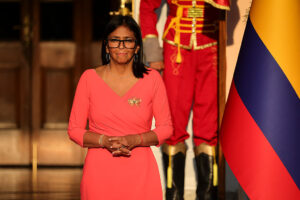
Normalization Without Transition: Delcy Rodríguez’s Playbook
Venezuela’s greatest risk is not the absence of a political transition, but the simulation of one, an expert writes.