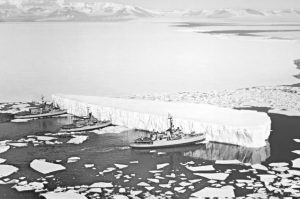



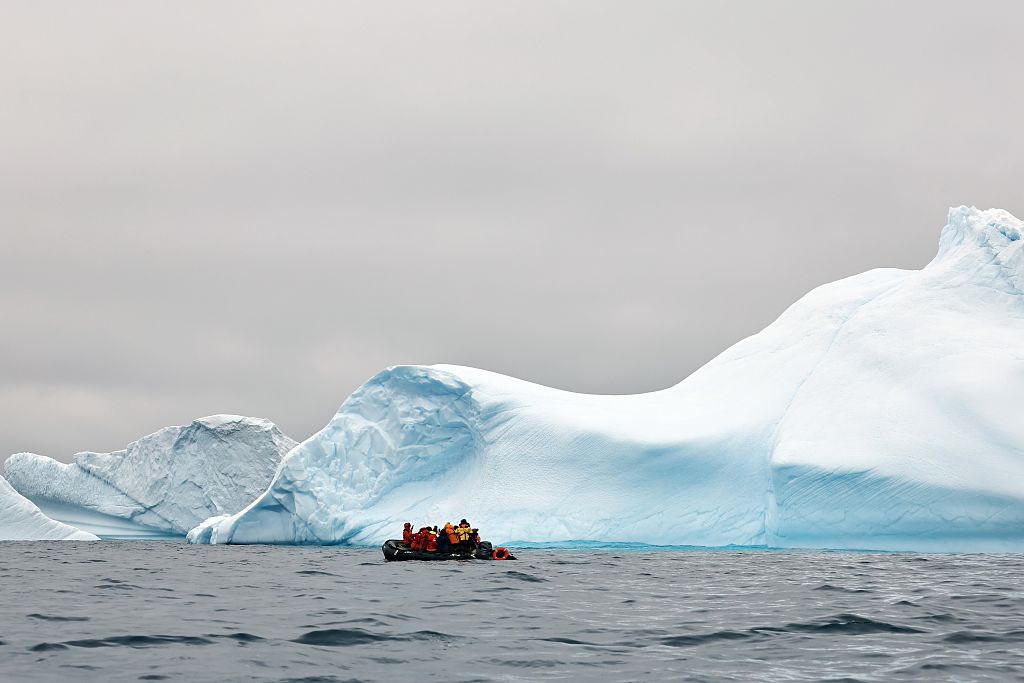
SANTIAGO—On any given day during the austral summer, the port of Punta Arenas is a theater of polar logistics. Research vessels from Chile, China, Spain, the United Kingdom, the United States, and Ukraine are vying for space alongside luxury cruise ships. All are either bound for or returning from Antarctica—a continent that, like a vast white inkblot at the foot of our maps, continues to mask its true strategic dimensions.
On the ice, this burgeoning interest manifests as a stark reality for the few who visit. Competing with Hollywood stars in search of “extreme tourism,” new flags are being planted alongside old ones. The goal, presumably, is to be positioned in anticipation of the day the “Great Partition” begins in earnest.
Two centuries after its discovery, this 14-million-square-kilometer landmass remains a geopolitical anomaly. Within its borders, nations with formal territorial demands coexist with those who—ostensibly—ask for nothing. There is even a vast “unclaimed” sector, coveted by no one. For now.
Under the Antarctic Treaty (1961), a remnant of the Cold War, the signatory countries (Argentina, Australia, Belgium, Chile, France, Japan, New Zealand, Norway, South Africa, the Soviet Union [now Russia], the United Kingdom, and the U.S.) agreed to use the continent for peaceful and scientific purposes. Territorial claims remained essentially frozen. However, in a world where the rules-based order is breaking down due to unilateral actions, the question of whether this gentlemen’s agreement will survive is increasingly urgent.
As “spheres of influence” have returned to the global lexicon—bolstered by the latest U.S. National Security Strategy and President Donald Trump’s claims regarding Greenland, plus Russia’s aggressive and China’s assertive behaviors—the survival of the Antarctic status quo may be in jeopardy. Complicating an already intricate scenario, Antarctica is one of the fastest-warming places on Earth, and most experts agree that the melting of its vast ice sheet could have unpredictable consequences for life as we know it.
The seven original claimant nations (Argentina, Australia, Chile, France, New Zealand, Norway, the United Kingdom) once fretted over the dual-use civilian-military nature of space activities and the rapid expansion of Chinese outposts—the country is reaching for a sixth base even as the fifth remains a work in progress. But now, a new wildcard has emerged: the U.S.
The U.S presence
Though Washington maintains no formal claim, its bases are masterfully positioned. By occupying the South Pole itself, the U.S. effectively keeps a foot in every existing territorial claim. President Trump’s explicit interest in Greenland finds an echo here on King George Island; the southern landscapes and the energy and mineral resources beneath them are not dissimilar to their northern counterparts.
Yet, if Greenland is a piece of the North American soil tethered to Denmark, Antarctica is a continent unto itself. Nevertheless, it possesses a natural affinity with the Americas. Access is most seamless via Chilean and Argentine ports and airports. Between these landmasses lie the interoceanic passages—the Drake Passage, the Strait of Magellan, and the Beagle Channel—that serve as natural alternatives to Panama. Though currently under-traversed, they remain the mandatory route for mega container ships and American aircraft carriers. Historically, whenever the Suez Canal has been choked, or global conflict has flared, Washington’s gaze has invariably turned toward these southern arteries.
This physical proximity suggests the existence of a “South American Antarctica.” This strategic link was codified in another Cold War relic, the Inter-American Treaty of Reciprocal Assistance (TIAR) of 1947, which included the Antarctic quadrant between the 24° and 90° W meridians within the American security zone. Under this framework, an armed attack against an American state within that area would, technically, trigger a collective response.
Hemispheric security
It is a bold wager on collective security from a bygone era. If one day “South American Antarctica” comes to be perceived as an “extension” of the Western Hemisphere’s security system—a concept not yet explicitly named in U.S. strategy—it may cease to be a neutral sanctuary. Instead, it could be transformed into a containment zone against Chinese and Russian expansion.
There are no perfect mirrors for the future of the “White Continent” in a world where international norms are blurring and spheres of influence are being reactivated as the playgrounds of Great Powers. For South American nations with claims, such as Chile and Argentina, the fate of Greenland should serve as a wake-up call. It signals both a shift in the posture of major powers and a desperate need to boost national presence—much like Denmark is doing—while strengthening collaboration with those still supporting the Antarctic Treaty.
As the ice retreats and faint green vegetation appears under rising temperatures on the Antarctic Peninsula, it is easy to imagine a future in which this land is more permanently inhabited or even exploited (which is not possible under the Antarctic Treaty today). Something is definitely changing in these southern latitudes, far but maybe not so different from Greenland. This is because polar regions have ceased to be peripheral. Instead, they have become key parts of the global landscape.
ABOUT THE AUTHOR

Juan Pablo Toro
Reading Time: 3 minutesToro is a Senior Research Fellow at AthenaLab think tank (Chile) and Senior Associated Fellow at RUSI. He recently visited Antarctica for the fourth time.
Why the U.S. and China Suddenly Care About a Port in Southern Chile
Punta Arenas is at the intersection of changing shipping routes, new industries like green hydrogen, and the race for Antarctica. The U.S. and China have noticed.