



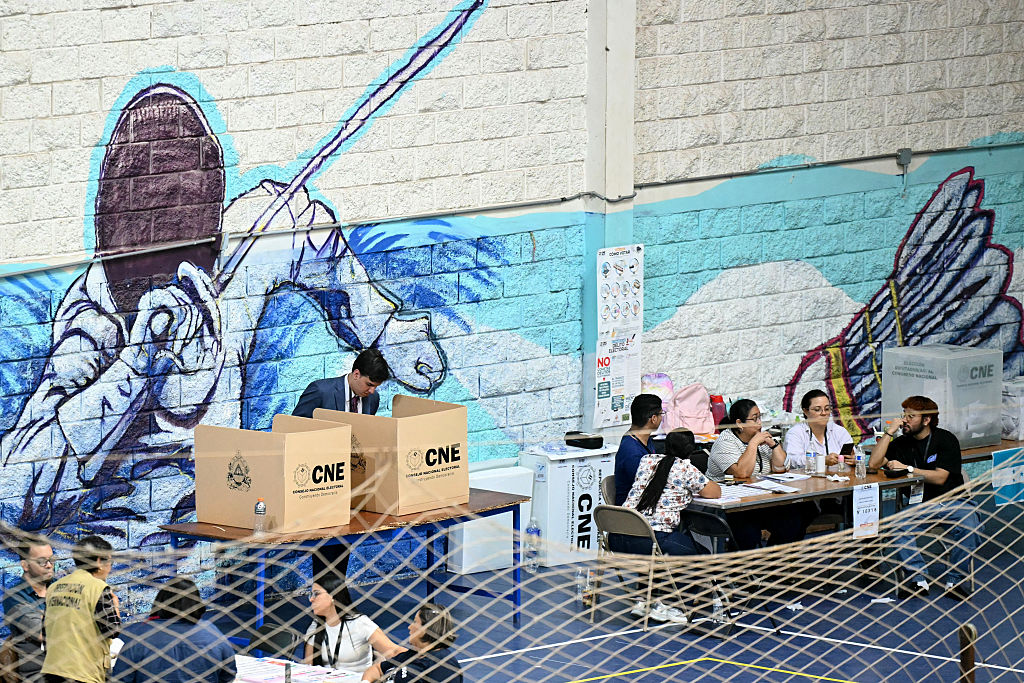
In Honduras’s single-round presidential election, former Tegucigalpa Mayor Nasry “Tito” Asfura holds a narrow lead over television personality and perennial hopeful Salvador Nasrallah, according to preliminary results from the national elections authority, called the CNE.
With only 57% of precincts officially tallied two days after the election, the CNE is behind, and there’s no clear indication of when the vote-counting process will lead to an official result. As of Tuesday morning, Asfura and Nasrallah each had about 40% of the vote, while Rixi Moncada—the ruling LIBRE party’s former defense secretary—had 19%. On Monday, Moncada cast doubt about whether she would accept the results, alleging irregularities and U.S. interference.
A CNE member attributed the delay to technical issues, and the CNE’s president said that, given the difference of just over 500 votes between the leading candidates, it would slow its count to adopt a more deliberate process.
Asfura received a controversial endorsement from U.S. President Donald Trump in the days ahead of the vote. Trump said on Friday that Honduras would enjoy better relations with the U.S. under Asfura, and announced he would pardon former Honduran President Juan Orlándo Hernández (2014-2022), of Asfura’s National Party. Hernández had been extradited to the U.S. and sentenced there to 45 years in prison on drug trafficking and weapons charges. He was released after the election.
Hondurans also went to the polls to elect all 128 seats in Congress, 20 seats in the Central American Parliament, almost 300 mayoral positions, and hundreds more local offices. Official results in many of these races are still pending.
AQ asked analysts to share their reactions.

Valeria Vásquez
Senior political risk analyst at Control Risks
In some ways, Honduras’s November 30 general elections went smoother than the primaries. While official results have yet to be published and the vote-counting process is still underway, it is likely to conclude within the next few days, particularly given close international scrutiny. The thin margin between Nasry Asfura and Salvador Nasralla increases the likelihood of disputes over the final count and could prolong uncertainty, as both candidates may be reluctant to concede without a clear and credible outcome. Meanwhile, Rixi Moncada and her LIBRE party will not concede defeat immediately, though they are unlikely to effectively contest the results given the significant gap.
Regardless of who ultimately wins, the road ahead remains uncertain, with numerous challenges awaiting the incoming administration. The thin margin of victory, combined with deep political divisions and fragile institutions, raises concerns about the government’s ability to represent the broader electorate and will complicate efforts to govern effectively. On the economic front, the new government will inherit a sluggish economy characterized by high unemployment, persistent poverty, and mounting public debt.
Inflationary pressures and fiscal constraints, accompanied by congressional gridlock, will limit policy flexibility, even as demands for social spending and infrastructure investment remain strong. At the same time, restoring investor confidence, attracting foreign direct investment, and strengthening trade ties will be essential to spur growth and stabilize the country’s economic trajectory. A key issue on this front will be implementing the reformist agenda that Asfura and Nasralla have promised.
If his lead holds, Asfura would likely adopt a business-friendly stance, prioritizing policies that encourage private investment and deepen engagement with international partners, particularly the U.S. Such an approach could help restore investor confidence and attract foreign direct investment, but it will require balancing pro-business measures with social demands in a context of fiscal constraints and political fragmentation. And if Nasralla wins, he will likely face more resistance, as his agenda emphasizes anti-corruption reforms and expanded social programs, which could encounter pushback from entrenched interests and a divided legislature, making implementation more challenging.

Lucas Perelló
Assistant professor of political science at Florida Atlantic University
The Honduran election yielded four takeaways. First, it was a bad night for the left-wing LIBRE ruling party and its presidential candidate, Rixi Moncada. Moncada appears to have failed to win a single department. Voters punished LIBRE for its poor performance in office under the presidency of Xiomara Castro.
The main winners of the election were the conservative opposition parties, the Liberal Party and National Party. While the presidential race is still too close to call, we can expect that Salvador Nasralla or Nasry Asfura will become the next president. Legislative elections will deliver similar results. Conservative forces will dominate the next Congress.
President Trump’s endorsement of Asfura may have upended the race. Until a couple of days ago, Nasralla seemed to be leading. Trump’s involvement appears to have boosted Asfura’s candidacy, confirming the outsized influence the U.S. has in the country.
Lastly, there are serious concerns about how the CNE is managing the transmission of results. There have been long delays, reminiscent of the 2017 election crisis. Each party will publish its own results, and the losing parties will cry foul play over alleged election fraud. This spells trouble.

Jennifer Ávila
Director of the Contracorriente news outlet
Honduras still lacks clarity on the results of the elections for president, Congress, mayors and other positions. The most recent results in the presidential race, which show a tight contest between then Liberal Party and National Party candidates, reflect the polarization of the country and the return of the pendulum to Honduras’s traditional bipartisanship between those two camps.
Polarization only intensified in the run-up to the elections. U.S. President Donald Trump openly called for votes for Asfura, assuring that he would be a good friend, but also warned of the consequences of not respecting results that favored him. And the day after the elections, Trump allowed Juan Orlando Hernández to walk free, which will further inflame tensions in Honduras.
Meanwhile, the electorate delivered a blow to the leftist LIBRE party. The protest votes against the government indicated that a large part of the electorate reject the LIBRE party’s identification with models including those in Venezuela and Nicaragua.

Joaquín Mejía
Human rights lawyer and researcher specializing in rule of law and democracy
Two days after the elections, failures in the CNE system have rekindled fears of election fraud reminiscent of events in 2017. Honduras remains mired in uncertainty, with a close race between Salvador Nasralla and Nasry Asfura.
If Nasralla emerges victorious, he would represent a political shift. His support reflects a rejection of both the ruling LIBRE Party and the traditional structures of the National Party. In fact, much of his support appears to represent protest votes more than a clear endorsement of his agenda.
Although Nasralla has been involved in politics for over a decade, many in the electorate still see him as an outsider. However, his history of shifting alliances has raised doubts among some voters about the reliability of his reform agenda. Some sectors fear he might take a conservative turn that would empower major business as well as religious groups, preserving their privileges while restricting rights on issues including reproductive choice.
A victory for Asfura would strengthen the National Party’s continuity and the legacy of Juan Orlando Hernández. Hernández’s tenure is remembered for scandals involving state-sponsored drug trafficking and violence against civilians, as well as expanded privileges for traditional elites. An Asfura win would likely result in greater U.S. influence and close alignment of Honduran policy with U.S. geopolitical interests. This would raise questions around sovereignty and respect for international law.