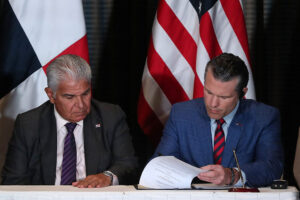



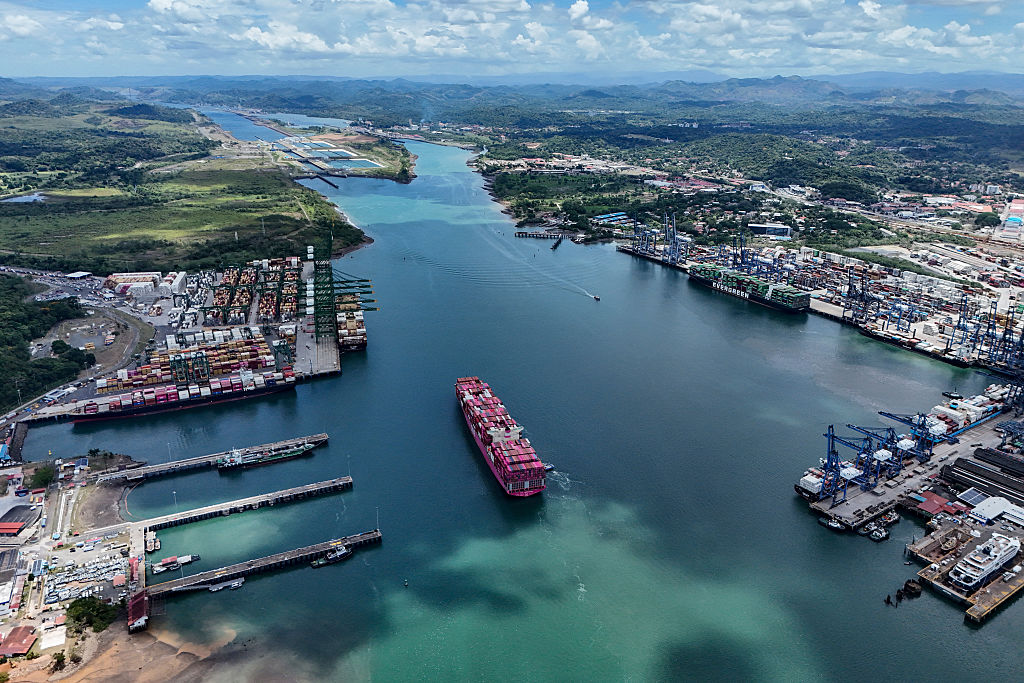
Earlier this year, Panama’s Supreme Court struck down concessions held by CK Hutchison, a Hong Kong-based conglomerate, over the two port facilities flanking the Panama Canal on the Atlantic and Pacific. The ruling had vast implications, because it effectively expelled a Chinese Communist Party-linked operator from key maritime infrastructure at a time when Washington and Beijing are engaged in the most consequential strategic competition since the Cold War.
The ruling also exposed a critical weakness in Panama: the lack of a true doctrine about how to manage the Canal and the great-power jockeying it attracts. For decades, Panama’s foreign policy has been largely improvised, and now, given intense new pressure from China and the U.S., this has become a serious liability.
Every nation in Latin America is grappling with the question of how best to navigate the U.S.-China rivalry. It is especially urgent in Panama, however, because of the unique importance of the Canal, the depth of the country’s ties with the U.S., and the extent of its flirtation with Beijing over the past decade.
This is why, at the beginning of his second term, U.S. President Donald Trump threatened to “take back” the Canal and placed Panama at the heart of global strategic discourse. Like never before, the Panama’s domestic decisions reverberate not just in Houston, Rotterdam, and Shanghai, but also in every foreign ministry, intelligence agency, and major newspaper tracking great-power competition.
In response, China is testing a new tactic in Panama to target a key national sensitivity. In late April, a Chinese foreign ministry spokesman recited Panama’s litany of historical grievances against the U.S. The list is long, and includes the 1989 invasion, the protracted military occupation of the Canal Zone, and of course, Trump’s recent statements. Beijing is attempting to play on Panamanian patriotism, auditioning for the role of the defender of Panama’s sovereignty in the international arena.
The gambit is finding some genuine purchase among Panama’s public and even its political class. This represents a serious vulnerability, and to stop China from exploiting it, Panama must address one of its key causes—a weak, meandering political system that has for too long improvised its responses to great powers.
A longstanding failure
Panama’s failure to articulate a grand strategy doesn’t belong to any single administration. For a century and across governments of every stripe, in periods of boom and austerity, under foreign ministers celebrated and forgotten alike, the country has never produced a coherent foreign policy doctrine.
The historic principle of Canal neutrality, enshrined in the Canal Treaties of 1977, has served only as a philosophical anchor, without ever becoming a sustained operational policy framework. Nobody has articulated with the intellectual seriousness this century requires what Panamanian strategic autonomy might mean in practice.
True to form, Panama’s 2017 decision to break relations with Taiwan and embrace Beijing was ill-conceived. Such a recalibration was not inherently mistaken; China is the world’s second-largest economy, Panama’s second-largest Canal client, and a central node in the global supply chains the waterway serves. The question was never whether to engage Beijing, but how. The decision merited a transparent public accounting of the geopolitical trade-offs involved and the safeguards, legal architecture, and strategic reservations at play.
Instead, what unfolded was a pivot that was transactional in spirit and opaque in execution. The renewed CK Hutchison concessions, for example, had constitutional vulnerabilities that legal scholars had been flagging for years. They went unaddressed, leading to the recent Supreme Court ruling and its fallout.
What Panama needs
Panama needs a written strategic doctrine that lays out publicly, for its own citizens and the international community alike, the principles and priorities that will guide its decision-making well into the future. The drafting process would rightfully involve spirited debate to ensure the doctrine goes beyond the politics of any single administration, but the fundamental goal would be simple: to convert the longstanding tenet of Canal neutrality into an operational policy framework that identifies real triggers, real red lines, and real consequences for those who test them.
This would include thorough geopolitical vetting mechanisms for key infrastructure concessions and technological partnerships. No strategic international asset should change hands without technocratic assessment and constitutional review. This kind of process would have caught the Hutchison vulnerabilities years before the Supreme Court had to—and before the case became an international spectacle.
To cement long-term thinking over short-term improvisation, the doctrine would ideally also call for a foreign ministry staffed with career policymakers and diplomats with institutional memory, rather than political appointees who rotate with every administration.
These elements would allow Panama to both work with and stand up to China, which has proven across the Global South that it is commercially aggressive and possesses a discipline that its critics consistently underestimate. Similarly, they would help Panama avoid knee-jerk politics in response to the U.S.
It is easy to criticize the belligerent new U.S. posture as it deploys rhetoric reminiscent of the Monroe Doctrine, applies economic pressure through tariffs and trade, and steps up its military operations in Latin America. But Panama has an obligation to itself and to the maritime order on which we are built to rise above the politics of reaction, locally and abroad. After all, the U.S. is an indispensable client as well as partner in the maintenance of the open maritime order on which Panama’s own prosperity is built. Up to 5%-6% of global maritime trade transits the Panama Canal annually, and perhaps 70% of the cargo moving through it originates or terminates in the U.S.
Panama cannot control the pendulums of other nations, but it can steady its own by crafting a purposeful doctrine. This could strengthen its institutions, make its decision-making more transparent and deliberate, and build the policy architecture necessary to withstand economic coercion or ideological swings both domestic and foreign.
If Panama draws the right lessons from its recent great-power problems, it will not set out to choose sides more vocally, teach punitive lessons to Washington or Beijing, or revive the exhausted vocabulary of “alignment” that has cluttered hemispheric diplomacy for a century.
Instead, it will steady its ship of state, and could even provide a useful model for the rest of Latin America.
ABOUT THE AUTHOR
Carlos Ruiz-Hernández
Reading Time: 4 minutesRuiz-Hernández is an international lawyer based in Washington, D.C., and a former Deputy Minister of Foreign Affairs of Panama who led the country’s representation before the UN Security Council and its relationship with the U.S.
Panama: A 2026 Snapshot
AQ tracks key indicators and political and economic trends to watch in 2026.
Panama’s Protests Test President Mulino on Multiple Fronts
Controversial deals with the U.S. have supercharged demonstrations, but the government seems capable of avoiding a repeat of 2023.