


BOGOTÁ—With all the expectations the Trump administration has created about the stabilization, recovery, and eventual democratic transition in Venezuela, everybody knew that oil was supposed to be a key component of the playbook and endgame. In an era when Washington is unabashedly pushing for energy dominance, turning to an old partner makes some sense, if imperfect.
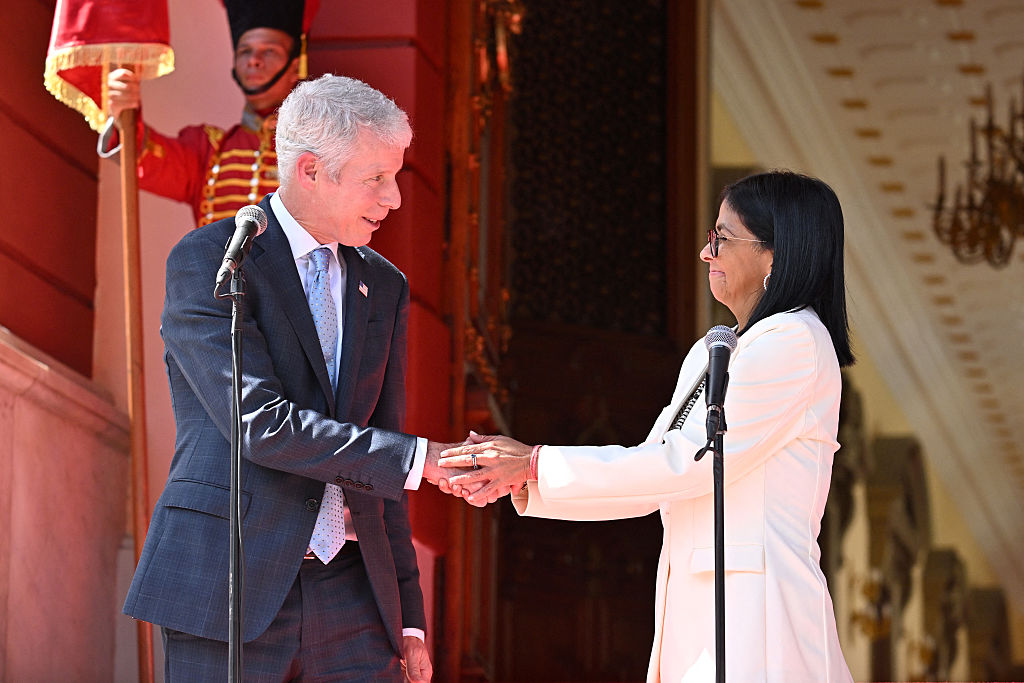
Yet the latest oil deal announced by the Trump administration and the regime led by acting President Delcy Rodríguez is testing the patience and hopes of the Venezuelan people, who, since the capture of Nicolás Maduro, thought the country was turning the page on years of mismanagement and oppression. The “biggest oil deal in world history”—as President Donald Trump touted it on August 28—is also set to test the fundamentals of diplomacy under the Donroe Doctrine. It comes at a time when Venezuela is reportedly considering a possible departure from OPEC, and Chevron Corp. committed earlier this week to expand its presence in the country.
Several aspects demand careful attention. Under the deal, the U.S. chose a little-known oil operator, North American Blue Energy Partners (NABEP), purported to be Venezuela’s second-largest private oil operator. The Barbados-based company, led by controversial Venezuelan entrepreneur Alejandro Betancourt, has prospered through opaque block assignments from the regime rather than its own technical prowess, carrying out a coup de grace to take “control” of a large portion of Venezuela’s oil resources.
Here is where the dance of the billions starts to appear: The White House argues that through the accord the U.S. will have majority control over 65 billion barrels of oil reserves, while Venezuela will see $100 billion in investment and collect $200-plus billion in royalty and tax payments over the first 25 years of the agreement. These figures can impress crowds in both countries and lead them to focus on hype rather than the deal’s substance.
Little is known about how this deal will proceed, so important questions still need answers
Pertinent questions
First, there’s the political and lawful side: Is this deal legal? Is the Rodríguez regime empowered to go forward with this? Earlier this week, Venezuela’s National Assembly rushed to pass the agreement, leaving little doubt about legislative support. It’s the same assembly that managed to approve in record time a new hydrocarbons law in January that, in theory, makes the Trump-Rodríguez oil deal viable.
Despite the legislative approval, it’s unclear whether future governments will respect it. Some analysts argue that this government is as illegitimate as José Vicente Gómez’s dictatorship at the beginning of the 20th century, which signed the first oil concession, raising doubts about the deal’s validity.
Then there is the corporate structure itself. Will NABEP sign this deal with Petróleos de Venezuela (PDVSA), the state oil company, making it more like a standard joint venture? Other considerations remain. It’s still unclear whether NABEP can turn around and share ownership with the U.S. government, specifically with the Pentagon’s special unit originally designated as a counterpart to this pact. Beyond this critical aspect, there is also the question of NABEP’s financial and technical muscle. Will a firm that lacks these credentials be able to outsource to established oil companies to fulfill the contract’s scope?
There are many technical issues. As far as one can tell, the 17 oil blocks assigned to the deal cover different regions (East and West), different environments (offshore and land), and different types of crude: light, heavy, and Venezuela’s proverbial extra heavy. It’s the same oil that led President Trump to characterize Venezuelan oil as “the worst oil probably anywhere in the world.”
The development effort will require excellence in distinct technical skills that one can safely say NABEP does not have. Where is the money to invest coming from? Given NABEP’s stated obligation to sell crude below market prices, the economics of future investments are dodgy at best.
Finally, if this deal goes ahead, will it discourage real oil companies from participating in the industry, or will it encourage them to ask for what one must assume are the special conditions NABEP is receiving? Chevron and Eni seem to be taking up the gauntlet. Or, if the deal falls on its face, are we losing a precious opportunity at “no cost” to the Americans?
A victory?
Given that the U.S. is still embroiled in a protracted Middle East conflict, that Iran is strangling the Strait of Hormuz, and the effect of all this on oil prices, it’s understandable that the Trump administration decided on a new Venezuela gambit. This gambit may help demonstrate some measure of foreign policy success and influence over oil prices, as improbable as that may seem.
For Venezuela, the prospect of sizable investment is enticing. It is widely accepted that Chavismo’s policies have led to the destruction of the oil industry and, hence, the country. It is also accepted that the best way to recover that industry is through the participation of private oil and gas companies, with sufficient technical and financial wherewithal to tackle Venezuela’s challenging basins.
Lessons from recent history teach us that these decisions rarely follow a straight line. Soon, we shall see whether all the billions lead somewhere or are just fool’s gold.
ABOUT THE AUTHOR

Luis A. Pacheco
Reading Time: 3 minutesPacheco is a nonresident fellow at Rice University’s Baker Institute for Public Policy and a former PDVSA executive.
Venezuela’s Overwhelming Electricity Crisis
Simultaneous pressures are colliding at the worst possible time, making power generation a central test of the country’s capacity to recover.
AQ Podcast | Venezuela’s Transition Talks
The New York Times correspondent Anatoly Kurmanaev on what the new round of negotiations means for the future of Venezuela.