



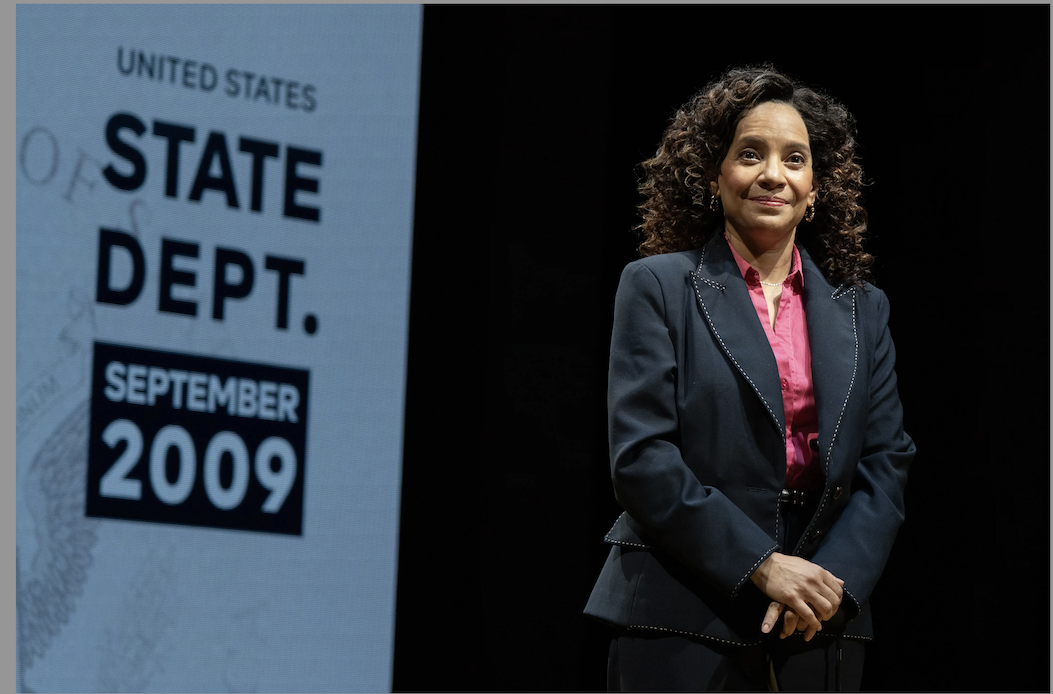
Since returning to the White House in 2025, Donald Trump has pushed a muscular foreign policy that has broken with long-standing conventions and taken risky actions to reassert Washington’s role in Latin America. From capturing former Venezuelan dictator Nicolás Maduro to negotiating directly with the Castros in Cuba, Trump 2.0 has made it clear: The old rule book has been thrown away.
Amid today’s big-stick diplomacy, the new play Public Charge—showing at Manhattan’s Newman Theater until April 12—rekindles a different approach to U.S. foreign policy through the eyes of diplomat Julissa Reynoso. The former U.S. ambassador to Uruguay and deputy assistant secretary of state for Western Hemisphere affairs under the Obama administration, Reynoso also served as assistant to the president, chief of staff to the first lady, and later as U.S. ambassador to Spain and Andorra during the Biden presidency.
Add to that resume playwright. Yes, Reynoso is not only the subject of Public Charge, she’s also its author, alongside writer Michael J. Chepiga. The two have produced a show that provides a first-hand account of Latin America policy during the Obama administration, when the State Department was helmed by Hillary Clinton, for whom Reynoso campaigned in 2008.
At the start of the play, Reynoso (played by Zabryna Guevara in an assured yet vulnerable performance) arrives for interviews for a position at the State Department with a recommendation from Hillary in hand. There, she’s grilled by Ricardo Zúniga, a career foreign service officer who sits on the Latin America desk. In these scenes and childhood flashbacks, Reynoso’s history and worldview are expressed. She immigrated from the Dominican Republic as a child and grew up immersed in the political chatter of Bronx bodegas. She’s not naive to flaws of the United States, nor to Washington’s checkered history in the Western Hemisphere. But she wants to do good. She’s a believer in her country, which, in the Obama era, is a good thing to be.
Reynoso is put in charge of policy toward Central America and the Caribbean, a level of authority that surprises even her. We watch as she—along with Zúniga and Cheryl Mills, counselor and chief of staff to Secretary of State Clinton—navigates the many conflicts that arise during her tenure. Three events get particular focus: the 2010 earthquake in Haiti, the start of Obama’s “Cuba Thaw” policy, and the transfer of six prisoners from Guantánamo Bay to Uruguay. Reynoso and Chepiga use each episode to offer insight into diplomats navigating a web of domestic institutions and foreign governments to advance U.S. interests.
Public Charge makes the case for a form of diplomacy conducted in a cautious, considered, and calculated way, marked by a series of small steps that lead to larger shifts.
Diplomacy, Reynoso emphasizes throughout the play, is ultimately about people, even on the most calcified issues. On Cuba, for example, Reynoso believes that if the two sides just talk and understand each other’s perspectives, solutions can be found, even as Zúniga warns her that those in power in Havana are slippery. She’s sympathetic to the way geopolitics—and stubborn orthodoxies—can protract problems and hurt real people, namely immigrant families like hers.
Public Charge’s greatest example of how humans get caught in the crosshairs of global politics comes not in the form of immigrants but in USAID subcontractor Alan Gross, who was arrested and imprisoned in Cuba in 2009. Reynoso is determined to free Gross and in conversations with Gross’s wife, we see how in her work, empathy can be her greatest asset and liability.
The play certainly makes a strong case for Reynoso as a force for good, but it struggles to make that same case for the U.S. Several characters in the play—including late Uruguayan President José “Pepe” Mujica (in a convincing impersonation by Al Rodrigo)—remind Reynoso that in many parts of the region, the U.S. is not seen as benevolent. After all, Reynoso is asking Mujica to resettle inmates from the Guantánamo Bay prison, a clear-cut example of many of the excesses of the U.S.’s war on terror. And, in exchanges with the Cubans over Gross’s imprisonment, the audience comes to understand how one country’s hero is another country’s spy.
Throughout the show, Reynoso is assured about the value of what she’s doing, but the play could go further to make that case to the audience. Reynoso’s patriotism—and her history as a child Republican during the Reagan years—are often brought up in a cheeky way when her motives are questioned. By the end, the play seems to be building to some serious speeches about why the hemisphere needs U.S. leadership. And Reynoso, one of the highest-ranking Latina officials in U.S. diplomatic history, is primed to give a positive vision of what her country can provide to the region—beyond righting historical wrongs and aiding during disasters.
No such monologues come. Instead, the play ends on a comic yet ironic note. Reynoso and Zúniga joke that Hillary will certainly win the 2016 election and a streak of technocratic leadership will supercharge U.S. foreign policy. And surely they laugh: The U.S. will never elect a strongman leader like those in Latin America.
The audience laughs, too. But by foreshadowing the Trump administration, Public Charge reminds the audience of how far we’ve come from the Obama era, then casts itself as a bit of nostalgia play. “Remember how good we had it?” it seems to ask. “Remember when honorable, meritocratic leaders like Reynoso were in charge?” Now, that’s not just history, it’s ticketed theater.
ABOUT THE AUTHOR

Chase Harrison
Reading Time: 4 minutesHarrison is editorial manager at AS/COA Online.

The Other Underground Railroad
A new rap musical tells the story of the enslaved people shepherded to salvation in Mexico.