



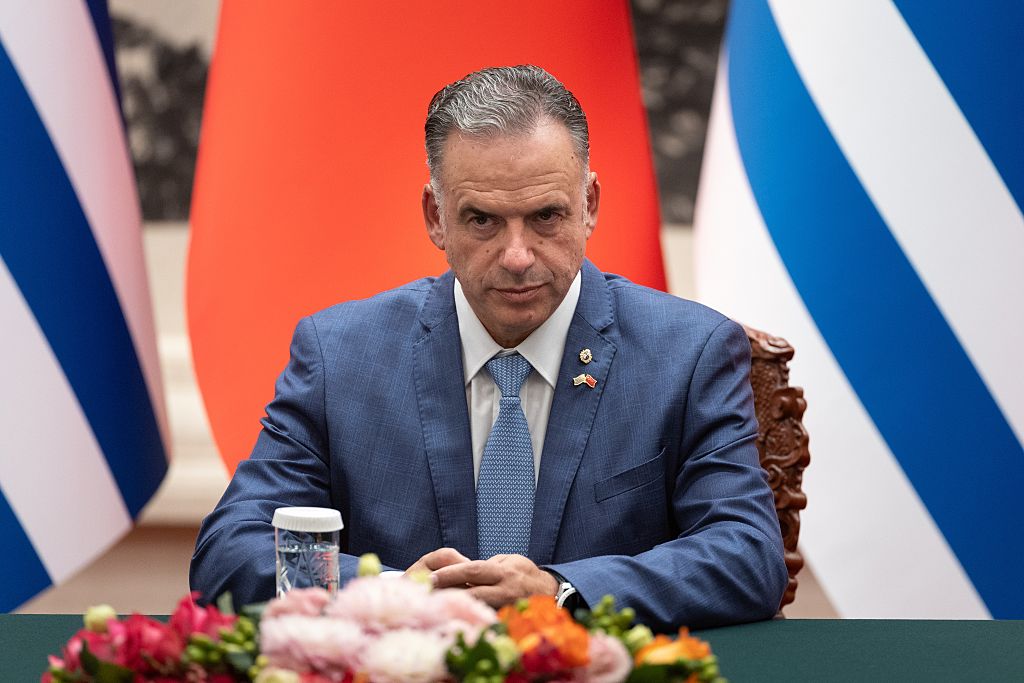
Uruguay’s president, Yamandú Orsi, has just completed his first year in power amid a rapidly changing political landscape. Latin America’s continuing shift to the right and renewed U.S. assertiveness in the region have created new foreign policy challenges for Orsi’s left-wing government, which are in some cases aggravating domestic economic problems.
Orsi’s administration faces a marked economic slowdown and a widening fiscal deficit, while hard-left parties within the ruling Frente Amplio coalition are pressuring the government to implement a new tax on the wealthy and preserve labor protections. With its conservative neighbors pursuing market-friendly reforms, Uruguay risks losing out on foreign investment and favorable trade deals.
But there are bright spots for this administration. Orsi has managed to make progress on reducing crime, Uruguayans’ top concern. His government is also having some success in diversifying its trade relations. A Mercosur-EU deal seems close, Uruguay’s petition to join the Trans-Pacific Partnership was accepted in November, and ties with China are gradually deepening.
The year ahead will be a difficult one for Orsi’s administration. The new geopolitical reality in the region presents a clear challenge, but there’s a chance that Orsi and his allies will be able to show what successful adaptation can look like for the left.
A small state in a turbulent world
Uruguay punches above its weight on the global stage. It has the highest GDP per capita in the region, Latin America’ lowest country risk premium, and one of the world’s strongest democracies. However, these soft power advantages are becoming less valuable as multilateralism fades in the face of U.S. efforts to pursue narrow self-interest and explicit ideological alignment from allies.
This misalignment with U.S. policy was made explicit as the Orsi administration opposed the Trump administration’s operation to capture Nicolás Maduro from Venezuela. The U.S. oil blockade on Cuba is also putting Uruguay’s government in a difficult position at home. On the one hand, hard-left factions of the Frente Amplio are strong defenders of the Cuban regime, while on the other, Uruguay received a record number of Cuban migrants in 2025.
The diplomatic distance between Uruguay and the United States means that it is being left out of the Trump administration’s overtures to the region. For example, Orsi is unlikely to be invited to join other Latin American leaders to meet Trump in Miami this month to discuss how the region can confront Chinese influence. Uruguay was added to a list of 75 countries to which the U.S. says it will no longer grant immigrant visas. In another blow, Argentina’s trade and investment agreement with the U.S. substantially boosts its tariff-free quota of beef exports to the U.S. This places Uruguay at a comparative disadvantage, as beef exports constitute a significant part of its U.S. exports. The government says it is seeking to increase its own quota to the U.S., but given the lack of political alignment, this seems unlikely.
Diversifying trade
Uruguay’s long-standing efforts to diversify its markets have taken on a new urgency. On February 26, it became the first country to ratify the EU-Mercosur free trade agreement. While Uruguay’s benefits from the deal will take time to materialize, it will result in both increased goods exports and European investment, especially in services—an area of comparative advantage for Uruguay. This is in part due to the bumpy ratification process in the EU, but also the phased nature of the agreement’s provisions that only gradually liberalizes their economies.
Uruguay’s application to join the Comprehensive and Progressive Agreement for Trans-Pacific Partnership (CPTPP) was also accepted, but the road to membership will be a long and uncertain one. Joining the CPTPP will not only open Asia’s rapidly growing markets to Uruguayan goods, but it will also make it more attractive for Asian investors, owing to regulatory synchronization. However, like the EU FTA, benefits would be gradual.
On February 3, Orsi met in Beijing with Chinese President Xi Jinping. Some relatively minor economic and technology agreements were signed, and the main message was symbolic: The Orsi administration sees China as a valued partner despite—and perhaps in part due to—renewed U.S. pressure. Uruguay also adopted language aligned with China’s that rejects Taiwanese independence, which was rebuked by Taiwan and raised the ire of the opposition at home.
Domestic policy challenges are mounting
On the domestic front, the Orsi administration’s most important accomplishment was to pass its five-year budget with opposition support. The budget backloads the fiscal consolidation process to the second half of the Orsi administration, which was a political priority for the government to avoid fiscal austerity that would have led to a serious backlash from the government’s supporters. Orsi has also raised taxes, including on de minimis imports. This has prompted criticism from the opposition, as Orsi promised during the campaign that his government would not raise taxes.
Looking ahead, Uruguay’s economy is experiencing a soft patch, growth is expected to slow further, from 2% last year to about 1.8% in 2026. The economy is being buffeted by a weak harvest amid dry conditions, an exceptionally strong peso weighing on export competitiveness, and high labor costs in dollar terms. Market-friendly reforms in Argentina, and potentially similar reforms in Chile under President-elect José Antonio Kast, may also hinder Uruguay’s attractiveness to investors. This loss of competitiveness has been reflected in a number of high-profile closures over the past year. Local business chambers claim that firms are closing up shop owing to high costs and powerful and combative unions. The government has made efforts to reduce the burden of bureaucracy in order to help improve competitiveness.
The Orsi administration is also facing pressure from left-wing factions of the Frente Amplio and the powerful union movement (PIT-CNT) to increase taxes on the wealthy to finance increased social spending. Uruguay’s economy minister has said that a wealth tax is off the table, but it is unlikely that pressure will relent. Balancing the government’s desire to narrow the fiscal deficit, while also keeping the base satisfied against the backdrop of low economic growth, will be a major challenge in 2026 and beyond.
Bright spots
On a more positive note, the government has made some modest progress on reducing crime. Robberies, as well as computer scams and fraud, saw double-digit declines from 2024 to 2025. Although preliminary 2025 data indicate that homicides declined by a small margin, Uruguay’s homicide rate (10.3 per 100,000) is significantly higher than in Chile (5.4 per 100,000 in 2025) and Argentina (3.7 per 100,000 in 2025). On the social front, Uruguay was once again at the forefront of progressive reforms in the region, becoming the first country to pass a law to legalize euthanasia.
After a short honeymoon, Orsi’s job approval rating (36%) now equals his disapproval rating. Even so, Orsi’s personal favorability rating is 10 percentage points higher than his approval rating, underscoring that he still has the goodwill of many of those who voted for him.
The challenge for Orsi going forward is to leverage his personal appeal to make important policy gains that will spur economic growth, such as further deregulation that will reduce the cost of doing business. Orsi can also utilize his skill as a measured, balanced and open-minded political figure, and Uruguay’s traditional neutral foreign policy, to help bridge the gap between the region’s left and right in a constructive manner on the regional stage as polarization rises.
ABOUT THE AUTHOR

Nicolás Saldías
Reading Time: 5 minutesSaldías is a Latin America and Caribbean senior analyst at the Economist Intelligence Unit and received his Ph.D. in political science from the University of Toronto.